A refrigerator water filter is an inline carbon block that treats water on its way to the dispenser and ice maker. Because it runs under household pressure inside a sealed line, it gets far better contact time than a pitcher, and many are certified for health contaminants rather than taste alone. What you have to verify is which certifications your specific model actually carries.
Key Takeaways — Are refrigerator filters any good?
Better than most people assume, and better than the pitcher sitting next to them. A genuine fridge filter is a compressed carbon block running under pressure, and plenty are certified for lead and cysts. Two things undo that: running the cartridge months past its rating, and dropping in a cheap “compatible” cartridge that fits the housing but was never tested in it.
START WITH YOUR WATER
Your fridge filter may already cover you — or may not
It depends entirely on what’s in your water. Pull the detections for your ZIP first.
What’s Actually Inside a Refrigerator Filter
Cut one open and you find a compressed carbon block, usually wrapped in a sediment layer, sealed in a plastic cartridge with an inlet and outlet at one end. It sits in the cold water line between your household supply and the dispenser.
Two design facts follow from that placement, and both work in your favor. The filter runs at line pressure, so water is pushed through dense media rather than trickling through it. And the block is compressed rather than granular, so water can’t take a shortcut between particles the way it does in a pitcher cartridge.
That combination puts a fridge filter closer to an under sink carbon block than to the pitcher on the counter. It’s genuinely capable hardware, and most households already own one without ever checking what it does.
Check Your Model in the Listing, Not on the Box
Certification is per model, not per brand. Two filters from the same manufacturer, fitting two refrigerators in the same product line, can carry different certifications — and packaging language is where this gets blurred. “Tested to NSF standards” is a claim a company makes about itself. “NSF certified” means an independent body verified it and lists the model.
The check takes a minute. Find the model number printed on the cartridge, then look it up in the certifier’s public listing rather than trusting the carton — NSF’s database is at info.nsf.org/Certified/DWTU, and WQA publishes its Gold Seal listings at wqa.org/find-products. What you want to see is the model number, the certifying body, the standards it holds, and the specific contaminants named under each. If the model doesn’t appear, the claim on the box isn’t backed by the certification it’s implying. Our guide to NSF certified water filters walks through reading one of those entries.
What Fridge Filters Are Typically Certified For
Coverage varies by model, but the pattern across the category is consistent enough to be useful as a starting point.
| Contaminant | Common on fridge filters? | Standard that covers it |
|---|---|---|
| Chlorine taste and odor | Nearly always | NSF/ANSI 42 |
| Lead | Often, on mid-range and up | NSF/ANSI 53, lead named on the sheet |
| Cysts (cryptosporidium, giardia) | Often | NSF/ANSI 53 |
| PFAS | Occasionally, on newer models | NSF/ANSI 53 with the compounds listed |
| Pharmaceuticals and trace compounds | Some | NSF/ANSI 401 |
| Fluoride, nitrate, hardness | No | Needs reverse osmosis or specialty media |
Worth knowing about PFAS specifically: the old NSF P473 protocol has been discontinued and folded into standards 53 and 58. A current listing should name 53 with the individual PFAS compounds, so a filter still marketed on P473 is quoting a standard that no longer exists.
Six Months, or the Gallons, Whichever Comes First
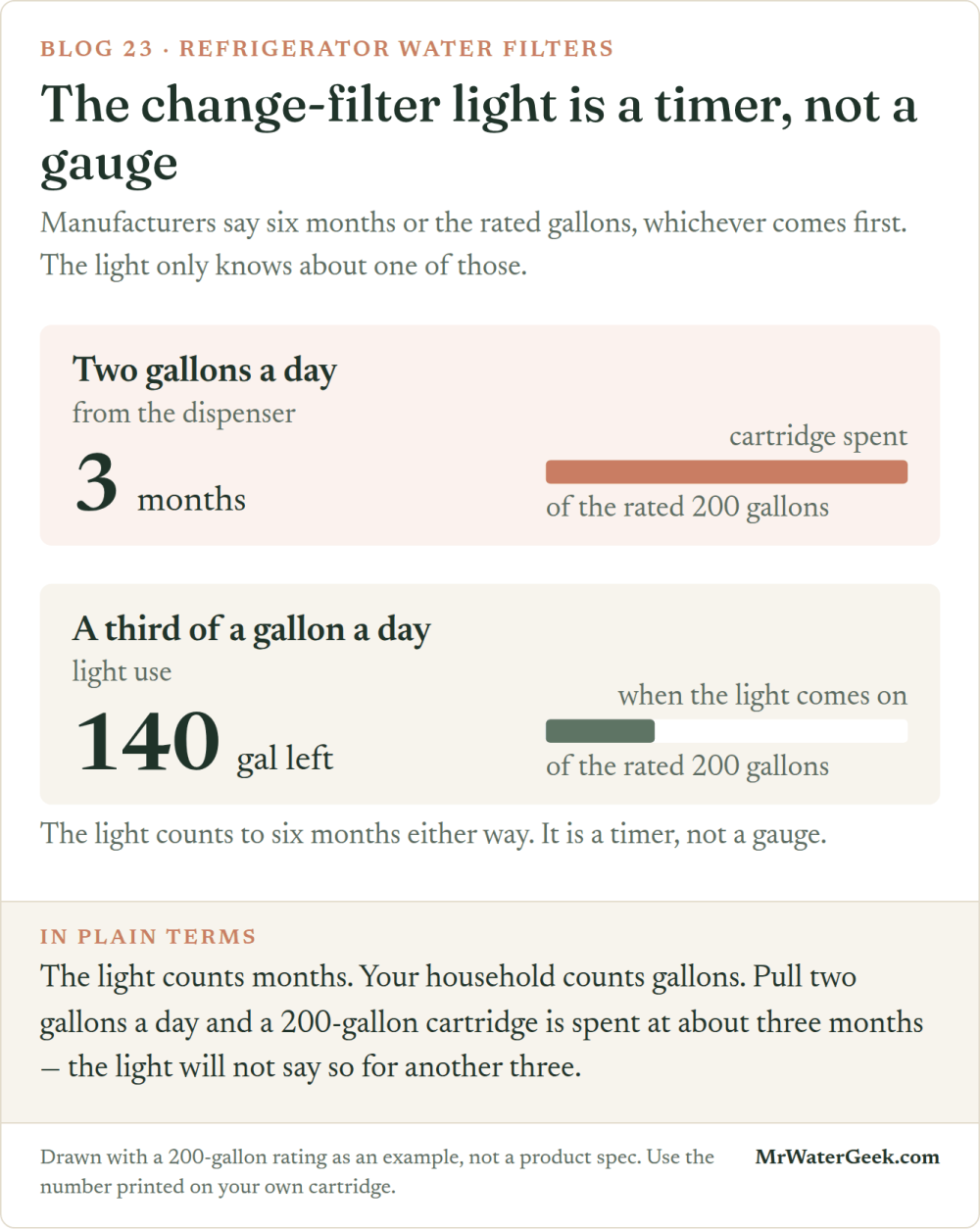
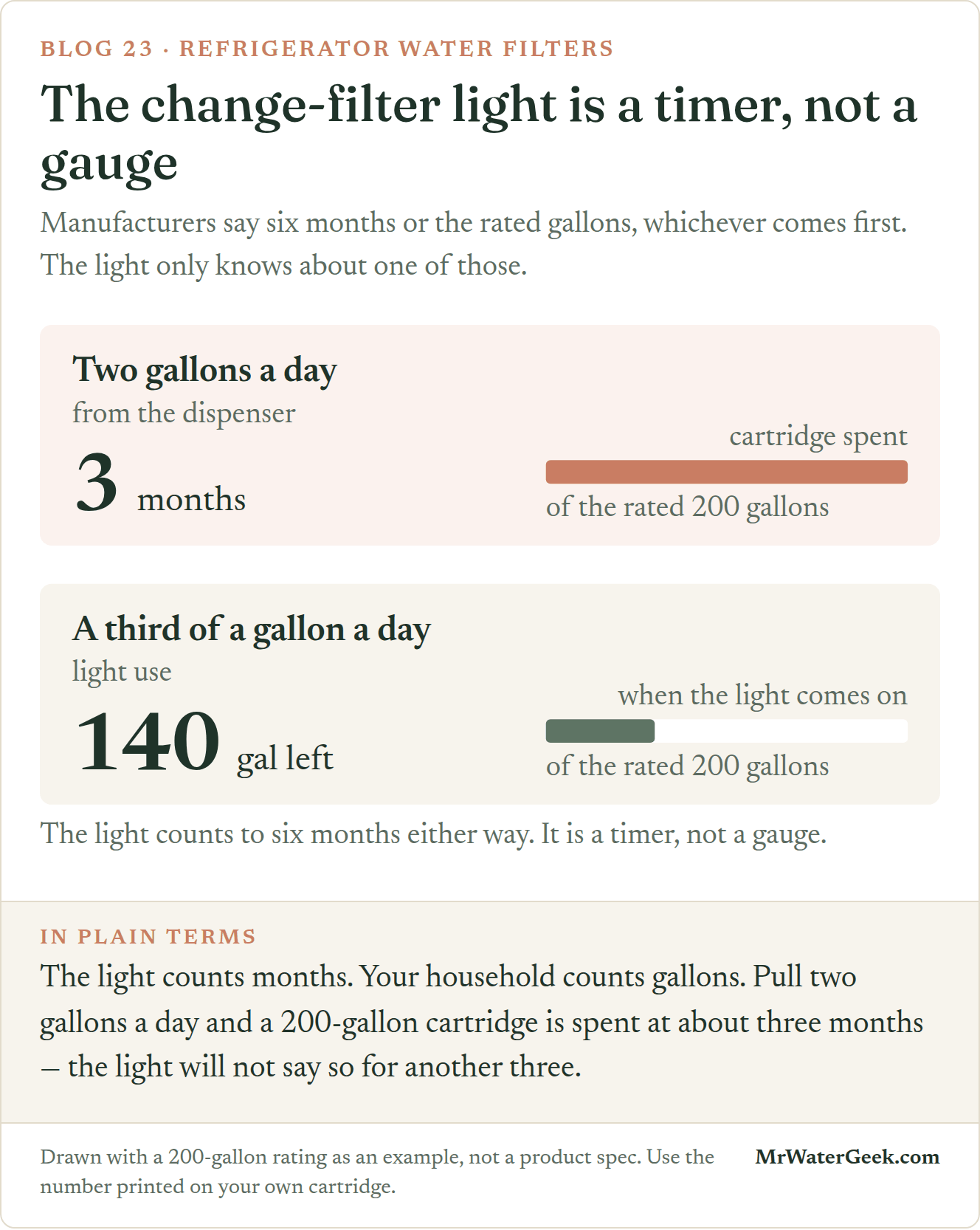
Most manufacturers specify six months or a rated gallon capacity. Both numbers matter, and the indicator light on your door probably tracks neither one accurately.
On most refrigerators that light is a timer, sometimes combined with a rough volume counter. It doesn’t measure how loaded the carbon is or what your water was carrying. A household drawing heavily from the dispenser will exhaust a cartridge before the light changes; a household that rarely uses it will get a warning based on elapsed months while the block still has capacity — and in that case the six-month limit still applies, because a filter sitting damp and unused for a year has its own problems.
The consequence of overrunning is the same as in any carbon device: a block that has adsorbed contaminants to capacity can release them back into the water, so an overdue cartridge can perform worse than no cartridge. If your dispenser has slowed noticeably or the water has picked up a taste, that’s the cartridge asking to be replaced regardless of what the light says.
WORTH CONFIRMING
Is your fridge filter rated for what you actually have?
Check the detections for your ZIP, then match them against the certifications on your cartridge.
The “Compatible” Cartridge Problem
Aftermarket cartridges sell for a fraction of the manufacturer’s price, and the sales pitch is that they fit the same housing. Fitting is not the same as performing.
Certification applies to a filter and its housing as a tested combination. Swap in a third-party cartridge and you have an untested pairing: the seal may differ, the media volume may differ, the flow path may differ. Any of those changes what actually happens to the water, and none of it was measured. A cartridge that seats perfectly and produces clear water may be passing far more of a contaminant than the original did, and there’s no way to tell by looking.
Some aftermarket cartridges carry their own independent certification for the specific fridge models they’re sold against. Those are a legitimate option, and the way to identify them is the same as before: find the cartridge’s own model number in the certifier’s listing. If it isn’t there, you’re buying a plastic housing full of carbon and a claim.
The Bypass Plug, and Running Without a Filter
Nearly every refrigerator with a water line ships with a bypass plug — a solid cartridge that closes the circuit without filtering. It exists so the dispenser still works between filters.
Running on bypass is fine as an interim measure. What it isn’t is a filter, and it’s worth being deliberate about the distinction, because a bypass plug installed “temporarily” tends to become permanent. If you’re going to run unfiltered for a while, that’s a decision to make knowingly rather than one to discover a year later.
The opposite mistake is leaving a spent cartridge in place because it’s still producing water. A cartridge past capacity is doing less than the bypass plug in one specific respect: the plug at least can’t release anything back.
Do You Still Need Another Filter?
Often not. If your fridge filter is certified for the contaminants your water report actually shows, and you replace it on schedule, that’s a legitimate point-of-use solution for drinking and ice. Adding a second device to the same water is spending money on redundancy.
The case for more filtration is specific. Your report shows something the fridge filter isn’t certified for — fluoride, nitrate, or PFAS on a model that doesn’t list it. You want filtered water at the kitchen sink for cooking, which the fridge can’t reach. Or you’re on a private well, where the treatment question is a different one entirely and starts with well water filtration.
For most homes on municipal water, the filter already in the door is likely doing more than the pitcher in the fridge beside it — provided it’s certified for the right things and hasn’t been in there since the last time you moved.
If you’re weighing the fridge filter against the other point-of-use options, we’ve covered each on its own terms: water filter pitchers, kitchen faucet water filters, and under sink systems. If you’re not sure you need any of them, start with whether you need a water filter at all.
CLOSE THE LOOP
Match the cartridge to the contaminant
See what’s been detected where you live, then check it against your filter’s certifications.
FAQ
Do refrigerator water filters remove lead? Many do, and the certification tells you which. Look for NSF/ANSI 53 with lead named on the performance data sheet for your specific model number. Lead reduction is common on mid-range and higher cartridges but is not universal, and a filter certified only to NSF/ANSI 42 has been tested for chlorine taste and odor alone.
How often should you change a refrigerator water filter? Six months or the rated gallon capacity, whichever comes first. The indicator light on the door is usually a timer rather than a measure of how loaded the carbon is, so heavy dispenser users reach capacity before the light changes. A filter that has sat damp and unused for a year should also be replaced.
Are aftermarket refrigerator filters safe? Only if the cartridge carries its own certification for your refrigerator model. Certification covers a filter and housing as a tested pair, so a third-party cartridge in an OEM housing is an untested combination regardless of how well it fits. Look up the aftermarket cartridge’s own model number in the certifier’s listing before buying.
Is a fridge filter better than a pitcher? Generally yes, on two counts. It uses a compressed carbon block rather than loose granules, and it runs under household pressure instead of gravity, so water gets more contact with denser media. It also avoids the standing-water problem a pitcher has. Whether it’s enough still depends on what your water contains.
Can you run a refrigerator without a water filter? Yes, using the bypass plug that shipped with the appliance, which closes the water circuit without filtering. That’s a reasonable interim step between cartridges. It’s worth treating as a deliberate choice rather than a default, since a bypass plug installed temporarily has a way of staying in.
Do refrigerator filters remove PFAS? Some newer models do. You need NSF/ANSI 53 with the specific PFAS compounds named on the sheet, since a general claim without that listing isn’t backed by certification. The older NSF P473 protocol has been discontinued and folded into standards 53 and 58, so a listing citing it is out of date.
Shashank — 9 years at Kohler building water products. Currently building the next generation of water health products.