Hard water will not hurt you. What hard water does is leave things behind. Spots on glasses. A film on the shower door. Soap that will not lather. A kettle with a crust in the bottom. Over years, the same mineral builds up inside your water heater and any appliances that heat water – reducing the life of those devices, which does cost money.
So the question is not whether your water is hard. It is whether it is hard enough to be worth investing a few thousand dollars and a bag of salt every couple of months.
Key Takeaways — Is a water softener worth it?
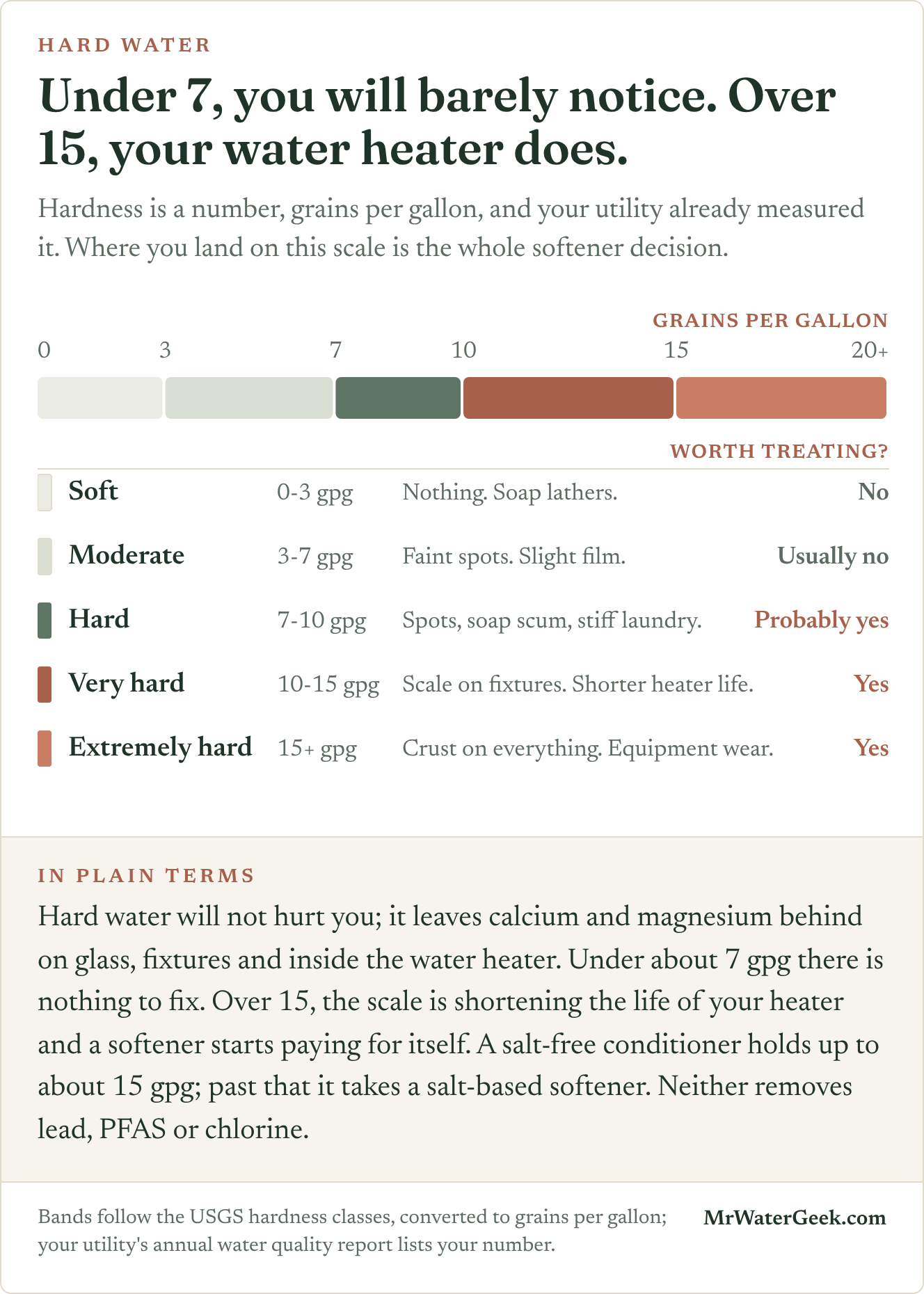
Water softness is measured by grains per gallon; the more grains per gallon, the harder the water. If your water is under about 7 grains per gallon, you will barely notice. Over 10, you will. Over 15, it is shortening the life of your water heater and your fixtures, and a softener starts paying for itself. Get your number first — your utility publishes it free, and a test strip will tell you in a minute. Everything else is a sales conversation.
START WITH YOUR NUMBER
Find out how hard your water is
Your utility already measured it. Pull the report by ZIP in about 30 seconds.
What is hard water, in plain terms?
Rain water starts out soft. It picks up hardness on the way to you, by moving through rock. Limestone and chalk dissolve a little calcium and magnesium into the water, and those two minerals are what create “hard” water.
This is why hardness is so regional. It has almost nothing to do with your utility and almost everything to do with the minerals under your feet.
Hardness is measured in grains per gallon, written gpg. One grain is about the weight of a single grain of table salt, dissolved in a full gallon of water. While this doesn’t sound like much, it adds up to a few pounds of mineral a year in a house using 300 gallons a day, and all of it has to go somewhere.
| Hardness | What you see | Worth treating? | Salt softener or conditioner? |
|---|---|---|---|
| 0–3 gpg (soft) | Nothing. Soap lathers easily. | No | Neither |
| 3–7 gpg (moderate) | Faint spotting on glass. Slight film. | Usually no | Neither. A conditioner if heater scale bothers you. |
| 7–10 gpg (hard) | Visible spots, soap scum, stiff laundry. | Probably yes | Conditioner for scale. Softener if soap scum is the complaint. |
| 10–15 gpg (very hard) | Scale on fixtures, shorter heater life. | Yes | Either. Conditioners hold up to about 15. |
| 15+ gpg (extremely hard) | Crust on everything. Real equipment wear. | Yes | Salt-based softener. Conditioners tap out here. |
How do you find out what yours is?
Three ways, cheapest first.
-
Your utility’s annual water quality report lists hardness. It is free, it is online, and it covers the water leaving the plant. Hardness does not change much between there and your house, so this number is reliable — unlike lead, which very much does change on the way.
-
A hardness test strip costs a few dollars and takes a minute. Hardness is one of the few things a strip is good at. It is measured in grains per gallon rather than parts per billion, so there is plenty for the chemistry to grab onto.
-
A softener company will test it for you for free. The number will probably be accurate. The recommendation that follows it will be a sales pitch. Know your own number before anyone comes to your door.
One thing people miss on a well
If you are on a private well, nobody publishes a report for you, and hardness is frequently much higher than municipal water nearby. Well hardness in the twenties is common. Test it yourself, and test it again if you ever notice the water changing — well hardness drifts over years in a way city water does not.
What a softener actually does
A softener is a tank of small resin beads that are designed to be negatively charged. Hard water, which is called hard because it contains dissolved calcium and magnesium, runs through, and because opposite charges attract each other, the positively charged calcium and magnesium ions in the water stick to the negatively charged beads, and stay there until the hardness minerals are rinsed down the drain with a sodium and chloride wash before the beads get saturated. Simply put, the softener swaps one mineral for another.
Two consequences nobody mentions in the showroom. Salt-based water softeners waste water. They have to rinse the beads periodically – daily to every few days, depending on how hard your water is. And softened water feels different. People describe it as slippery, like the soap will not rinse off. Fortunately, the soap is rinsing off fine — you are just no longer feeling the film that hard water used to leave behind.
What a softener does not do
This is where a lot of money gets spent badly.
A softener removes hardness. It does not remove lead, PFAS, chlorine taste, nitrate, or bacteria. If you bought one because you were worried about what is in your water, you bought the wrong machine. A softener is a plumbing appliance that protects your pipes. A filter is what protects you.
Plenty of households want both, and that is a perfectly sensible setup: a softener where the water comes in, and a filter certified under NSF 53 for whatever your test actually found, at the tap you drink from. They do different jobs and neither substitutes for the other.
THE OTHER HALF OF THE QUESTION
Check what is in your water before you shop for anything
Hardness is rarely the only thing on the report. By ZIP, in about 30 seconds.
What about the salt-free ones?
Salt-free systems, also known as conditioners, do not soften water. Conditioners use completely different technology (TAC or NAC) to change the shape of the hardness minerals so they are less likely to stick to surfaces. These conditioners try to make the calcium and magnesium ions lose their charge and bind into bigger and bigger crystals so they don’t accumulate on surfaces. The calcium and magnesium are still in the water — your hardness number does not change. In practice, people report less scale in the kettle and no change in how soap behaves, which fits what the technology claims to do.
However, this technology gets overwhelmed with hardness above 15–20 gpg. Literature on TAC and NAC says they can handle gpg as high as 25. I have not found that to be the case in my own testing. It would tap out around the 15-20 gpg range.
If your problem is scale inside a water heater and your hardness is not extreme, a conditioner may be enough and it costs less to run, has no maintenance requirements, and does not waste any water. If your problem is soap scum, stiff towels, and spotted glasses, a conditioner will unfortunately disappoint you, because those are extreme hardness problems and the conditioners are not equipped to deal with that.
BEFORE ANYONE QUOTES YOU
Your hardness number is in your utility’s report
Pull it by ZIP before anyone comes to your door with a number of their own.
FAQ
Is softened water safe to drink? For most people, yes. It has slightly more sodium than the water going in — roughly proportional to how hard your water was to begin with. If you are on a sodium-restricted diet, many households leave the kitchen cold tap unsoftened and run drinking water through a separate filter. To be clear, this is not medical advice and you should consult your doctor if this applies to you.
Will a softener fix my water’s taste? It will change the taste, because the main thing you taste in water is its minerals, and a softener swaps calcium and magnesium for sodium. Whether that counts as an improvement is personal; some people notice the salt. Chlorine gets blamed for taste because NSF 42, the filter standard for it, is labeled “taste and odor,” but chlorine is only one driver. Salt and other dissolved contaminants all shape how water tastes, and a softener adds salt rather than removing it. If the taste you dislike is chlorine, a carbon filter fixes it. If it is salt, the only household system that removes salt is reverse osmosis.
How much salt will I actually use? It depends on your hardness and how much water you use, but a family of four with very hard water is typically in the range of a 40-pound bag every four to six weeks. Softer water, less salt. A softener that is eating salt far faster than that usually needs its settings checked.
Can I install one myself? If you are comfortable with plumbing and your water line is accessible, yes. Most people pay for installation because it means cutting into the main line and adding a drain connection. Get the number on your water hardness before you get the quote, so you can tell whether the unit being proposed is sized for your house or for their margin. And make sure a dealer’s quote includes the installation cost, not just the unit. If you are buying direct from a manufacturer, ask a local plumber or handyman for an installation quote first, so you see the full investment before you commit.
Next: once you know your hardness, the other number worth knowing is how much a filter costs to run — because the cartridge, not the box, is where the money goes.
Shashank — 9 years at Kohler building water products. Currently building the next generation of water health products.