Nobody hands you a file on the water when you get the keys to your new apartment or home.
Meanwhile, the water has been sitting in pipes you have never seen, in a house whose last owner may or may not have replaced anything. The good news is that sorting this out costs almost nothing and takes about an hour of attention spread over a week.
Key Takeaways — The short version
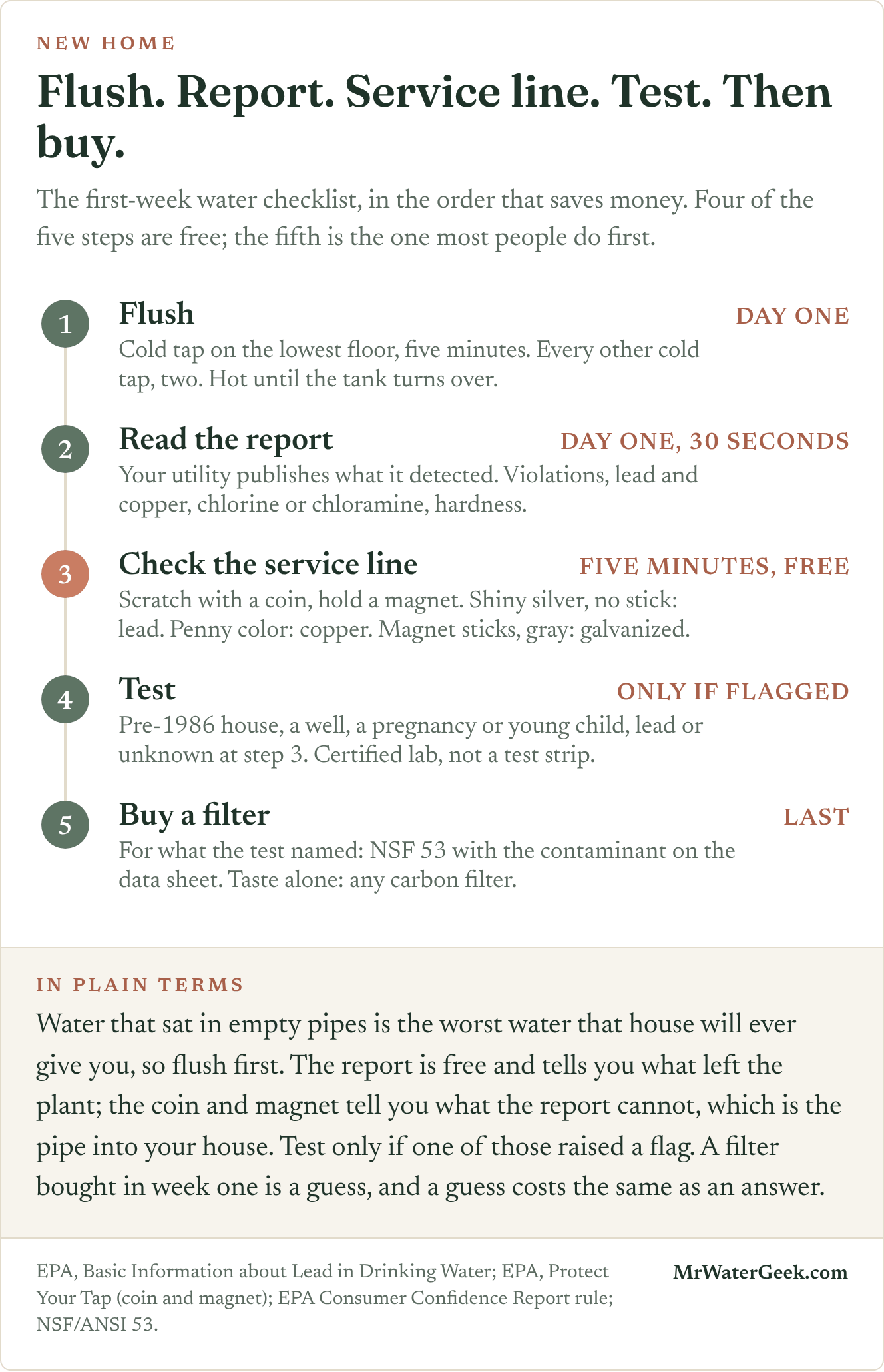
Flush the pipes hard on day one, because water that sat still while the house was empty is the worst water that house will ever give you. Pull your utility’s annual report, which is free and takes a minute. For your convenience we have a free tool you can use below for this. Find out what your service line is made of — there is a five-minute test you can do with a coin and a magnet. Test only if something in those first three steps raises a flag. Buy a filter last, once you know what you are buying it for.
STEP TWO, DONE FOR YOU
Pull your area’s water quality report
What your utility detected, at what level. About 30 seconds by ZIP.
Step one: flush it, properly
If the house sat empty for even a few weeks, the water inside those pipes has been in contact with the plumbing the entire time and metals leach into standing water. That is simply what happens, and it is why the first draw in the morning is always the worst of the day.
Open the cold tap on the lowest floor and let it run for five full minutes. Then do every other cold tap for two minutes each. Run the shower. Flush every toilet a couple of times. Run the dishwasher and the washing machine empty.
If the house was vacant for months, do that again the next morning. It costs a few dollars of water and it clears out the single worst thing about moving into a house nobody has lived in.
Do not forget the water heater
A tank that has been sitting warm and still for months is its own problem. It is the one place in your house that is both wet and the right temperature for bacteria to be comfortable. Run the hot water until the tank has turned over completely, which on a typical 40-gallon tank means ten to fifteen minutes of a running hot tap. If the house was empty a long time, it is worth having the tank drained and refilled.
Step two: read what the utility already published
Every community water system publishes an annual report of what it detected, at what level, and whether the system had any violations. It is free, it is specific to your supply, and almost nobody reads it.
You’re looking for a few things:
-
Any violation in the last couple of years.
-
Lead and copper results and when they were last sampled.
-
Whether your system uses chlorine or chloramine, because that changes which filter handles taste.
-
And hardness, which tells you whether to expect scale.
Remember what the report cannot tell you: it describes the water leaving the plant and traveling through the mains. It knows nothing about the pipe from the street into your house, or about anything inside your walls. That gap is the whole reason for step three.
Step three: find out what your service line is made of
This is the single highest-value five minutes in the whole list, and it is free.
Find where the water pipe enters your house — usually in a basement or crawlspace, near the meter. Scratch the pipe gently with a coin, then hold a magnet to it.
-
Scratches to a shiny silver and the magnet does not stick: that is lead. It is soft — a coin marks it easily.
-
Scratches to a bright copper-penny color: copper. Fine.
-
The magnet sticks firmly and it scratches to gray: galvanized steel. Not lead itself, but old galvanized pipe can hold onto lead that passed through it earlier.
-
Plastic, usually white, gray or blue: modern PEX or PVC. No lead, but not a free pass either. Some plastic pipe carries a Prop 65 warning for the additives in it, and hot water speeds up how much of that leaches out — one more reason to drink and cook from the cold tap.
Houses built after 1986 are very unlikely to have a lead service line, because that is when the federal ban took effect. One nuance worth knowing: the law passed in 1986, but states had a two-year window to put it into practice, so the confident line is a house built or replumbed after 1988. Before that, it depends entirely on the city and the year. If you find lead or galvanized steel, or you cannot tell, call your utility. Most are now required to keep an inventory of service line materials, and they will tell you what is on record for your address.
If you moved into an apartment
Most of this still applies; what changes is how much of the plumbing you can see. Flush your own taps the same way. The utility report covers your building. The service line into the building is the one you cannot scratch with a coin, so ask the building manager what it is made of, or ask the utility — their inventory lists the building’s address. The pipes between the basement and your unit are the building’s, and in an older building that is where lead solder and galvanized pipe tend to hide. A lab test from your own kitchen tap is the only thing that answers for your unit specifically, and it is the result that makes a conversation with the landlord go somewhere.
Step four: test, but only if something pointed you there
You should test if step one, two, or three gave you a reason — or if any of these apply: the house was built before 1986; you are on a private well; there is a pregnancy or a young child in the house; or the water looks, smells, or tastes like something you cannot explain.
If you do test, use a laboratory certified for drinking water rather than a strip from the hardware store. Strips are fine for hardness and chlorine. They cannot see lead at the concentrations that matter — the gap is roughly a thousandfold, and no color change will bridge it.
Call your local health department first. A lot of them test private wells free, and most keep a list of certified labs nearby.
BEFORE YOU SPEND ANYTHING
See what has been reported for your area
Enter your ZIP. If the report is clean and the pipe is not lead, you may be done.
Step five: if you need a filter, buy one
By this point, you shouldn’t be guessing. You are shopping for a specific answer to a specific finding, which is a completely different experience from standing in an aisle reading boxes.
If the only thing you want is better-tasting water, almost any carbon filter will do it, and a pitcher is a reasonable place to start. If your test named something — lead, PFAS, nitrate — you want a filter certified under NSF 53 with that contaminant listed by name on its performance data sheet. For taste and odor claims there is a separate standard, and for emerging contaminants like PFAS, look for NSF 401.
The thing to avoid is the order most people follow, which is to buy a filter in week one because the move was stressful and it felt like doing something. That filter is a guess. A guess costs the same as an answer.
STEP TWO TAKES 30 SECONDS
Pull your area’s report by ZIP
Free, specific to your supply, and the thing almost nobody reads.
FAQ
How long should I keep flushing after I move in? The deep flush is a one-time job. After that, a thirty-second run on the cold tap each morning handles water that sat overnight. Worth making a habit in any house built before 1986.
The previous owner left a filter under the sink. Should I use it? Replace the cartridge before you drink through it. You have no idea how long it has been in there, and a cartridge that has been sitting damp and unused is worse than no cartridge. Find the model number and check what it is actually certified for while you are at it.
I am renting. How much of this applies? All of steps one through four, which are free and yours to do. Step five is where it gets constrained — a pitcher or a faucet-mount filter needs no permission, while anything plumbed in usually does. If a test turns up something serious, that is your landlord’s problem to fix, and a lab result is what makes that conversation go somewhere.
Is well water a different checklist? Mostly the same, with one change: nobody publishes a report for you, so step two becomes a test rather than a download. Start with total coliform bacteria and nitrate, which are the two baseline health tests, and repeat them every year.
Next: if step three turned up lead or “unknown,” the follow-up is what a lead service line actually means for you and how the replacement rules work — that piece is coming.
Shashank — 9 years at Kohler building water products. Currently building the next generation of water health products.