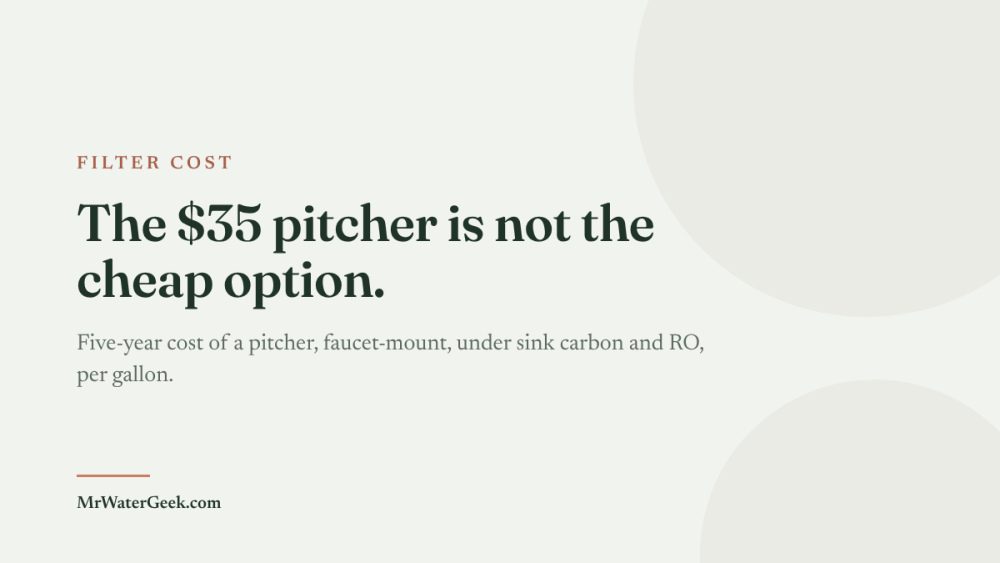
A $35 pitcher can cost more over five years than a $300 under sink filter.
Key Takeaways — Where does the money go?
Hardware is usually a quarter of what you spend. Cartridges are most of the rest. The cheapest setup to buy is often the most expensive to own, because small cartridges cost nearly as much as big ones and die far sooner. Before you compare prices, work out how many gallons your household actually filters in a year — that one number changes which option is cheapest, sometimes by a factor of three.
KNOW THE PROBLEM BEFORE THE PRICE
Know what you need to filter for before you price anything
Your utility’s report names what was detected. Check your area by ZIP.
The number that decides everything
Gallons per year. Not people, not budget, not square footage.
Work it out roughly. Drinking water is about half a gallon per person per day — that is the familiar eight glasses, since a gallon is sixteen cups. Add cooking, coffee, and pet bowls and most households land somewhere between two and four gallons a day. Call it 700 to 1,500 gallons a year.
Now look at what a cartridge is rated for. A standard pitcher cartridge is about 40 gallons. An under sink carbon block is commonly 500 to 1,000 gallons. That is a pretty large gap. Coupled with the maintenance work of managing a pitcher – remembering to refill, the limitations when hosting, etc – it seldom makes a pitcher the better purchase.
Five years, four setups
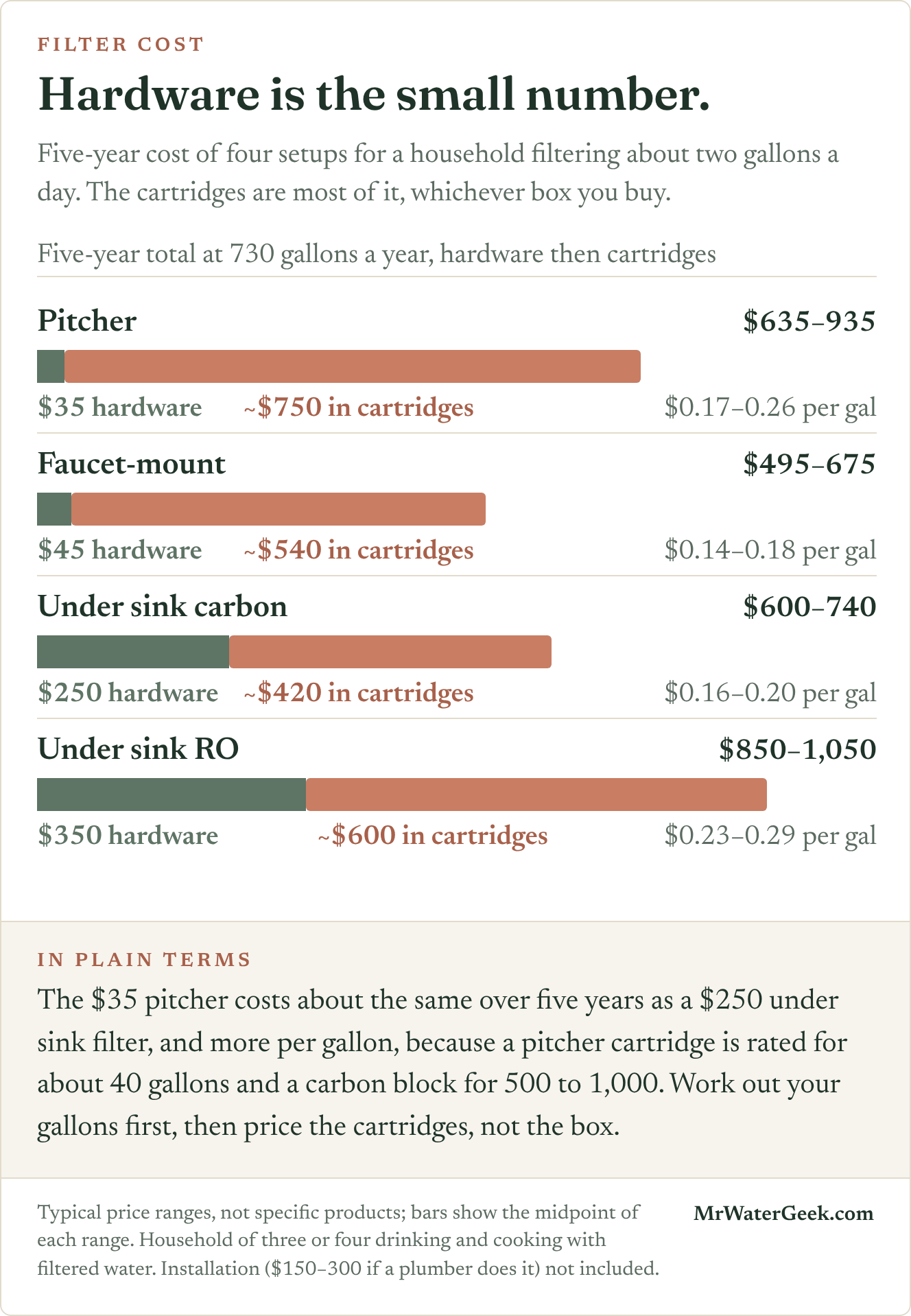
The table below assumes a household filtering about 2 gallons a day — 730 a year, which is a realistic family of three or four who drink and cook with filtered water. Prices are typical ranges rather than any specific product. Your own numbers will move, but the shape of the answer rarely does.
| Setup | Hardware | Cartridges / 5 yr | 5-year total | Per gallon |
|---|---|---|---|---|
| Pitcher | $35 | ~91 cartridges, $600–900 | $635–935 | $0.17–0.26 |
| Faucet-mount | $45 | ~18 cartridges, $450–630 | $495–675 | $0.14–0.18 |
| Under sink carbon | $250 | ~7 cartridges, $350–490 | $600–740 | $0.16–0.20 |
| Under sink RO | $350 | filters + membrane, $500–700 | $850–1,050 | $0.23–0.29 |
Two things jump out. The pitcher is not as cheap as it appears on day one. Which means filtering efficacy, not cost, should be the deciding factor.
The number that is not on the table: Installation
An under sink filter needs a hole in your counter for the dedicated tap, or a connection to an existing one. If you are handy, that is an afternoon. If you are not, budget $150 to $300 for a plumber, and add it to the five-year total before you compare. On a rental, it may not be an option at all.
Why cartridges cost what they cost
A carbon block that has been tested and certified under NSF 53 for lead costs meaningfully more to make than one that has only been tested for taste. The testing itself is expensive, the carbon is denser, and the manufacturer has to continually renew its certification.
While off-brand products are often a wise way to save money, filter cartridge replacements are not one of them. A cheap replacement cartridge that fits your housing but was never tested in it is the most common way people quietly lose the protection they paid for. The certification is per cartridge, not per machine.
If you take one thing from this piece: when the replacement is suspiciously cheaper than the original, check the certification, not just whether it fits.
Where people overspend
-
Buying whole-house filtration to solve a drinking water problem. You do not need to filter the water going to your toilets and your lawn. A whole-house system makes sense for sediment, iron, or chlorine you can smell in the shower — not as a way to make one tap safer.
-
Buying RO when carbon solves your problem. Reverse osmosis is the right answer for nitrate, PFAS, and a handful of other things. It costs more, wastes some water, and strips minerals that do not need stripping. If your report comes back clean and you just want better-tasting water, carbon is cheaper and simpler.
-
Replacing based on a calendar rather than usage. If you are replacing a cartridge every two months because the box said so, and your household drinks half of what the box assumed, you are throwing away a third of what you paid for.
-
Buying before testing. The most expensive filter is the one that does not address what is actually in your water. That is a few hundred dollars for peace of mind you did not get.
THE TEST, NOT THE CART
Start with the test, not the cart
Enter your ZIP to see what is reported locally before you buy anything.
Where it is worth spending more: Certification, Capacity, and Faucet
Certification: A filter certified under NSF 53 with lead listed on its data sheet costs more than one that promises better taste, and it is the only one of the two that will do anything about lead.
Capacity: Paying more up front for a larger cartridge almost always lowers your cost per gallon.
A Dedicated Faucet: The single biggest reason people stop using a filter is friction. A filter you stop using has an infinite cost per gallon, and a dedicated faucet tends to use a high-capacity filter requiring fewer changes and less confusion.
PRICE IT AFTER YOU KNOW THE PROBLEM
Check your area by ZIP first
Then price the filter that handles what was actually found.
FAQ
Is a more expensive filter always better? No. Price tracks capacity and certification, and those are the two things worth paying for. It does not track brand, and it very much does not track packaging. All current filter systems work using very similar, if not identical technologies by class – all pitchers are basically the same, all under sink carbon filters are similar to one another, same for RO systems. However, those that stand behind certifications – which are expensive – are worth spending more on as too many brands cut corners with filtration media that passed selective tests that may or may not protect you and your family from the contaminants in your water.
How do I know when a cartridge is really spent? Count gallons rather than months, and treat the calendar estimate as a default for an average household. A noticeable drop in flow, or taste coming back, means it is done regardless of the date.
Are subscription cartridge plans worth it? They solve a real problem, that people forget. Check the per-cartridge price against buying them outright, because convenience is frequently priced at a premium of 20 to 30 percent.
What about filtered water bottles and travel filters? Different job. Those are mostly built for taste and for backcountry pathogens, not for the dissolved contaminants in a municipal supply. Useful for what they are — not a substitute for a filter at home.
Next: the cost math only works if you know what you are filtering for — and if you just moved, there is a free five-step check that answers that before you spend anything.
Shashank — 9 years at Kohler building water products. Currently building the next generation of water health products.