Under-sink water filters are the most popular home water treatment,
and for good reason. They remove contaminants at the point where you
actually drink, they don’t require whole-house plumbing work, and the
technology behind them (carbon block, reverse osmosis membranes) is
proven. After 9 years building filtration systems, I’d still recommend
an under-sink filter over no filter at all if your water test says you
need treatment. That being said, under-sink water filters have some
serious structural problems that the industry has zero incentive to fix.
Here are five that I’ve spent years thinking about.
Key
Takeaways — What’s actually wrong with under-sink filters?
Under-sink filters are the best point-of-use option available — and
I’d still recommend one over nothing if your water test says you need
treatment. But the category has real problems the industry ignores. RO
systems waste 2–4 gallons for every gallon they produce, then add
minerals back into the water they just stripped. Carbon filters expire
invisibly — no affordable system tells you when it stops working.
Installation means a second faucet on your sink that most people forget
to use. The deeper issue: the filtration industry and the faucet
industry evolved separately, so nobody makes a fixture that actually
takes responsibility for the water it delivers. The technology exists to
fix this. The industry structure doesn’t.
Free · 30 seconds
Before you buy any filter, know what you’re filtering.
Look up what your utility has detected by zip code — then match the filter to the problem.
Why
does reverse osmosis (RO) waste so much water?
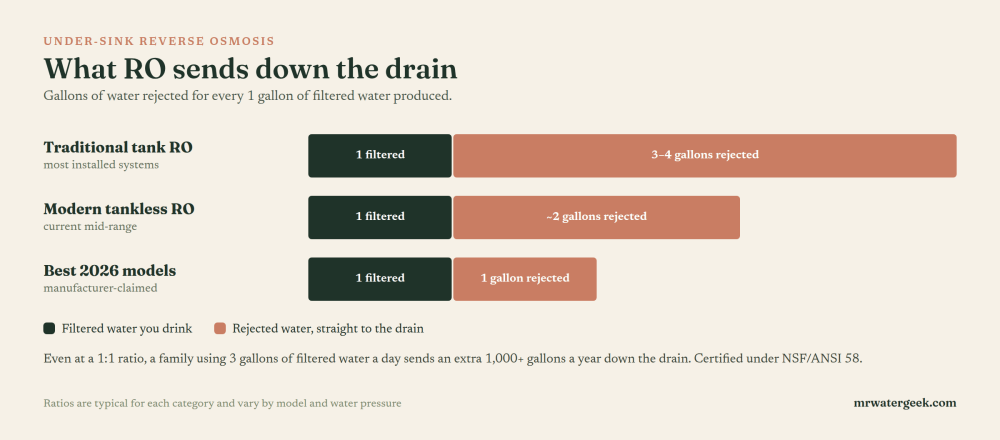
This is the one that bothers me most as an engineer. Traditional RO
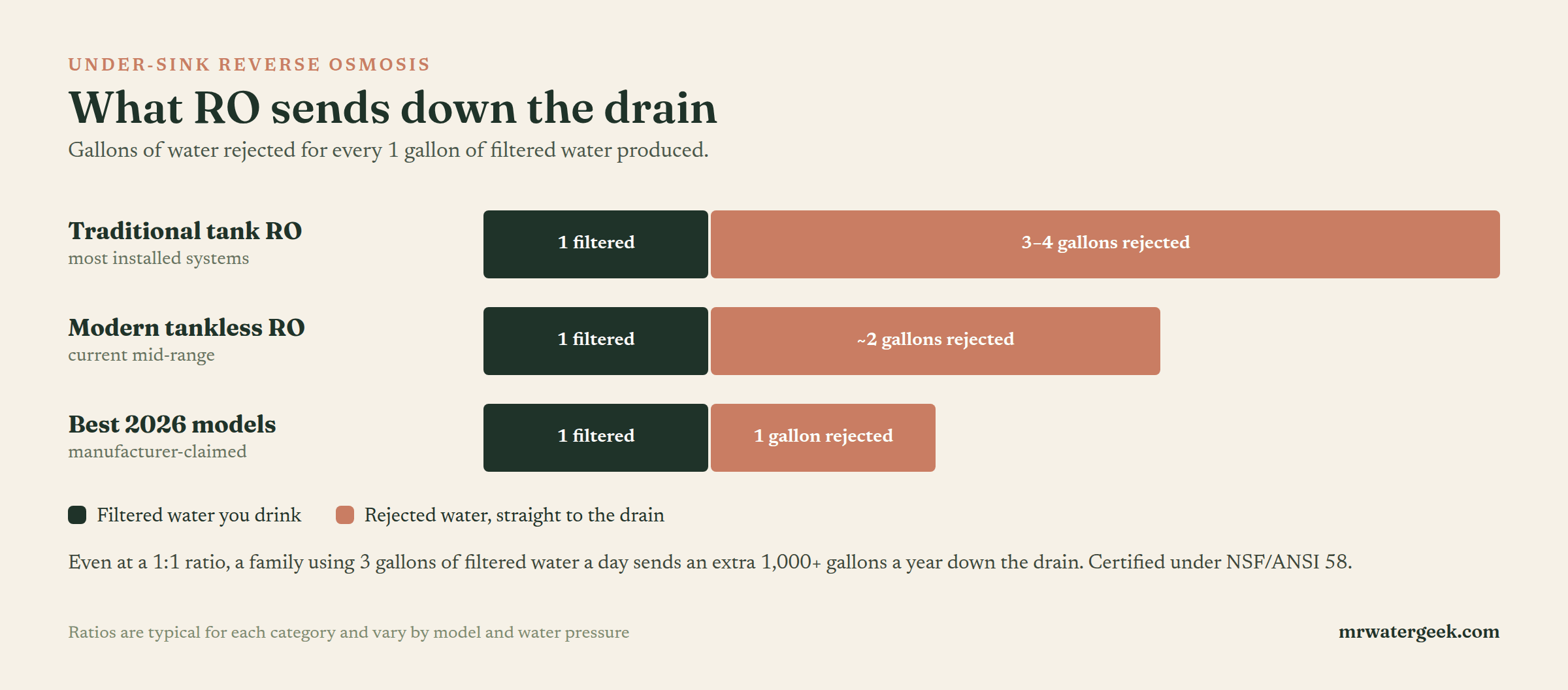
systems reject 3–4 gallons of water for every 1 gallon of filtered water
they produce. That rejected water, carrying the concentrated
contaminants the membrane blocked, goes straight down the drain.
Modern tankless RO systems have improved the ratio to roughly 2:1,
and some 2026 models claim 1:1. That’s real progress. But even at 1:1,
you’re doubling your water consumption at the kitchen tap. For a family
that drinks and cooks with 3 gallons of filtered water a day, that’s an
extra 1,000+ gallons a year going down the drain. In Phoenix. In a
drought.
The engineering problem isn’t that RO has to waste water – it’s that
residential RO systems are designed as cheap, disposable units with thin
membranes operating at household pressure. Industrial and commercial RO
systems achieve much higher recovery rates because they use better
membranes, higher pressures, and recirculation. But bringing that
engineering to a residential price point hasn’t been a priority for the
industry because the wastewater is invisible to most buyers. You don’t
see it; you don’t complain about it.
The environmental math gets worse when you factor in that RO strips
beneficial minerals, like calcium, magnesium, trace elements, along with
the contaminants. Most premium systems now add a remineralization stage
to put some minerals back. Think about that for a second: we’re using
energy and pressure to force water through a membrane that removes
everything, then immediately adding minerals back into the water on the
other side. An engineer would look at that and ask why we didn’t design
a system that was selective in the first place.
Why
does filtered water taste flat (and what does remineralization actually
do)?
RO-treated water has a Total Dissolved Solids (TDS) rate near zero.
This means that even substances like calcium, salt, and other minerals
have been dissolved from RO water. It tastes flat, slightly acidic, and
nothing like the spring water that premium brands train your palate to
expect. The minerals that give water its character are gone.
The remineralization cartridges that come with modern RO systems add
back some of that taste, making the water less flat. Typically calcite
(calcium carbonate) is added to raise the pH and add some calcium, along
with maybe a bit of magnesium. It’s better than nothing, but it’s a
blunt instrument – a one-size-fits-all approach that falls short of what
your body has adapted to drinking from your local water source.
This matters because the mineral content of drinking water is a
legitimate nutritional question. The World
Health Organization has noted that demineralized water may not
be suitable as a primary drinking source, and that calcium and magnesium
from drinking water can be meaningful contributors to daily intake,
especially in populations with lower dietary mineral consumption. (Source: WHO, Nutrients in Drinking Water (2005).)
Carbon block filters don’t have this problem. They leave minerals
intact while removing chlorine, VOCs, and – when properly rated – lead
and certain other contaminants. But carbon can’t remove dissolved salts,
nitrate, PFAS at ultra-low levels, or arsenic. So if your water test
shows those, RO (with its mineral trade-off) or an NSF/ANSI
53-certified filter specifically rated for your contaminant is
the path forward. To address PFAS specifically, look for certification
under NSF/ANSI 53 or 58 – not the discontinued P473 standard, which has
been folded into those two.
How do
you know when your filter stops working?
You don’t. That’s the problem.
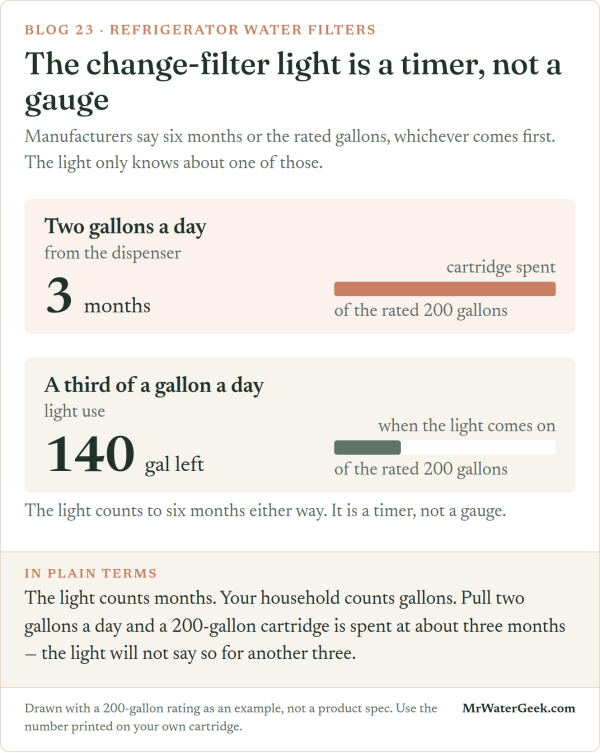
Most under-sink carbon filters are rated for 6 months or a specific
gallon capacity, whichever comes first. But no affordable residential
system actually measures how much water has passed through the filter.
You’re trusting a calendar reminder, an app notification, or your own
memory. And human memory is not a reliable water treatment strategy.
When carbon is past its rated capacity, its adsorption sites are
saturated. It stops removing contaminants. Worse, in warm conditions, an
exhausted carbon filter can become a bacterial breeding ground — the very
thing you installed the filter to avoid. You’re drinking water that
passed through a biologically active carbon bed, and you think you’re
protected because the filter is “installed.”
Some premium systems include a flow meter or a digital gauge that
estimates remaining capacity. These are better than nothing but they’re
estimating based on volume, not actually measuring contaminant
breakthrough. The only way to know a filter is still performing is to
test the output water, and almost nobody does that.
RO membranes have the same issue on a longer timeline. Most are rated
for 2–3 years, but actual lifespan depends on feedwater quality,
pressure, and temperature. A membrane treating hard, sediment-heavy well
water degrades faster than one on pre-treated municipal water. Without a
TDS meter on the output side (some systems include one; most don’t), you
won’t know when the membrane has degraded past its useful life.
The industry response to this is subscription filter delivery
services. They solve the “forgetting to buy a replacement” problem but
not the “knowing whether the filter is actually still effective”
problem. You get a new filter every 6 months whether your old one failed
at month 3 or still had capacity at month 8.
Why
is the installation so much harder than the box suggests?
The marketing says “easy DIY installation.” The reality, for the
average homeowner, involves: clearing everything out from under the
sink, identifying the cold water supply line, installing a T-valve or
saddle valve (which many plumbers recommend against because they’re
prone to leaking), running tubing from the valve to the filter housing,
running a separate drain line for RO wastewater, drilling a hole in the
countertop or sink for the separate filtered water faucet, and mounting
the filter housing in a way that allows future cartridge changes without
dismantling everything.
If your under-sink area is already crowded with a garbage disposal,
hot water dispenser, or soap dispenser – which is most kitchens – you’re
negotiating for real estate in a space that wasn’t designed for another
appliance.
The separate faucet is maybe the biggest design concession in the
entire category. You have your main kitchen faucet for everyday use and
a tiny secondary faucet for filtered water. Two faucets. On the same
sink. Because the filtration industry and the faucet industry developed
as separate categories that never talked to each other.
The result is that you have to consciously choose which faucet to
use. Fill a pot from the main faucet? Unfiltered. Rinse vegetables under
the main faucet? Unfiltered. Make ice? Unfiltered, unless you ran a
separate line to the refrigerator. The filter protects one small stream
of water while everything else from that sink goes untreated. And most
people default to the main faucet out of habit and convenience. (Installed-cost figures are typical market estimates and vary by system and region.)
Why
does the industry treat the faucet and the filter as separate
problems?
This is the structural issue underneath all the others. The plumbing
fixture industry and the water treatment industry evolved independently.
Faucet companies design for flow, finish, and form. Filter companies
design for contaminant removal. Neither designs for the other.
The consequence: your kitchen faucet was designed with zero
consideration for water quality. It might be adding lead to your water
if it’s pre-2014 brass. It delivers water at 1.8–2.2 GPM with no idea
what’s in it. And the filter that does know what’s in it sits
hidden under the sink, connected to a secondary faucet that most people
forget they have.
A 2024 revision to NSF/ANSI 61 lowered
the lead leaching limit for faucets to 1 microgram, five times
more protective than the previous standard. Even with that improvement,
the faucet itself is still a dumb pipe. It has no connection to the
filtration happening below it. The filter industry sells filters. The
faucet industry sells faucets. Nobody sells a system where the fixture
is the treatment.
Engineers have been talking about this disconnect for years. The
technology exists to integrate filtration directly into the faucet, to
make the fixture itself responsible for the quality of the water it
dispenses. It would eliminate the second faucet, eliminate the
installation complexity, and make filtered water the default instead of
the exception. The reason it hasn’t happened at scale isn’t technical.
It’s categorical. The industries don’t overlap, and neither one has had
a strong enough reason to cross the line.
That might be changing. But that’s a different article.
FAQ
Are under-sink water filters worth it? For people
whose water tests show contaminants above health-based guidelines – yes.
A certified
under-sink filter is the most effective point-of-use treatment
available. The problems described in this article are real limitations,
but they don’t negate the core value: these systems remove contaminants
that matter for health. The question is whether the filtration industry
will evolve past its current design constraints.
How much does an under-sink water filter cost? Basic
carbon systems run $100–$300 for the unit plus $40–$80/year in
replacement filters. RO systems cost $200–$600 for the unit plus
$60–$150/year for pre-filters, post-filters, and membrane replacements.
Professional installation adds $150–$300. (Installed-cost figures are typical market estimates and vary by system and region.)
Do under-sink filters remove PFAS? Some do, if they
carry the right certification. RO systems certified under NSF/ANSI 58
can reduce PFAS. Certain activated carbon filters certified under
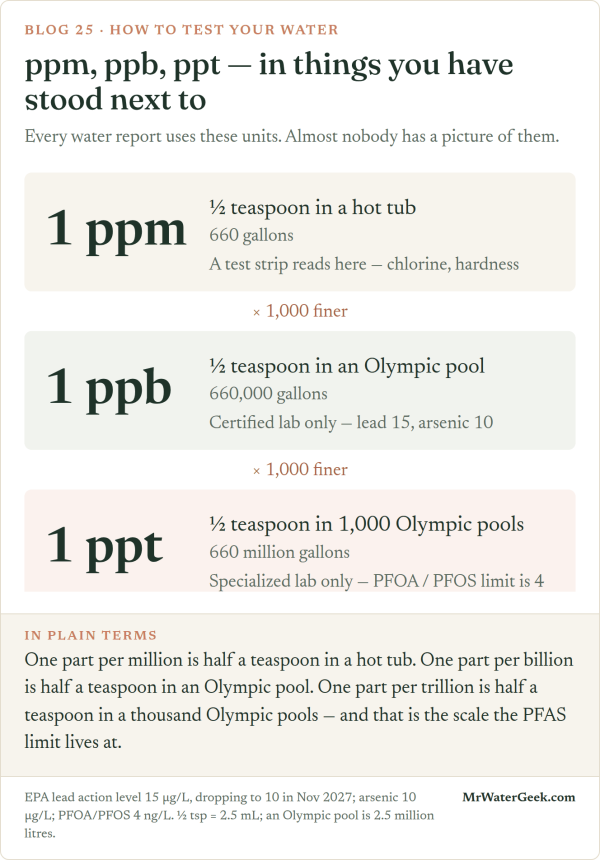
NSF/ANSI 53 for PFAS can also reduce PFOA and PFOS to below the EPA’s 4
ppt limit. The discontinued P473 standard has been folded into 53 and 58
– look for certification under those current standards. Our PFAS filter
guide covers this in detail. (Sources: NSF International; EPA, PFAS standards.)
Can I install an under-sink filter myself? Depends
on your comfort with basic plumbing. Installation involves turning off
water, connecting push-fit fittings, and running tubing. If that doesn’t
intimidate you, the installation itself takes 30–90 minutes. For
under-sink filtration systems that require a separate faucet, the harder
part is the countertop hole for the separate faucet, which requires a
drill and the right bit for your counter material.
Why not just use a pitcher filter instead? Pitchers
work for chlorine and basic taste/odor. Some carry NSF/ANSI 53
certification for lead. They’re a reasonable choice if your CCR shows a
clean profile and you want basic chlorine/taste reduction. For PFAS,
arsenic, nitrate, or serious lead contamination, pitchers don’t have the
capacity or certification depth that under-sink systems do. (Source: NSF/ANSI 42 & 53 standards.)
Shashank — 9 years at Kohler building water filtration. Mr Water Geek translates water science into clear decisions.