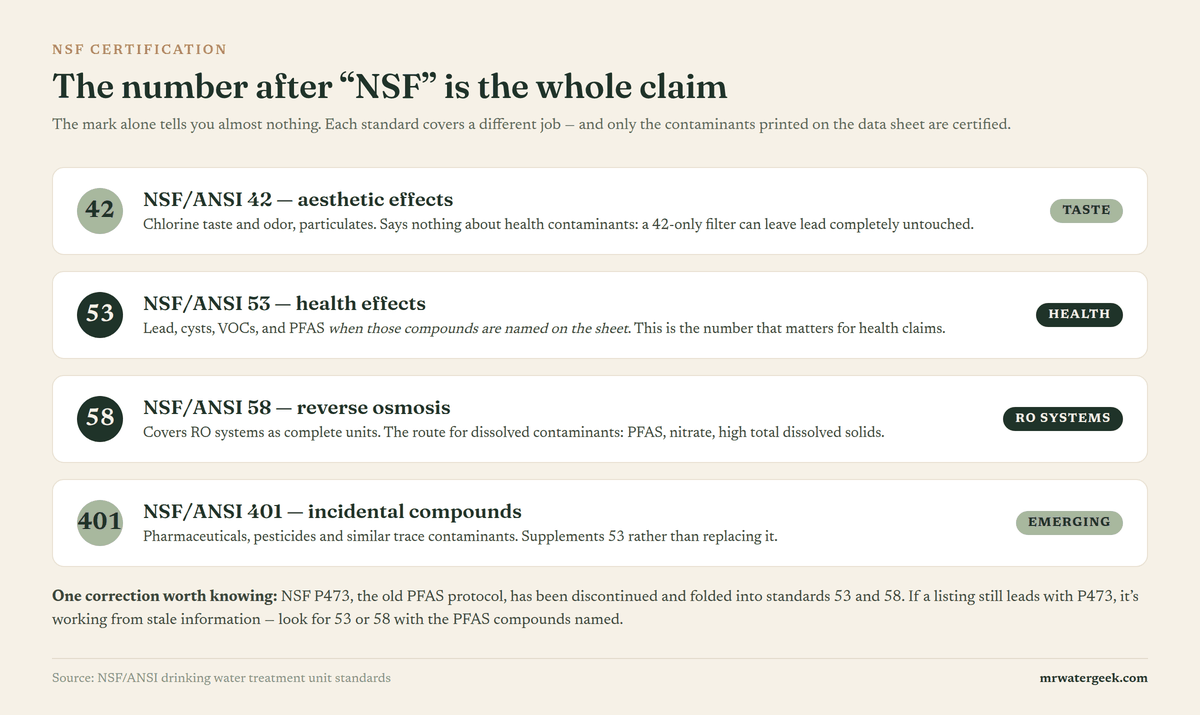
That NSF logo on your water filter? It might be telling you almost nothing. A filter can carry the NSF mark, pass every test it was given, and still offer zero protection against lead, PFAS, or any health-related contaminant. The reason: NSF certification only covers the specific standard a manufacturer chose to test against. The standard number — not the logo — tells you what the filter actually removes.
Key Takeaways: NSF certification is not one thing — it spans multiple standards (42, 53, 58, 401), each covering different contaminants. A filter can carry the NSF mark and still miss lead, PFAS, or pharmaceuticals entirely. Always check the standard number and verify the listing in the NSF database before buying.
Free · 30 seconds
What’s actually in your tap water?
Your utility’s real numbers — free, by ZIP code.
Check my ZIP →What does “NSF certified” actually mean?
NSF International is a third-party testing organization based in Ann Arbor, Michigan. When a manufacturer wants the NSF logo, they submit their product for testing against one or more ANSI/NSF standards. Lab technicians run challenge water — spiked with known concentrations of target contaminants — through the filter and measure what comes out the other side.
If the filter hits the reduction percentages required by that standard, it earns certification. For that standard — not for everything.
A manufacturer can certify against NSF 42 (taste and chlorine), put the NSF logo on the box, and claim “NSF certified.” Technically true. But that certification says nothing about lead, mercury, chemical pollutants from industry and agriculture (called VOCs), or the PFAS contamination that the EPA now regulates at 4 parts per trillion for PFOA and PFOS.
After 9 years at Kohler, I watched this confusion constantly. Consumers saw the logo, assumed comprehensive protection, and never checked which standard was listed.
Which NSF standards actually matter for drinking water?
Five standards cover the territory most households care about. Two more handle materials safety. They are not interchangeable, and the gaps between them are where marketing thrives.
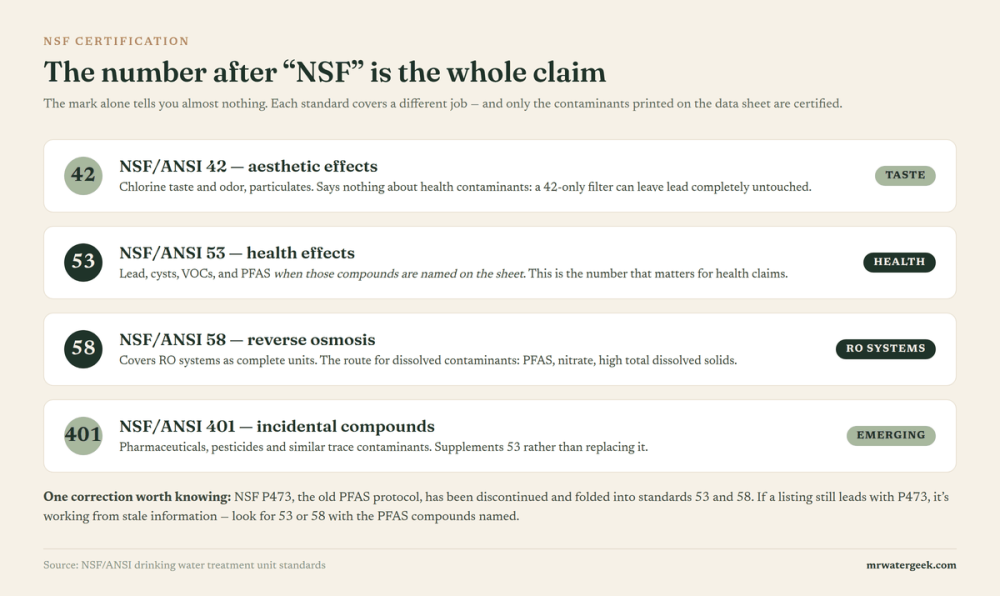
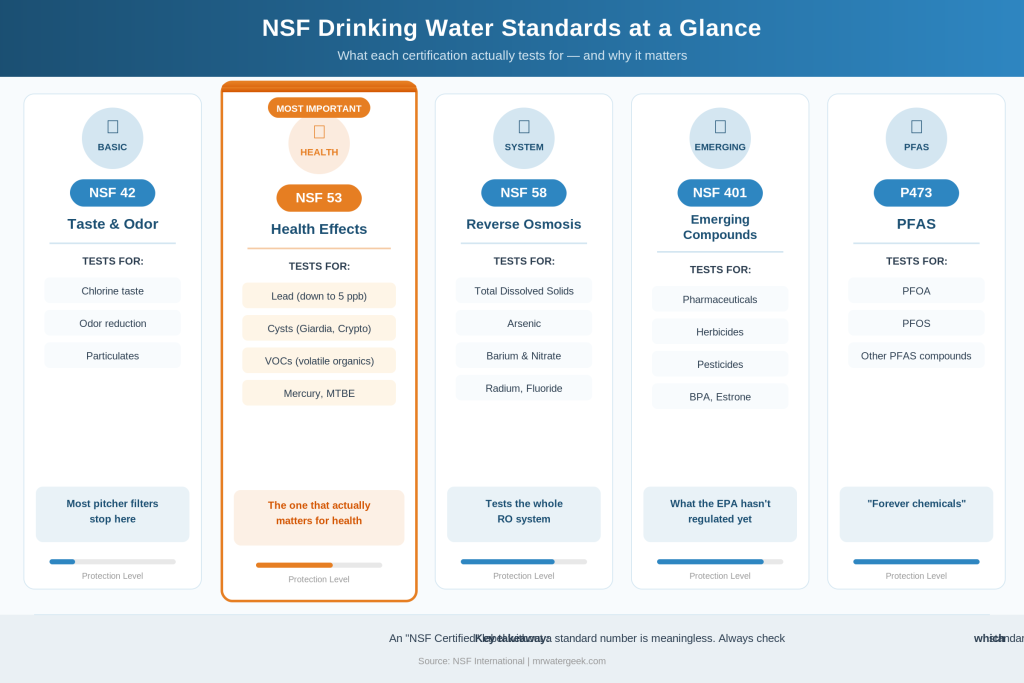
| Standard | What It Covers | Key Contaminants | Who Needs It |
| NSF/ANSI 42 | Aesthetic effects | Chlorine taste & odor | Anyone who dislikes tap water taste |
| NSF/ANSI 53 | Health effects | Lead, cysts, VOCs | Homes with verified lead or VOC concerns |
| NSF/ANSI 58 | RO systems | TDS, arsenic, barium, nitrate | Households using reverse osmosis |
| NSF/ANSI 401 | Emerging compounds | Pharmaceuticals, herbicides | Concerned about unregulated contaminants |
| NSF/ANSI 53 or 58 | PFAS reduction | PFOA, PFOS | Anyone in a PFAS-affected area |
NSF/ANSI 42 — Aesthetic Effects.
Covers taste, odor, and chlorine reduction. No health-related contaminants. Most pitcher filters and basic faucet-mount units certify to 42 alone.
NSF/ANSI 53 — Health Effects.
The heavy hitter. Covers lead reduction (to below 5 ppb), cyst removal, and chemical pollutants from industry and agriculture (called VOCs) like benzene and trichloroethylene. If you have verified lead in your water, you need 53, not 42. The CDC recommends NSF 53-certified filters for lead concerns specifically.
At Kohler, I watched marketing teams debate which standards to pursue. The calculus was simple: NSF 42 is cheap to test for and lets you put the NSF logo on the box. NSF 53 costs more and requires real filtration performance. Guess which one most brands stop at.
NSF/ANSI 58 — Reverse Osmosis Systems.
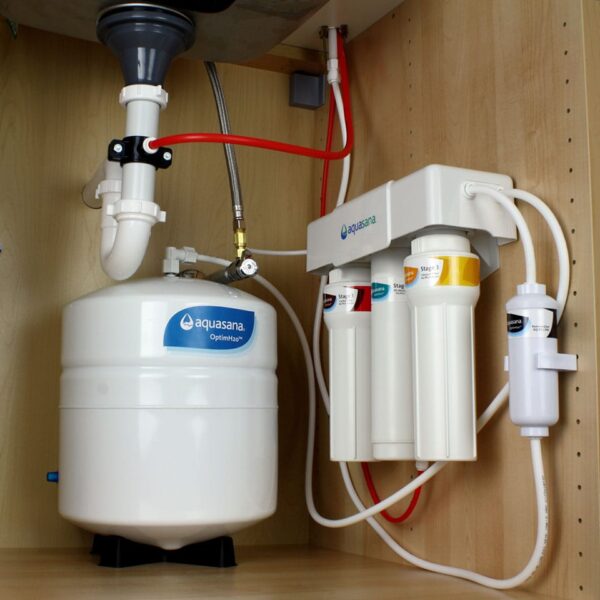
Tests the entire RO system as an integrated unit — membrane, pre-filters, post-filters. Covers TDS reduction, and depending on claims, also arsenic, barium, chromium, and nitrate. A whole home water filter using RO should carry this certification.
NSF/ANSI 401 — Emerging Compounds.
Tests for pharmaceuticals (ibuprofen, estrone), herbicides (atrazine, linuron), and compounds not yet EPA-regulated but showing up in water supplies. Look for 401 if trace pharmaceuticals concern you.
NSF/ANSI 53 & 58 — PFAS Reduction.
Covers PFOA, PFOS, and other per- and polyfluoroalkyl substances. With the EPA’s 2024 rule setting maximum contaminant levels at 4 parts per trillion for PFOA and PFOS, certification under 53 or 58 for PFAS reduction is what proves a filter can handle these compounds (the standalone NSF P473 protocol was discontinued and folded into those standards, which also tightened the combined PFAS limit from 70 ppt to 20 ppt). If you live in a PFAS-affected area, this is the certification to look for.
Note: In 2025, the EPA extended the PFOA/PFOS compliance deadline to 2031 and proposed rescinding limits on several other PFAS compounds (PFHxS, PFNA, GenX). The 4 ppt MCLs for PFOA and PFOS remain in effect.
Two bonus standards you’ll encounter:
NSF/ANSI 61 — Materials Safety verifies that filter components don’t leach harmful substances into your water. The 2024 revision tightened the lead leaching limit to 1 microgram for faucets.
NSF/ANSI 372 — Lead Content confirms the product meets the federal “lead-free” definition — 0.25% or less weighted average lead on wetted surfaces (enacted 2011, effective January 2014). A filter could reduce lead in your water while itself containing lead in its brass fittings. Standard 372 closes that gap.
What’s the difference between “tested to NSF” and “NSF certified”?
Some brands claim their filters were “tested to NSF standards” or “tested by an NSF-accredited lab.” These phrases sound nearly identical to “NSF certified,” and that ambiguity is the point.
The difference is significant. NSF certification comes with ongoing accountability — annual factory audits, periodic retesting, and the manufacturer has to report any material changes. “Tested to NSF standards” might mean a lab ran the test once and nobody checked again. Or the product was tested by WQA (Water Quality Association), which uses the same test methods but issues its own mark. WQA is legitimate — but it is a different organization than NSF International.
Then there are brands that test in-house. I’ve seen claims of 99.9% reduction for contaminants that were never checked by an outside lab. Without independent testing, those numbers are marketing copy, not verified performance.
The tell: if a brand says “tested to NSF/ANSI 53” rather than “certified to NSF/ANSI 53,” ask why they stopped short. Sometimes it is the cost — certification is not cheap. But sometimes the filter could not keep performing all the way through its rated lifespan.
Not sure what’s in your water?
Check your ZIP code — free, takes 30 seconds.
How do you check if a water filter is really NSF certified?
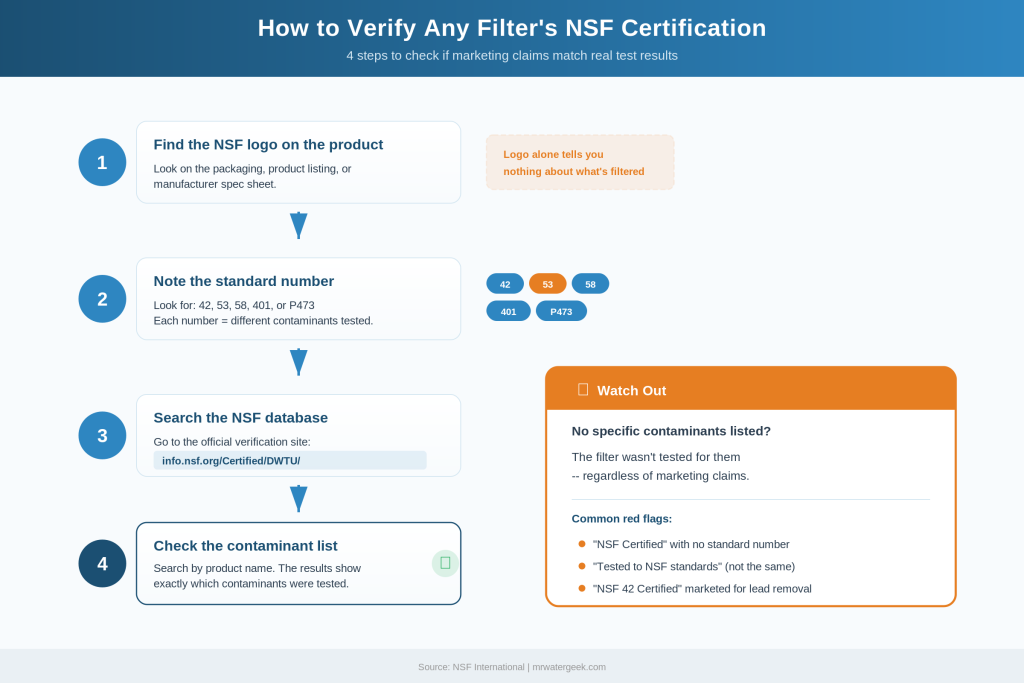
It takes about 30 seconds. Go to the NSF Certified Drinking Water Treatment Units database. Type the brand name or model number. If the product is currently certified, you will see exactly which standards it holds and which contaminants were tested.
If it does not show up, it is not NSF certified. The Amazon listing might say “NSF certified” in the bullet points. But if the product is not in that database, the claim is either outdated, misleading, or flat-out wrong. In my experience, roughly half the filters marketed with “NSF certified” claims don’t include the contaminants most buyers assume they cover. The database takes two minutes to check. Use it.
A few things to watch for: the certification might be under the parent company name rather than the brand name. Aquasana products, for example, might be listed under their corporate entity. Also, certifications expire — look for active status. And two filters can both hold NSF 53 while covering different contaminant lists. Same standard, different protection.
What should you check before buying any water filter?
Use this before you hand over your credit card. Five questions, five minutes.
1. Find out what is actually in your water. Pull your local water quality report — your utility publishes one every year (search “[your city] CCR” or “Consumer Confidence Report”). A filter that handles chlorine is useless if your real problem is arsenic.
2. Match the contaminant to the NSF standard. Chlorine taste? NSF 42. Lead? NSF 53. PFAS? NSF 53 or 58. Pharmaceuticals? NSF 401. RO system? Demand NSF 58 for the complete unit, not just a single component.
3. Verify in the NSF database. Go to info.nsf.org/Certified/DWTU/ and confirm the product is actively listed. Don’t rely on the manufacturer’s claim.
4. Check which specific contaminants are covered. Two filters with the same standard can cover different contaminant lists. The database shows exactly what was tested and at what reduction percentage.
5. Check the filter’s rated capacity. NSF testing runs for the entire rated filter life — say, 400 gallons. Use it past that point and nobody guarantees it is still doing its job. Replace on schedule.
How can you tell at home if your filter is still working?
Certifications tell you what a filter can do when new. They don’t monitor the unit under your kitchen sink right now.
A few practical checks. If your water starts tasting like chlorine again, the carbon is likely exhausted. If you notice sediment appears — cloudiness that wasn’t there before — the mechanical filtration has degraded. For RO systems, a TDS meter costs under $15. Your RO permeate should read well below your tap water TDS. If the numbers are converging, the membrane needs replacement.
None of this replaces following the manufacturer’s replacement schedule. But it gives you what engineers call a “reasonableness test” — does the output make sense given the input? You don’t need a lab. You need attention.
One more wrinkle for homes dealing with hardness alongside filtration. If you’re weighing salt-based versus salt-free softening, know that hard water can exhaust carbon faster than rated. Above 15 gpg, look at softener alternatives to protect your filtration investment.
FAQ
Does NSF certified mean a filter removes everything? No. NSF certification is standard-specific. A filter certified to NSF 42 only covers taste, odor, and chlorine. To cover lead, you need NSF 53. For PFAS, you need NSF 53 or 58. Always check which standard number the product carries, then verify it in the NSF database.
What’s the difference between NSF certified and WQA certified? WQA (Water Quality Association) tests products using the same NSF/ANSI standards but is a separate certifying body. Both require ongoing compliance, facility audits, and retesting. Both are legitimate. The key is independent testing — not self-reported manufacturer data.
Can a water filter lose its NSF certification? Yes. NSF conducts periodic retesting and facility audits. If a manufacturer changes materials, fails a retest, or stops paying, the certification lapses. The online database reflects current status — always check there rather than trusting the box.
Is NSF 53 enough for PFAS? No. NSF 53 covers lead and cysts. PFAS reduction is certified under NSF/ANSI 53 or 58 (the former P473 protocol was discontinued and folded into those standards). Some filters hold both, but NSF 53 alone does not guarantee PFAS reduction. With the EPA’s 2024 rule at 4 ppt for PFOA and PFOS, a 53 or 58 PFAS-reduction certification is what you need.
Do I need all the NSF standards? No. Match the standard to your water. If your municipal report shows compliant lead levels and your only complaint is chlorine taste, NSF 42 handles the job. A residential kitchen doesn’t need an RO system certified to every standard on the list. Know your water, then buy accordingly.
Certification tells you what a filter proved in the lab. But the lab doesn’t know what’s in your water — and your utility’s report measures at the treatment plant, not your tap. Next up: what happens between the plant and your faucet, and why the last 100 feet of pipe might matter more than the first 100 miles.
About the author: Shashank — 9 years at Kohler building water filtration. Mr Water Geek translates water science into clear decisions.
Your water tells a story. Find out what’s actually in it.
Free report by ZIP →