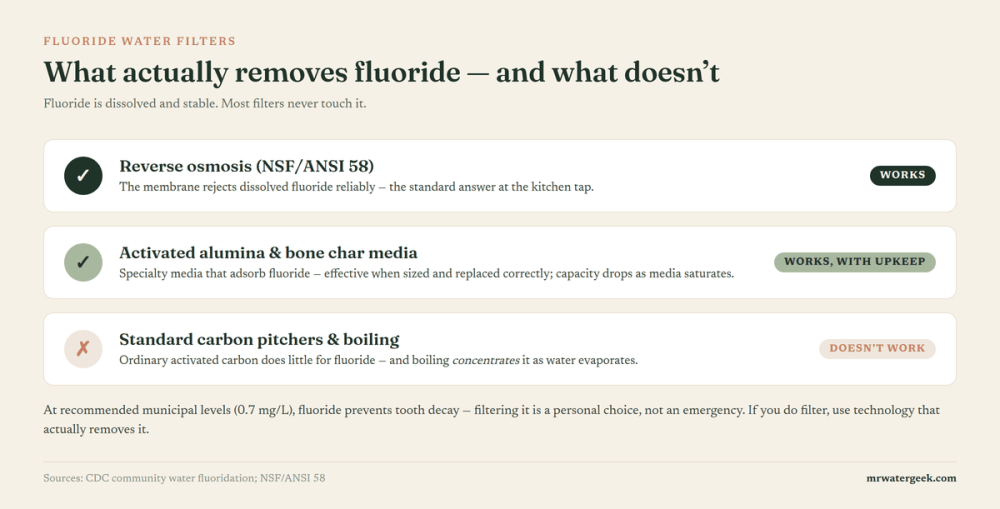
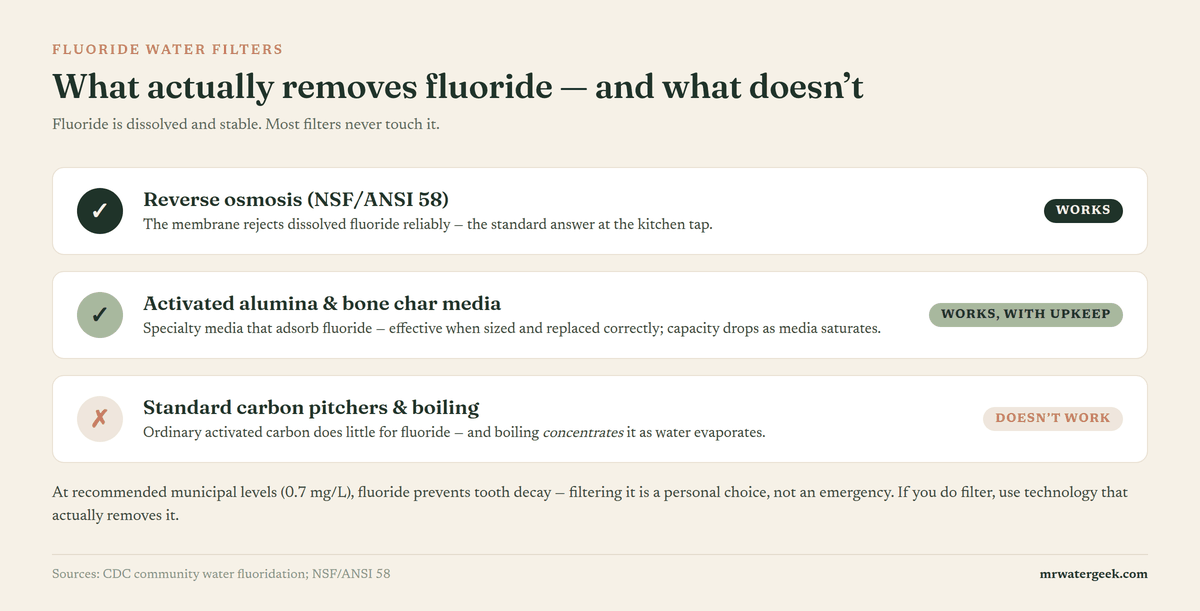
A fluoride water filter must use reverse osmosis, activated alumina, or bone char to reduce fluoride in drinking water. Standard carbon filters — including popular pitcher filters and basic faucet attachments — do not remove fluoride. To verify a filter’s fluoride claims, check for NSF/ANSI 53 certification with fluoride specifically listed, or NSF/ANSI 58 for reverse osmosis systems with fluoride in the product’s certification scope.
Key Takeaways
Most filters people already own do nothing to fluoride. The carbon inside a typical pitcher or faucet filter catches chlorine and organic compounds but lets fluoride pass right through. Three technologies actually work: reverse osmosis (90-95% reduction), activated alumina (pulls fluoride out of water like a magnet), and bone char (made from the same mineral as your teeth and bones). Look for NSF 53 certification with fluoride specifically listed — not just any NSF 53 claim.
Free · 30 seconds
What’s actually in your tap water?
Your utility’s real numbers — free, by ZIP code.
Check my ZIP →Why Doesn’t My Carbon Filter Remove Fluoride?
Activated carbon works through adsorption (where contaminants stick to the surface). Chlorine, pesticides, and many chemicals cling to carbon’s huge surface area because they’re naturally attracted to it. Fluoride is different.
Fluoride floats through water as a tiny dissolved particle with a negative charge. Carbon has almost no attraction to it. Think of it like a magnet trying to pick up a plastic bead — the magnet grabs metal just fine, but the plastic bead sits there untouched. Same idea. Carbon simply doesn’t have the right chemistry to grab fluoride.
I’ve seen people run water through a carbon pitcher three or four times thinking it might help. It won’t. You could pass fluoridated water through activated carbon a hundred times and the fluoride concentration would barely change. The mechanism simply isn’t there.
This matters because most household filters in the US are carbon-based. Brita-style pitchers, refrigerator filters, basic faucet mounts — all carbon. All ineffective against fluoride.
What Are the Three Technologies That Actually Remove Fluoride?
Three filtration technologies have proven, certifiable fluoride reduction. Each works in a completely different way.
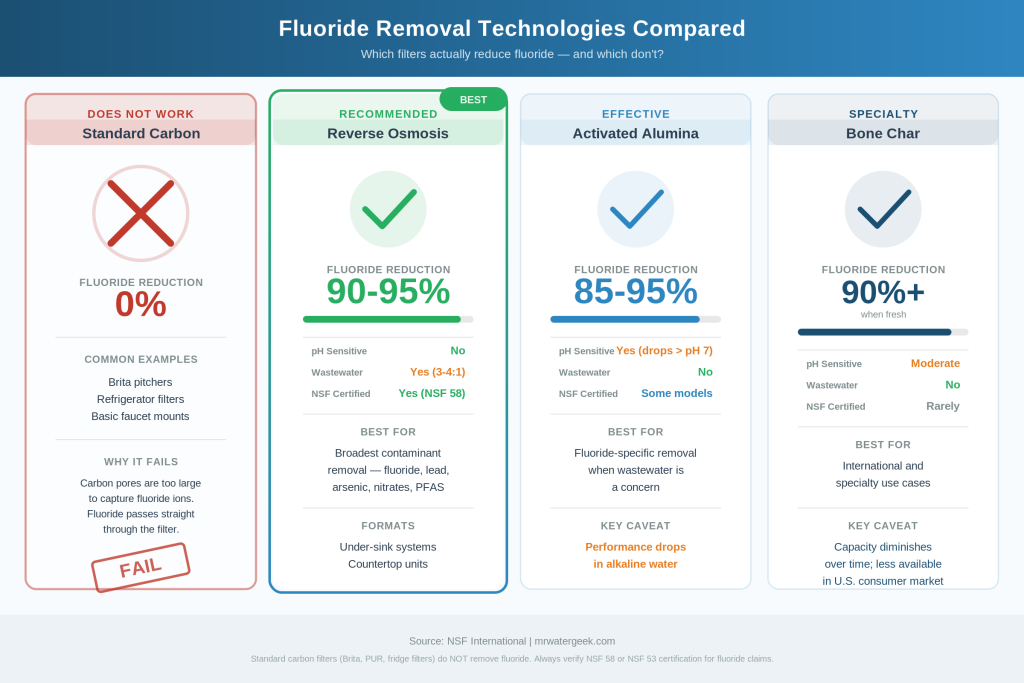
| Technology | Fluoride Reduction | pH Sensitive? | Wastewater? | Best For |
| Reverse osmosis | 90-95% | No | Yes (3-4:1 ratio) | Households wanting broadest contaminant removal |
| Activated alumina | 85-95% (at optimal pH) | Yes — drops above pH 7 | No | Point-of-use or whole-house fluoride-specific removal |
| Bone char | 90%+ when fresh | Moderate | No | International use; limited US consumer availability |
| Standard carbon | 0% | N/A | No | Does NOT remove fluoride — chlorine/VOCs only |
Reverse Osmosis (RO)
Reverse osmosis forces water through a filter so fine it blocks even dissolved minerals and salts, including fluoride. The membrane rejects 90-95% of fluoride along with most other dissolved solids.
RO is the most thoroughly documented fluoride removal method in consumer water treatment. NSF/ANSI 58 is the certification standard for RO systems. Fluoride is one of several optional contaminants a manufacturer can choose to have tested — not every NSF 58-certified system has been verified for fluoride. Always check the specific product listing to confirm fluoride is included in the certification scope.
How it works: the RO membrane has openings so small that water molecules can squeeze through, but fluoride particles can’t. The rejected fluoride gets flushed down the drain with the wastewater.
Activated Alumina
Activated alumina is aluminum oxide processed into a highly porous form. It was specifically developed for fluoride and arsenic removal. The alumina surface carries a positive charge, and fluoride — being negatively charged — gets pulled toward the surface like a magnet and sticks.
Think of it as the opposite problem from carbon. Carbon doesn’t attract fluoride because there’s no charge interaction. Activated alumina creates exactly the right charge environment to grab and hold it.
One important variable: water acidity matters a lot. Activated alumina works best at pH 5.5-6.5. As pH rises above 7, its ability to capture fluoride drops. Most municipal water sits around pH 7.0-8.5, which means real-world performance is often lower than lab-condition specs.
Bone Char
Bone char is made from animal bones heated to 400-500°C in a low-oxygen environment. The resulting material is primarily calcium hydroxyapatite — the same mineral your teeth and bones are made of. Fluoride particles swap places with other ions in the mineral structure, effectively locking the fluoride into the media.
Fresh bone char can achieve 90%+ fluoride reduction. But capacity is finite and diminishes with use. Once the available exchange sites are saturated, the media needs replacement.
Bone char is more common in international water treatment, particularly in regions of East Africa and South Asia where naturally occurring fluoride levels in groundwater can exceed 5-10 mg/L. In the US consumer market, it’s less widely available but does appear in some specialty filter cartridges.
How Do I Know If Fluoride Is in My Water?
Most US municipal water systems add fluoride intentionally. The CDC recommends a target level of 0.7 mg/Lfor community water fluoridation — a number reduced in 2015 from the previous range of 0.7-1.2 mg/L.
Here’s how to check your specific supply:
1. Your water utility’s Consumer Confidence Report (CCR). Every public water system is required to publish an annual water quality report. Search your utility’s name plus “water quality report” or “CCR.” Fluoride will be listed with the measured concentration. If your system fluoridates, you’ll typically see values between 0.5-0.9 mg/L.
2. The EWG Tap Water Database. Enter your zip code at ewg.org/tapwater to see reported contaminant levels for your local utility, including fluoride.
3. A home water test. Fluoride-specific test strips and color-change test kits are available for under $15. They won’t give you laboratory precision, but they’ll confirm whether fluoride is present and give you a rough concentration range. For exact numbers, send a sample to a certified lab — expect to pay $20-40 for a fluoride-specific analysis.
4. Well water owners: Your water isn’t fluoridated by a utility, but natural fluoride from geological sources can still be present. In some parts of the US Southwest and areas with volcanic geology, natural fluoride levels can approach or exceed the EPA’s maximum contaminant level of 4.0 mg/L. Testing is the only way to know.
Not sure what’s in your water?
Check your ZIP code — free, takes 30 seconds.
What Should I Look for in NSF 53 Fluoride Certification?
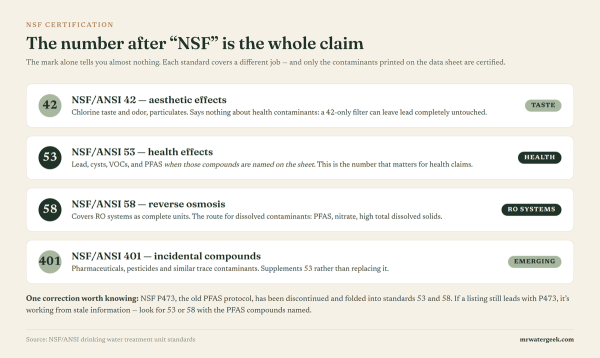
NSF/ANSI 53 is the standard for health effects reduction in drinking water treatment units. But — and this trips people up — NSF 53 covers a long list of contaminants. A filter can be NSF 53 certified for lead reduction and not be certified for fluoride at all.
When a manufacturer claims “NSF 53 certified,” that alone tells you nothing about fluoride performance. You need to check the specific contaminant listing.
How to verify:
1. Go to the NSF Certified Drinking Water Treatment Units database.
2. Search by manufacturer or product name.
3. Look at the individual product listing. It will show exactly which contaminants the certification covers.
4. Fluoride should appear explicitly in the list. If it doesn’t, the filter hasn’t been tested and certified for fluoride reduction under that standard, regardless of what marketing copy suggests.
For reverse osmosis systems, the relevant standard is NSF/ANSI 58 rather than 53. Same principle applies — fluoride is an optional claim under NSF 58, so verify that fluoride appears in the specific product’s certification listing.
In my experience, roughly half the filters marketed with vague “NSF certified” claims don’t include the contaminants most buyers assume they cover. The certification database takes two minutes to check. Use it.
Which Fluoride Water Filter Format Works Best?
Not every format can house the right technology. Here’s the breakdown by category.
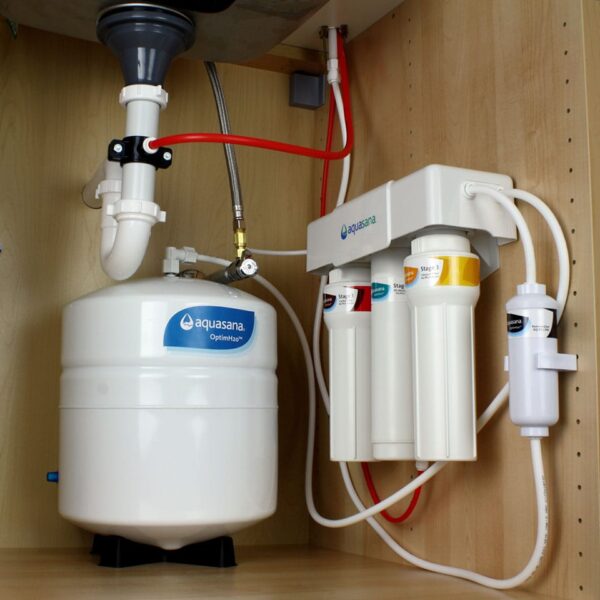
1. Under-sink reverse osmosis systems. The most reliable consumer option for fluoride removal. A multi-stage RO system with a dedicated fluoride-rated membrane will consistently deliver 90-95% reduction. These require installation, a storage tank, and a dedicated faucet. They’re the gold standard for point-of-use fluoride removal.
2. Countertop and under-sink filters with activated alumina cartridges. Several manufacturers offer cartridge-based systems using activated alumina media. Performance depends heavily on contact time — the water needs to spend enough time touching the media for fluoride to stick. Faster flow rates generally mean lower fluoride removal. Check that the specific cartridge carries NSF 53 fluoride certification.
3. Whole-house systems with activated alumina media tanks. For fluoride reduction at every tap, a whole-house system using activated alumina media is the primary option. These are larger, more expensive, and require periodic media replacement. The media volume needs to be sized correctly for your household’s flow rate and water chemistry. Consider these if you want fluoride removed from shower and bath water as well as drinking water — though for most people, a point-of-use system at the kitchen sink is sufficient. Learn more about whole-home water filter options and what they can address beyond fluoride.
4. Gravity-fed filters with specialty elements. Some gravity-fed (countertop) filter systems offer fluoride-specific filter elements, typically using activated alumina or a proprietary blend. These can be effective but verify third-party certification independently. Flow rate through gravity systems is slow, which actually helps fluoride removal by giving the water more contact time with the media.
5. Pitcher filters. Almost universally carbon-based. Do not remove fluoride. A few specialty pitchers have entered the market with fluoride reduction claims — if considering one, demand NSF 53 fluoride certification specifically. Without it, assume the claim is unsubstantiated.
What Are the Trade-Offs of Each Approach?
Every fluoride removal technology comes with compromises. Understanding them prevents buyer’s remorse.
Reverse osmosis trade-offs:
– Wastewater production. Standard RO systems produce 3-4 gallons of waste for every gallon of filtered water. High-efficiency units have improved this to 1:1 or 2:1 ratios, but waste is inherent to the process. If water conservation matters to you, factor this in.
– Mineral stripping. RO removes nearly everything — including calcium, magnesium, and other minerals some people prefer in their water. Some systems include a remineralization stage to add minerals back after filtration. If you’re also dealing with hard water, this total mineral removal might actually be a benefit; see how it compares with other water softener alternatives.
– Storage tank and space. Most under-sink RO systems need a pressurized storage tank roughly the size of a small propane cylinder. Tankless RO systems exist but are more expensive.
– Filter replacement costs. An RO system has multiple stages — pre-filter, membrane, post-filter — each on its own replacement schedule. Annual filter costs typically run $50-100 depending on the system.
Activated alumina trade-offs:
– pH sensitivity. Performance drops as water pH increases above 7. If your water is naturally alkaline (pH 8+), fluoride removal efficiency could fall below 70%.
– Capacity is finite and hard to predict. The media eventually fills up and stops removing fluoride. How quickly depends on fluoride levels, water acidity, flow rate, and other minerals in the water. You won’t see or taste the difference when the media is spent — only testing confirms it’s still working.
– Media replacement. Depending on usage and water chemistry, activated alumina media in a cartridge may last 3-6 months. In a whole-house tank, the media bed might last 1-3 years before replacement or regeneration.
Bone char trade-offs:
– Limited US availability. Fewer consumer products use bone char compared to RO or activated alumina.
– Not suitable for vegetarian or vegan households, as the media is animal-derived.
– Capacity diminishes gradually. Like activated alumina, bone char saturates over time, and there’s no visible indicator.
– Less standardized performance testing in the US market compared to RO and activated alumina.
Where Does the Science Stand on Fluoride in Drinking Water?
Fluoride is one of the most actively contested topics in drinking water right now, and the science and policy have both moved fast. Here’s where things stand as of 2026 — laid out neutrally, because your decision should rest on the evidence, not on either side’s framing.
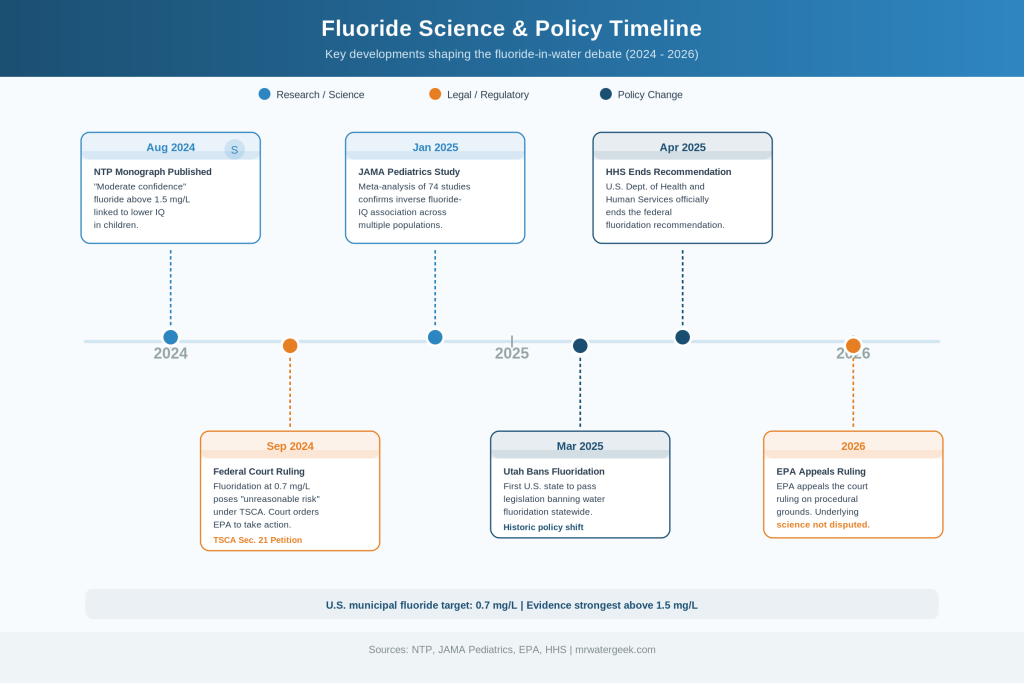
What the research found. In August 2024, the National Toxicology Program (NTP) published a systematic review concluding, with “moderate confidence,” that higher fluoride exposure is associated with lower IQ in children. A January 2025 meta-analysis in *JAMA Pediatrics*, pooling 74 studies, reported the same inverse association. The key nuance: the association is clearest above 1.5 mg/L — roughly twice the U.S. recommended level of 0.7 mg/L — and the evidence below 1.5 mg/L remains inconclusive and contested. A 2023 estimate put about 2.9 million Americans (~4.5% of community water systems) at or above 1.5 mg/L.
What regulators and courts are doing. In September 2024, a federal court found that fluoridation at the recommended 0.7 mg/L poses an “unreasonable risk” of reduced IQ in children and ordered the EPA to begin rulemaking under the Toxic Substances Control Act. The EPA is appealing that ruling as of 2026, arguing procedural grounds rather than disputing the science. In April 2025, HHS directed an end to the federal community-water-fluoridation recommendation, and Utah became the first state to ban fluoridation outright.
What the dental and pediatric bodies say. The American Dental Association, the American Academy of Pediatrics, and allied organizations continue to support community water fluoridation at recommended levels as an effective measure against tooth decay, and point to studies showing no IQ effect at the 0.7 mg/L target.
My perspective as an engineer: I’m not a toxicologist, dentist, or public health official. What I can tell you is which technologies physically remove fluoride and which don’t. Whether you reduce the fluoride in your household water is your call — a legitimate one in either direction. If you do, use a technology with verified, certified performance. Either way, base the decision on your water quality report and the primary research.
FAQ
Does boiling water remove fluoride? No. Boiling actually concentrates fluoride because water evaporates but the dissolved fluoride stays behind. If you start with 1 mg/L fluoride and boil off half the water, you’ll have roughly 2 mg/L fluoride in the remaining water.
Do ZeroWater pitchers remove fluoride? ZeroWater uses an ion exchange filter (which swaps unwanted contaminants for harmless ones), and this can reduce fluoride. Their filters are NSF/ANSI 42 and 53 certified, and the brand has published fluoride reduction data. However, the cartridges have limited capacity and need frequent replacement, especially in water with higher total dissolved solids. Verify current certification status through the NSF database before purchasing.
What about distillation? Distillation does remove fluoride effectively. Water is boiled, the steam is collected and condensed, and fluoride stays in the boiling chamber. But countertop distillers are slow (producing 1 gallon in 4-6 hours), energy-intensive, and impractical as a primary household water source.
Can a shower filter remove fluoride? Standard shower filters use basic filtration media or carbon, neither of which removes fluoride. A whole-house activated alumina system would address shower water, but a shower-head filter alone won’t. The contact time is far too short and the media is wrong.
How much fluoride does a refrigerator filter remove? Essentially zero. Refrigerator filters are activated carbon, sometimes with a basic sediment stage. They improve taste and reduce chlorine but do not affect fluoride concentration.
Is fluoride in well water the same as added fluoride? Chemically, fluoride is fluoride — the ion is identical whether it dissolved from fluoride-bearing minerals underground or was added at a treatment plant. Natural fluoride concentrations vary enormously by geology; some wells have undetectable levels while others exceed the EPA’s 4.0 mg/L maximum. Test your well water to know what you’re dealing with.
What about the Berkey filter and fluoride? Some gravity-fed filter manufacturers sell optional fluoride reduction elements as add-ons to their standard filter setup. These typically use activated alumina. If you’re considering this route, confirm independent certification and understand that these elements have a finite capacity and must be replaced on schedule.
Fluoride is just one contaminant in a long list of things that can end up in your tap water. Next in this series, we’ll look at the full picture — which filter technologies cover which contaminants, and how to match the right system to your specific water quality report. Because buying a filter without knowing what’s actually in your water is like buying medicine without a diagnosis.
About the author: Shashank — 9 years at Kohler building water filtration. Mr Water Geek translates water science into clear decisions.
Your water tells a story. Find out what’s actually in it.
Free report by ZIP →