Every public water system in the U.S. is required by federal law to publish an annual Consumer Confidence Report — a document that tells you exactly what’s in your water, what the legal limits are, and whether your utility is meeting them. Most people don’t know this report exists. The ones who find it usually can’t parse it. This guide walks you through how to find yours, what the numbers actually mean, and when those numbers should change your behavior.
Key Takeaways — What should you actually do?
Your utility publishes a water quality report every year — most people never read it. Pull yours up, find the column labeled “MCLG,” and compare it to “Amount Detected.” If the MCLG is zero and anything was detected, that contaminant has no safe level according to the EPA. The legal limit (MCL) is a regulatory compromise, not a health all-clear. The report also won’t cover what happens inside your building’s plumbing — where lead, copper, and bacteria issues actually originate. If you’re in a home built before 2014 or you have older pipes, a first-draw test at your kitchen faucet tells you more than the CCR ever will.
Free · 30 seconds
What’s actually in your tap water?
Get the numbers behind your report — free, by ZIP code.
Check my ZIP →Why does your city publish a water quality report every year?
The EPA requires every community water system serving more than 15 connections — roughly 50,000 systems across the U.S. — to deliver an annual Consumer Confidence Report (CCR) to every customer by July 1. The rule has been in place since 1998. Starting in 2027, systems serving more than 10,000 people will deliver these reports twice a year instead of once, with a mid-year update covering lead detections, new violations, and unregulated contaminant monitoring.
The idea behind the CCR is transparency: your utility tests for dozens of regulated contaminants, and the report summarizes what they found. In practice, though, most reports are 8–15 pages of tables, acronyms, and legal boilerplate that make them nearly impossible for a non-specialist to read.
That’s what this guide fixes.
How do you find your water quality report?
Three paths, in order of ease:
Search “[your city name] water quality report” in any browser. Most utilities post their current CCR as a PDF on their website. If you’re on a small system, try adding your county name.
Use the EPA’s CCR search tool. Enter your state and water system name. This is especially useful for rural or small-utility customers whose reports don’t show up on Google.
Or check mrwatergeek.com/water-quality, which pulls data from the EWG Tap Water Database and benchmarks it against both EPA legal limits and health-based guidelines — a distinction the CCR itself doesn’t always make clear.
If you’re on a private well, you won’t have a CCR. Your water isn’t monitored by any agency. The CDC recommends annual testing for coliform bacteria, nitrates, total dissolved solids, and pH at a minimum.
What do the columns on a water quality report mean?
Open your CCR and you’ll see a table. The columns typically look something like this:
| Column | What It Means |
| Contaminant | What was tested — lead, chlorine, nitrate, THMs, etc. |
| MCL (Maximum Contaminant Level) | The legal limit — the highest concentration allowed in your water. Enforceable. |
| MCLG (Maximum Contaminant Level Goal) | The health-based goal — the level below which there’s no known health risk. Not enforceable. Often lower than the MCL, sometimes zero. |
| Your Water / Amount Detected | What your utility actually measured. |
| Range | The low-to-high spread across all testing points in the system. |
| Violation | Whether the detected level exceeded the MCL. |
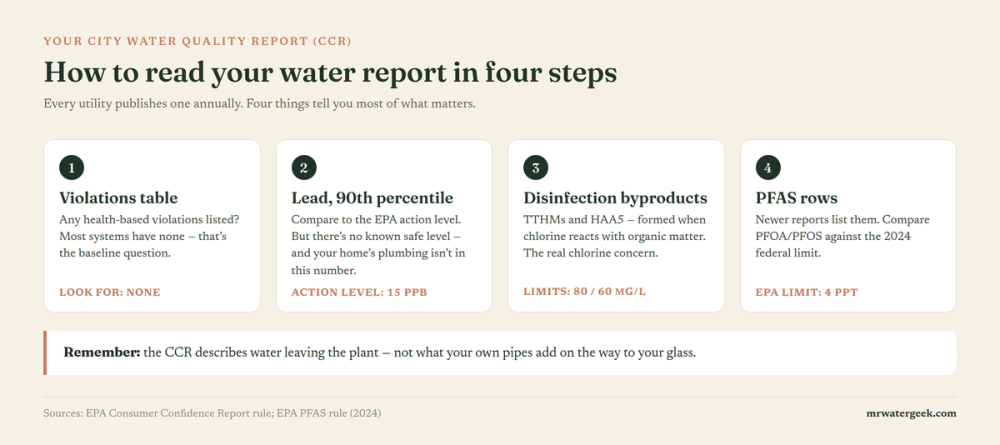
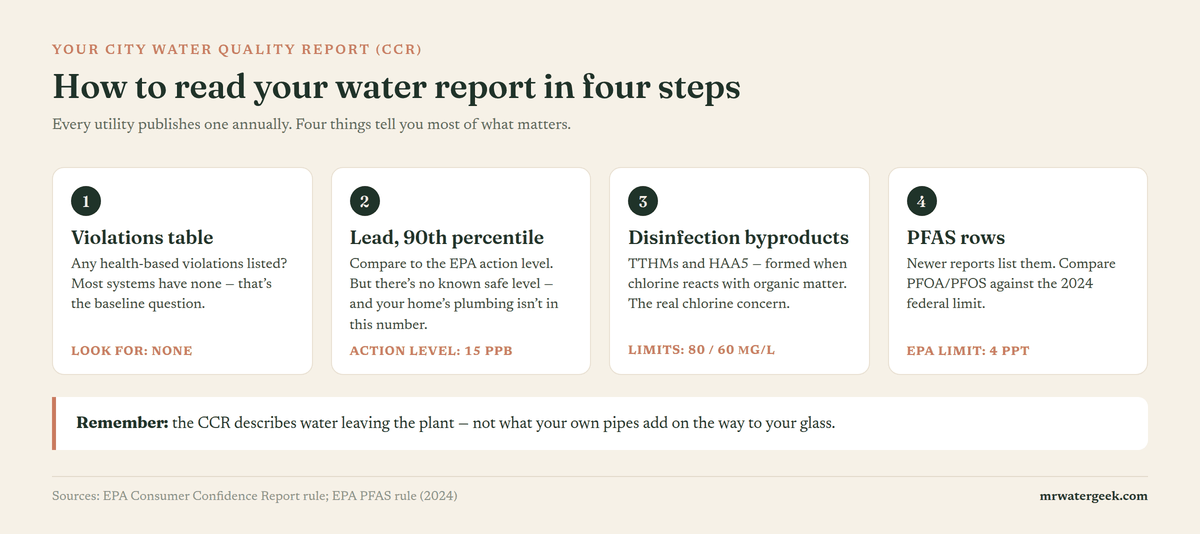
The gap between MCL and MCLG is where the interesting information lives. Take lead: the MCLG is zero — the EPA says there’s no safe level of lead exposure. But the MCL equivalent (technically an “action level” for lead) is 15 parts per billion — a number regulators set based on what was enforceable given U.S. plumbing infrastructure, not on what’s safe. Under the EPA’s Lead and Copper Rule Improvements, that action level drops to 10 ppb effective November 1, 2027. A report that says “no violation” for lead means your utility’s 90th-percentile sample came in below 15 ppb. (That threshold falls to 10 ppb in November 2027.) It doesn’t mean your water is lead-free.
[What’s actually in your tap water? →](https://mrwatergeek.com/water-quality/) Check your zip code. The gap between the legal limit and the health goal is where most people’s real questions start.
Which contaminants should you actually pay attention to?
Not everything on a CCR is equally worth your attention. Some contaminants — turbidity, total coliform — are process-control indicators that your utility manages continuously. If they’re in violation, you’ll usually hear about it through a boil-water advisory before you ever read a report.
The contaminants worth reading carefully are the ones with chronic, low-level health implications. In rough order of prevalence and concern:
Lead. No safe level. Millions of lead service lines still connect homes to water mains. Your CCR shows system-wide results; your actual exposure depends on your specific plumbing. If your home was built before 2014, or your neighborhood has older infrastructure, a first-draw test at your kitchen tap is worth more than the CCR number. (Source: EPA, Lead and Copper Rule.)
Disinfection byproducts (THMs and HAAs). These form when chlorine reacts with organic matter in distribution pipes. The EPA regulates total THMs at 80 ppb and HAAs at 60 ppb. A 2025 meta-analysis in *Environmental Health Perspectives* found that people in the highest THM-exposure group were roughly 1.5× more likely to develop bladder cancer than those in the lowest-exposure group. Your CCR will list these — check both the detected level and the MCLG, which for several THMs is zero. We cover this in detail in our chlorine byproducts guide.
Nitrate. Mostly a concern in agricultural areas and for homes on well water. The MCL is 10 mg/L. Above that level, nitrate can cause methemoglobinemia in infants — “blue baby syndrome.” If your CCR shows nitrate above 5 mg/L, pay attention to the trend across years.
PFAS. The EPA’s 2024 rule set enforceable limits at 4 ppt for PFOA and PFOS. But here’s the thing — your 2025 or 2026 CCR may not include PFAS data yet. The compliance deadline for utilities was originally 2029; the EPA has now proposed extending it to 2031 for systems that request an exemption. Until your utility starts testing, the CCR is silent on PFAS. That’s not the same as “no PFAS.” A USGS study estimated at least 45% of U.S. tap water contains one or more PFAS compounds.
Chromium-6 (hexavalent chromium). Not yet federally regulated as a separate contaminant — the EPA regulates “total chromium” at 100 ppb, which doesn’t distinguish between the harmless trivalent form and the carcinogenic hexavalent form, chromium-6. Some CCRs include it voluntarily. California set a state-level standard. If you’re concerned, third-party testing is the only way to know.
Arsenic. MCL is 10 ppb. MCLG is zero. Found naturally in groundwater in parts of the Southwest, Upper Midwest, and New England. If your CCR shows any detection above zero, it’s worth knowing whether your area has geological arsenic.
Not sure what’s in your water?
Check your ZIP code — free, takes 30 seconds.
What does “no violation” actually mean?
It means your utility’s testing didn’t exceed the legal MCL during the reporting period. Useful starting point — but not the same as “nothing to worry about.”
The CCR tests water in the distribution system — at the plant and at select sampling points in the network. It does not test what comes out of your specific faucet, through your specific plumbing. That last stretch is where lead contamination typically happens, where copper levels can spike, and where stagnant water in dead-leg pipes can harbor bacteria.
The Flint crisis is the extreme example, but smaller versions of that gap exist everywhere. A CCR that reads “no violation” for lead means the system’s 90th-percentile sample was below 15 ppb. It doesn’t account for your building’s internal plumbing, your faucet’s age, or whether your water sat in brass overnight.
What won’t the CCR tell you?
Several things your report can’t or won’t cover:
In-home plumbing. The CCR tests the distribution system, not individual homes. Everything between the water main and your faucet — service lines, interior pipes, solder joints, the fixture itself — is outside the report’s scope.
PFAS (in most systems). Until utilities begin mandatory testing under the 2024 rule, PFAS won’t appear in your CCR. The EPA has also proposed rescinding regulations for PFHxS, PFNA, and GenX — so even when testing starts, it may not cover all PFAS compounds.
Microplastics. No federal standard exists. No testing is required. They won’t appear in any CCR.
Emerging contaminants. Pharmaceutical residues, personal care product compounds, 1,4-dioxane — these show up in third-party testing (like the EWG database) but not in the legally mandated report.
Real-time fluctuations. The CCR summarizes data from the prior calendar year. Water quality varies seasonally, after heavy rain, and during distribution system maintenance. What you’re drinking today might differ from the annual average.
How do you know if you need a water filter?
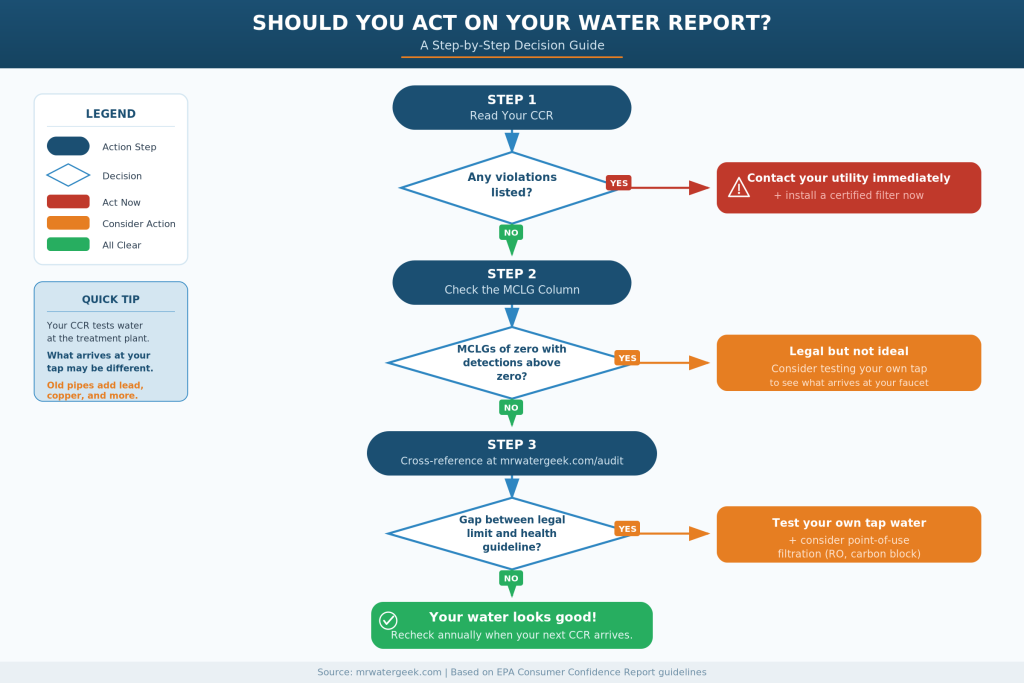
A simple framework, in order:
Step 1: Read your CCR. If anything shows a violation or is trending close to the MCL, you have a clear signal.
Step 2: Check the MCLG column. If the MCLG is zero (lead, several THMs, chromium-6) and your detected level is any number above zero, that tells you the EPA considers no amount safe. The MCL is a compromise, not a health clearance.
Step 3: Cross-reference with [mrwatergeek.com/water-quality](https://mrwatergeek.com/water-quality).This benchmarks your zip code’s data against health-based guidelines — not just legal limits. The gap between those two numbers is where most real decisions start.
Step 4: Test your own tap. A home water test kit or a lab test from a service like Tap Score tells you what’s happening at your faucet — not the system average. A first-draw test (water that sat overnight) is especially revealing for lead.
Step 5: Match the contaminant to the technology. If testing reveals a specific concern — lead, PFAS, chlorine byproducts — the right filter depends on the right certification. NSF/ANSI 53 for lead, NSF/ANSI 53 or 58 for PFAS, NSF/ANSI 42 for chlorine taste. We break down the specifics for lead, fluoride, and chlorine byproducts in separate guides.
If your CCR looks clean and your home test comes back clean, you may not need a filter at all. That’s an honest answer. Spend the money on something else.
How can you test your water at home without a lab?
Before you spend anything, there are a few things you can observe without equipment:
Run the cold tap first thing in the morning and watch the color. If the first few seconds run slightly yellow, orange, or brown, that’s iron or corroded pipe material — common in older homes, and a sign your plumbing is contributing something the CCR doesn’t capture.
Smell the water. A swimming-pool smell is chlorine — normal, and mostly a taste issue. A rotten-egg smell is hydrogen sulfide — common in well water and some municipal systems. A musty or earthy smell could be algae-related compounds in the source water. None of these are necessarily dangerous, but they do indicate your water isn’t as “clean” as it looks.
Check for white residue on faucets and around drains. That’s mineral scale from hard water. Hardness isn’t a health issue — it’s a maintenance and taste issue. Your CCR will list hardness in mg/L or grains per gallon (GPG). Above 7 GPG is considered hard. Above 10.5 GPG is very hard.
Fill a clear glass and hold it up to light. Cloudiness (turbidity) can mean anything from air bubbles (harmless — let it sit for a minute and see if it clears) to sediment (worth investigating).
A $15 TDS meter tells you the total dissolved solids in your water — minerals, salts, metals — but not which ones. A TDS reading doesn’t tell you whether your water is safe. It tells you whether it’s mineral-heavy. A reading of 50–150 ppm is typical for municipal water. Above 300 starts to affect taste. The WHO considers up to 600 acceptable for drinking.
Your utility publishes a report every year that tells you more about your water than most people realize. The problem isn’t that the information isn’t available — it’s that it’s buried in jargon and legal minimums. Once you learn to read the gap between what’s legal and what’s ideal, the decision about whether and how to filter stops being a marketing question and starts being an informed one. If your report flags one thing, it’s usually lead — that’s the contaminant with no safe level and the widest gap between “legal” and “ideal.” That’s the one we take apart next: where it actually comes from, and which certifications actually remove it.
[Your water tells a story. Find out what’s actually in it. →](https://mrwatergeek.com/water-quality/)Check your zip code at mrwatergeek.com/water-quality
Frequently asked questions about city water quality reports
How do I find my city’s water quality report? Search “[your city name] water quality report” — most utilities post their Consumer Confidence Report online as a PDF. You can also use the EPA’s CCR search tool or check the EWG Tap Water Database by zip code. Starting in 2027, utilities serving more than 10,000 people will be required to deliver these reports twice a year instead of once. (Source: EPA, CCR Rule Revisions.)
What does MCL mean on a water quality report? MCL stands for Maximum Contaminant Level — the highest concentration of a contaminant legally allowed in drinking water. It’s an enforceable standard. The MCLG (Maximum Contaminant Level Goal) is the health-based target — often lower than the MCL, and for some contaminants like lead, set at zero. If your water is below the MCL but above the MCLG, it’s legal but not necessarily optimal. (Source: EPA, National Primary Drinking Water Regulations.)
Does “no violation” mean my water is safe? It means your utility’s testing didn’t exceed EPA legal limits during the reporting period. The report tests water in the distribution system — not at your individual tap. In-home plumbing, the age of your faucet, and how long water sat in your pipes overnight all affect what you actually drink. A home water test gives you a more complete picture. (Source: EPA.)
Why doesn’t my water report include PFAS? Most utilities haven’t started mandatory PFAS testing yet. The EPA’s 2024 rule set enforceable limits for PFOA and PFOS at 4 parts per trillion, but the compliance deadline has been proposed for extension to 2031. Until testing begins, the absence of PFAS data doesn’t mean the absence of PFAS. (Source: EPA, PFAS drinking water regulation.)
How often is my water tested? It depends on the contaminant and the size of your water system. Some contaminants (like coliform bacteria) are tested monthly. Others (like synthetic organic chemicals) may be tested once every three years. Your CCR covers the previous calendar year’s results. (Source: EPA, Consumer Confidence Report Rule.)
Should I test my own water at home? If you have concerns about lead (especially in homes built before 2014), or if your CCR shows contaminants near the MCL, a home water test is worth the investment. First-draw testing — collecting water that sat in your pipes overnight — is the most revealing method for lead. Services like Tap Score can test for a broad panel including PFAS. (Sources: EPA; CDC.)
About the author: Shashank — 9 years at Kohler building water filtration. Mr Water Geek translates water science into clear decisions.
Your water tells a story. Find out what’s actually in it.
Free report by ZIP →