This guide explains how to choose a water filter that actually removes lead from drinking water. It covers the four filtration approaches with independently verified lead reduction — activated carbon block, reverse osmosis, KDF media, and ion exchange paired with advanced carbon — the NSF certifications that verify performance, and practical steps for testing your water and selecting the right filter for your home.
Key Takeaways — Which lead filter should you buy?
If your water tests positive for lead, install an under-sink filter certified to NSF/ANSI Standard 53 for lead. A carbon block system is the simplest option — proven performance (99%+), reasonable cost ($150–$350), minimal maintenance. For broader protection, multi-stage systems pairing ion exchange with advanced carbon handle lead through two independent removal pathways while also addressing chlorine, VOCs, and sediment. If your water shows multiple contaminants beyond lead — PFAS, arsenic, nitrates — a reverse osmosis system handles the full profile but wastes water and strips minerals. Before buying anything: test your water first. Lead contamination is hyper-local — your neighbor’s results don’t apply to your home.
Free · 30 seconds
Worried about lead? Start with your water, not a product.
Look up your utility’s lead results by ZIP code.
How does lead get into your water?
There is no safe level of lead in drinking water. That’s the position of the EPA, the CDC, and the WHO. The EPA’s MCLG for lead is set at 0 because any exposure carries risk. The federal mandate to replace all lead service lines was signed in 2024 and won’t be completed for another decade — and even after your service line is replaced, the plumbing inside your home can still contribute lead.
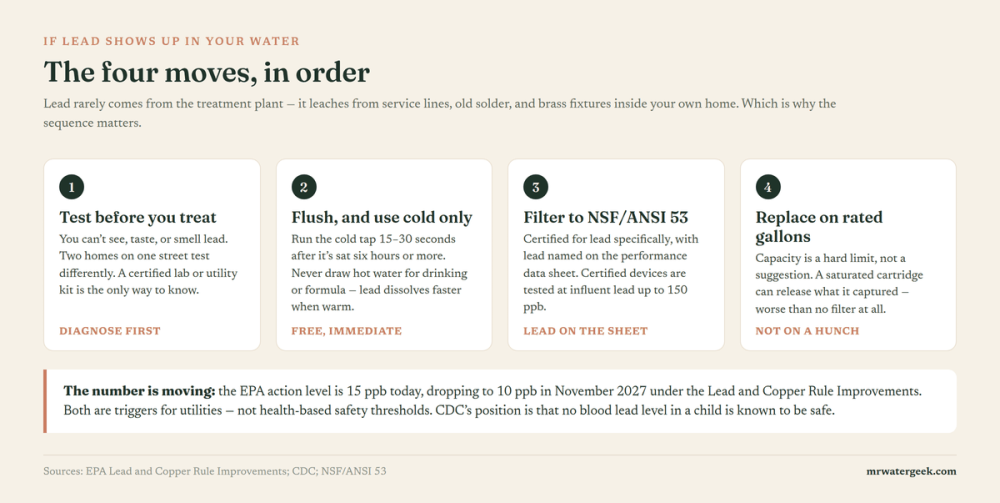
Lead contamination almost never starts at the treatment plant. Municipal water treatment handles source water effectively. The problem is what happens in the infrastructure between the plant and your faucet — and the faucet itself.
Lead service lines are the pipes connecting the water main under the street to your building’s plumbing. The EPA estimates millions of them are still made of lead, mostly installed before 1950. The 2024 Lead and Copper Rule Improvements mandate their replacement over 10 years, but that timeline depends on utility-by-utility implementation. If your home has a lead service line, every gallon of water you drink passed through it.
Lead solder was standard practice for joining copper pipes until Congress banned it in 1986 under the Safe Drinking Water Act amendments. Any home built before that year may have lead solder at dozens of joint connections throughout its plumbing. Even after 1986, the “lead-free” designation allowed up to 0.2% lead in solder — not zero.
Brass fixtures and fittings. This is the one almost nobody thinks about. Most kitchen faucets are brass — an alloy that, from 1986 until 2014, could legally be sold as “lead-free” while still containing up to 8% lead. The Reduction of Lead in Drinking Water Act (effective 2014) dropped the “lead-free” threshold to 0.25% weighted average — a major improvement, but not zero. And even new “lead-free” faucets can leach detectable amounts of lead during their first weeks of use. Your faucet is the last thing your water touches before you drink it. It deserves more scrutiny than it gets.
Water chemistry accelerates the problem. Lead doesn’t dissolve at a constant rate. Acidic water (low pH) and soft water (low mineral content) are more corrosive to metal fixtures and pipes. This is the dynamic that drove the Flint crisis — switching water sources changed the chemistry, accelerated corrosion, and lead levels spiked. You can live in a city with excellent water treatment and still have lead at your tap because of what’s happening in your building’s own plumbing.
Why don’t standard pitcher filters work for lead?
This is one of the most common misconceptions in water filtration. Most pitcher filters use granular activated carbon (GAC) — loose particles of carbon that water flows through inside a small cartridge. GAC works fine for chlorine taste and odor. It’s inconsistent for lead.
The issue is contact time and channeling. In a gravity-fed pitcher, water finds the path of least resistance through the loose granules. Some water gets extended contact with the media. Other water channels through gaps with minimal contact. The result is inconsistent performance — lead reduction that might test at 80% one pour and 40% the next.
Some higher-end pitcher filters carry NSF 53 certification for lead, which means they met the standard under controlled test conditions. But real-world performance in a pitcher — where flow rates, temperatures, and usage patterns vary — is less predictable than in a plumbed-in system.
This doesn’t mean pitchers are useless. A certified pitcher is better than nothing. But if lead is a serious concern based on your test results, an under-sink or faucet-mount system gives you more reliable performance where it matters most — at the tap where you actually fill glasses and cook.
What water filters actually remove lead?
Four approaches have solid, independently verified track records for lead removal. They work through different mechanisms, at different price points, with different trade-offs.
Does a carbon filter remove lead?
Carbon block filters compress activated carbon into a dense, solid block. Unlike loose granular carbon, there are no channels or gaps — water is forced through a uniform path at controlled flow rates. The combination of adsorption (lead ions binding to carbon surfaces) and mechanical filtration (particles caught by the tight pore structure) produces consistent lead reduction.
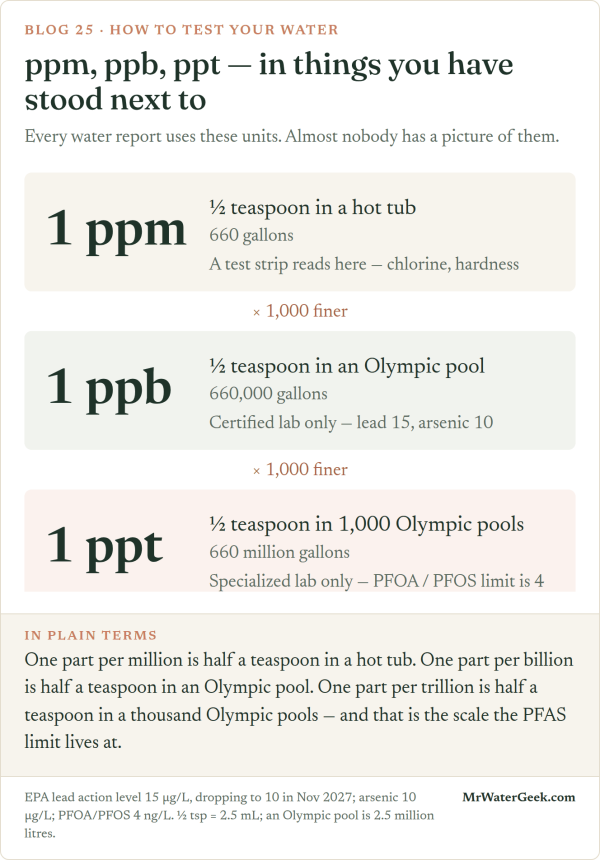
Quality carbon block filters certified to NSF 53 regularly demonstrate 99%+ lead reduction. Some are tested at challenge concentrations of 150 ppb — ten times the EPA action level of 15 ppb (and fifteen times the 10 ppb level coming in 2027) — which gives you confidence in the performance margin as the filter ages.
Carbon block is the technology inside most under-sink and faucet-mount lead filters. It handles lead effectively while also reducing chlorine, some VOCs, and sediment. It doesn’t strip minerals the way reverse osmosis does, so the water retains its natural taste profile.
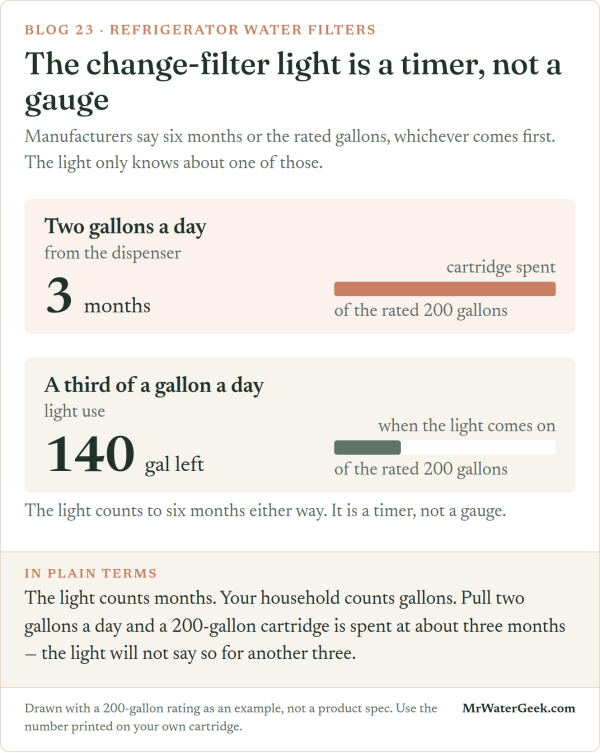
The main limitation is capacity. Carbon block filters have a defined lifespan — typically 6–12 months or a specific gallon rating, whichever comes first. As the carbon becomes saturated with contaminants, lead reduction drops. Replacing the cartridge on schedule isn’t optional.
Does reverse osmosis remove lead?
Reverse osmosis pushes water through a semipermeable membrane with pores small enough to block most dissolved contaminants, including lead ions. It’s the most comprehensive residential filtration technology available — lead, PFAS, arsenic, heavy metals, dissolved solids, and most other contaminants are reduced simultaneously. Lead reduction from quality RO systems typically exceeds 99%.
The trade-offs are real. RO produces wastewater — typically 3–4 gallons discarded for every 1 gallon filtered, though newer systems have improved this ratio. RO also strips beneficial minerals (calcium, magnesium, potassium), which changes the taste — many people describe RO water as flat. Some systems add a remineralization stage to address this. RO systems are more expensive ($200–$500+), require a storage tank under the sink, and often need a dedicated faucet.
For someone whose only concern is lead, RO is probably more system than they need. But if your water test shows multiple contaminants — lead plus PFAS, lead plus arsenic, lead plus nitrates — RO handles the full profile in one system.
Does KDF media remove lead?
KDF uses a granular copper-zinc alloy that removes lead through electrochemical reduction — a redox reaction that converts dissolved lead into an insoluble form trapped in the media bed. It’s a fundamentally different mechanism than adsorption (carbon) or physical barrier (RO).
KDF is rarely used as a standalone lead treatment. You’ll most often find it as one stage in a multi-stage under-sink system, typically paired with carbon block. The combination is effective — KDF handles lead and heavy metals through redox while carbon block handles chlorine, VOCs, and provides a secondary lead reduction pathway. Systems from brands like Springwell and Aquasana use variations of this multi-stage approach.
Does ion exchange remove lead?
Ion exchange and KDF rarely stand alone for lead — you’ll usually find them as one stage in a multi-stage system, paired with carbon block so lead removal doesn’t depend on a single mechanism. Instead of relying on a single removal mechanism, these systems layer two complementary technologies in sequence.
Ion exchange media uses specialized resin beads with a strong selective affinity for lead and other heavy metals. As water passes through, dissolved lead ions swap places with harmless ions (typically sodium or potassium) on the resin surface. It’s the same fundamental chemistry as a salt-based water softener, but the resin is engineered specifically for heavy metal selectivity rather than calcium and magnesium removal. The result is targeted, high-capacity lead reduction through chemical binding — not just physical filtration.
Advanced activated carbon follows the ion exchange stage and handles the broader contaminant profile: chlorine, chloramine, VOCs, sediment, and organic compounds that affect taste and odor. The carbon also provides a secondary lead reduction pathway through adsorption, which means lead removal doesn’t depend on a single mechanism. If the ion exchange resin’s capacity starts to degrade toward the end of its life, the carbon stage is still catching what gets through.
The practical advantages over RO are significant. No wastewater — every gallon that goes in comes out filtered. No mineral stripping — the water retains calcium and magnesium, so it tastes normal and doesn’t become corrosive downstream. No storage tank required. Flow rates are typically higher than RO. And the system can be built compact enough to fit inside a faucet-mount or small under-sink housing.
The trade-off is narrower contaminant coverage compared to RO. Ion exchange + carbon handles lead, heavy metals, chlorine, VOCs, and sediment effectively. It doesn’t handle dissolved salts, nitrates, or fluoride the way RO does. For most households where lead is the primary concern, that trade-off works in its favor — you get robust lead removal without the complexity and waste of a membrane system.
Does distillation remove lead?
Yes. Distillation boils water to steam and condenses it back, leaving lead and most contaminants behind. It’s highly effective but impractical as a primary source for most homes — slow, energy-intensive, small batches, and it strips minerals (flat taste), like RO. Best for specific situations, not everyday whole-household use.
What do NSF 53 and NSF 58 certifications actually prove?
The certification on the box matters more than the marketing copy. Two NSF standards are relevant:
NSF/ANSI Standard 53 (Health Effects) is the primary certification for lead reduction. It verifies that a filter reduces lead from a challenge concentration of 150 ppb to 5 ppb or lower under specified flow and capacity conditions. (NSF lowered this pass threshold from 10 ppb to 5 ppb effective 2020, matching Health Canada’s limit and the FDA’s bottled-water standard.) If a filter has NSF 53 certification for lead, it has been independently verified by a third-party lab. This is the minimum standard you should look for.
NSF/ANSI Standard 58 (Reverse Osmosis) covers RO systems and includes lead along with a comprehensive contaminant panel. If your RO system has NSF 58 certification, lead reduction has been independently verified as part of the broader testing.
What to watch out for: Manufacturers sometimes claim their filter “reduces lead” or is “tested for lead” without carrying NSF 53 or 58 certification. “Tested” doesn’t mean “certified.” Testing can be done in-house, under favorable conditions, for a limited number of samples. Certification requires independent third-party testing under standardized conditions, ongoing production audits, and annual retesting. You can verify any product’s certification on NSF’s website directly — it takes 30 seconds.
Not sure what’s in your water?
Check your ZIP code — free, takes 30 seconds.
How can you tell if lead is a problem in your home?
This is the part product pages skip. Before you buy anything, here’s how to actually find out whether lead is in your water.
Check your home’s age. If it was built before 1986, lead solder is likely in the plumbing. Before 1950, lead service lines are a possibility. Before 2014, lead-containing brass fixtures were standard.
Look up your service line. Many utilities now maintain public databases where you enter your address and see what your service line is made of. If yours is listed as lead or unknown, that’s actionable information. The EPA’s Lead and Copper Rule now requires utilities to complete these inventories.
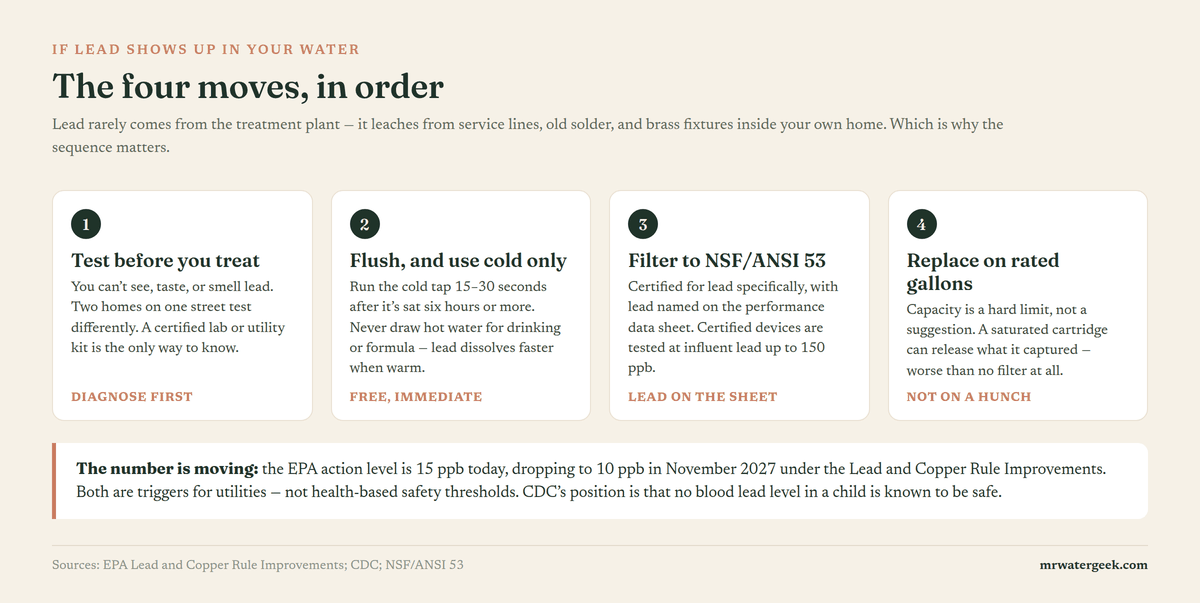
Run a first-draw test. Collect water that’s been sitting in your pipes for at least 6 hours — overnight is ideal. This captures the highest lead concentration from pipe and fixture contact. Most utilities offer free or low-cost lead testing kits. You can also order from a state-certified lab ($20–$50) or use a home water test kit for a preliminary reading.
Compare your result to the right number. The EPA’s action level is 15 ppb — a regulatory trigger for utilities, not a health threshold — and the 2024 Lead and Copper Rule Improvements lower it to 10 ppb effective November 2027. The health-based goal (MCLG) is zero. Many households with results in the 1–15 ppb range still choose to install a filter, especially with young children or pregnant women in the home. That’s a reasonable decision.
What should you do if your water has lead?
What to do while you wait for results
If you have reason to believe lead is present — pre-1986 home, known lead service line, utility advisory — flush your cold water for 2–3 minutes before using it for drinking or cooking. This clears standing water that’s been in contact with lead pipes and fixtures. Use cold water only for cooking and drinking — hot water dissolves lead faster.
If your results come back elevated
Above 15 ppb: Install a point-of-use filter with NSF 53 certification. An under-sink carbon block is the most practical single-stage option. A multi-stage system pairing ion exchange with advanced carbon gives you redundant lead removal through two pathways — stronger protection without RO’s wastewater and mineral stripping. If levels are significantly elevated (above 40–50 ppb) or you have multiple contaminants, consider RO for the broadest coverage, and contact your utility about your service line status.
Above 0 but below 15 ppb: The EPA action level is a regulatory trigger, not a health benchmark. There is no safe level. A filter is still a reasonable investment — especially where children drink the water.
Which type of water filter is best for lead removal?
Under-sink carbon block is the best fit for most households. Installed below the sink, plumbed into the cold water line, connected to the existing faucet or a dedicated filtered faucet. Consistent performance, reasonable cost ($150–$350 for the system, $40–$80 per replacement cartridge), and minimal daily effort — you just use your faucet normally.
Faucet-mount filters attach directly to the faucet spout. Less expensive ($25–$60), no installation beyond screwing onto the faucet. NSF 53-certified options exist and work acceptably for lead, though smaller cartridges mean shorter lifespans and lower total capacity. A good entry point if you’re renting or don’t want to modify plumbing.
Multi-stage ion exchange + carbon systems are the middle ground between a standalone carbon block and full RO. You get redundant lead removal through two independent mechanisms, plus broad filtration for chlorine, VOCs, and sediment — without the wastewater, mineral stripping, or storage tank that RO requires. These systems fit in compact under-sink housings and some faucet-mount formats. For households where lead is the primary concern and you want more protection than a single carbon block provides, this is the category to look at.
Reverse osmosis systems make sense when your water test shows lead plus contaminants that other approaches don’t handle well — arsenic, nitrates, high TDS, PFAS. Higher cost ($200–$500+) and complexity (tank, drain line, dedicated faucet, wastewater), but you’re solving the broadest possible contaminant profile in one installation.
Whole-house systems are rarely necessary for lead specifically. Lead contamination is usually localized to the last stretch of plumbing — your service line and your building’s internal pipes. A whole-house filter treats water before it enters your plumbing, which means it’s upstream of where lead typically enters. Point-of-use at the faucet is more logical and more cost-effective.
How do you read a filter’s lead spec sheet?
Beyond the NSF mark, a few numbers tell you how a filter will perform in your home:
Challenge concentration — the lead level the filter was tested against. NSF 53 requires 150 ppb. Higher challenge concentrations give you more confidence in the margin of safety.
Effluent concentration — how many ppb remain after filtration. The NSF 53 pass threshold is 5 ppb or lower (lowered from 10 ppb in 2020). This matters more than the reduction percentage. This matters more than the reduction percentage.
Rated capacity — how many gallons before lead reduction drops below certified levels. A filter rated for 750 gallons at 3 gallons/day lasts roughly 8 months. Don’t extend past this number — lead reduction degrades as media saturates.
Flow rate — measured in GPM. Slower flow rates generally produce better lead reduction because of longer contact time. Under-sink systems typically run at 0.5–0.75 GPM, which is fine for filling a glass but noticeably slower than unfiltered flow.
FAQ
What is the best water filter for lead removal? For most households, an under-sink filter with NSF 53 certification for lead. A carbon block system is the simplest option at 99%+ reduction. Multi-stage systems combining ion exchange with advanced carbon provide redundant lead removal through two independent pathways — stronger protection without the wastewater or mineral stripping of RO. Reverse osmosis is the most comprehensive option if you need to address contaminants beyond what carbon and ion exchange handle (arsenic, nitrates, fluoride).
Do Brita filters remove lead? Some Brita pitcher filters carry NSF 53 certification for lead — specifically, the Elite filter (formerly Longlast+). Standard Brita filters (white cartridge) are certified for chlorine taste and odor only. Check the specific filter model’s certifications, not just the brand name.
Does boiling water remove lead? No. Boiling actually concentrates lead by evaporating water while the lead stays behind. Never boil water as a strategy for lead contamination.
How often should I replace my lead water filter? Follow the manufacturer’s rated capacity — typically 6–12 months or a specific gallon count. Lead reduction degrades as filter media becomes saturated. Extending past the rated lifespan means reduced performance exactly when you’re relying on it most.
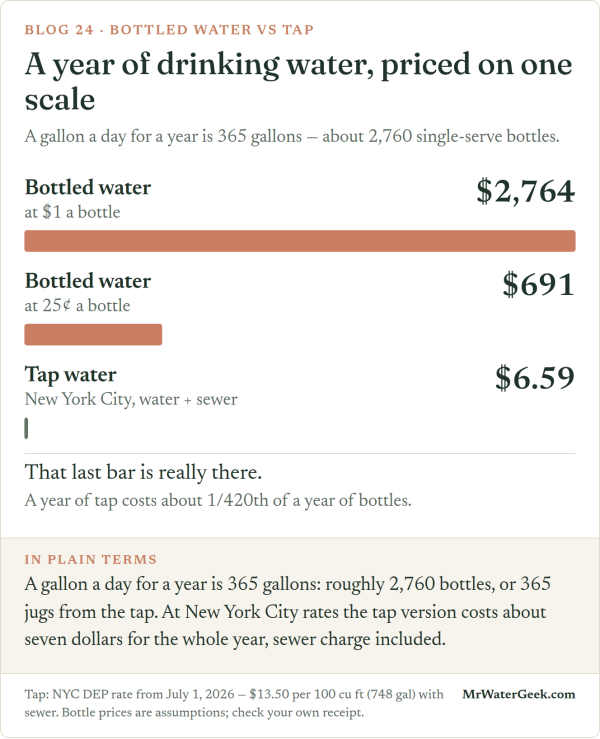
Is bottled water safer than tap water for lead? Bottled water is regulated by the FDA at a lead limit of 5 ppb — tighter than the EPA’s 15 ppb action level. But bottled water has its own concerns — microplastic content, environmental impact, inconsistent testing frequency, cost. A quality under-sink filter produces reliably lead-free water at a fraction of the per-gallon price.
Does the EPA’s Lead Pipe Replacement Rule solve this problem? The 2024 rule mandates replacement of all lead service lines within 10 years. That’s significant. But the timeline is long, enforcement is utility-by-utility, and the rule doesn’t address lead solder inside your home’s plumbing or lead in brass fixtures. Point-of-use filtration remains relevant even after your service line is replaced.
Your faucet is the last thing your water touches — and right now, no residential faucet on the market is designed to make that water safer. The technology exists. Ion exchange and advanced carbon filtration are proven at the point of use. But the industry builds fixtures to deliver water, not to protect it. What if filtration wasn’t something you bolted onto your plumbing, but something your faucet handled on its own? That’s a gap worth thinking about — and it’s one we’ll be examining closely.
About the author: Shashank — 9 years at Kohler building water filtration. Mr Water Geek translates water science into clear decisions.
Your water tells a story. Find out what’s actually in it.