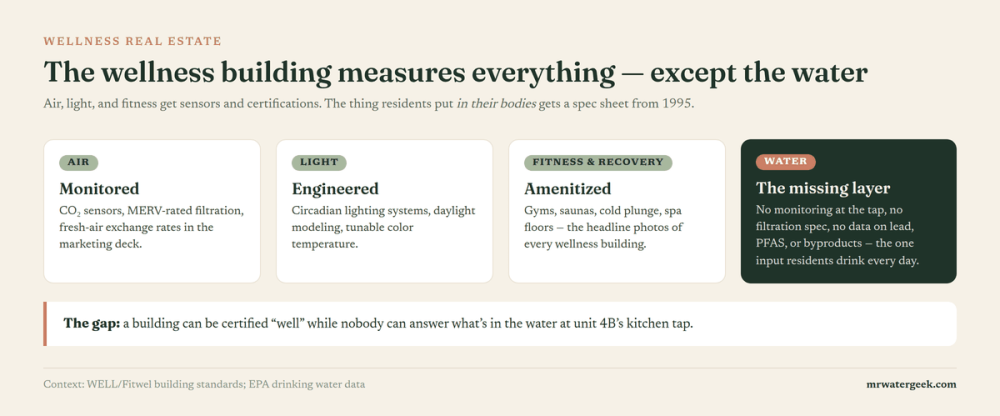
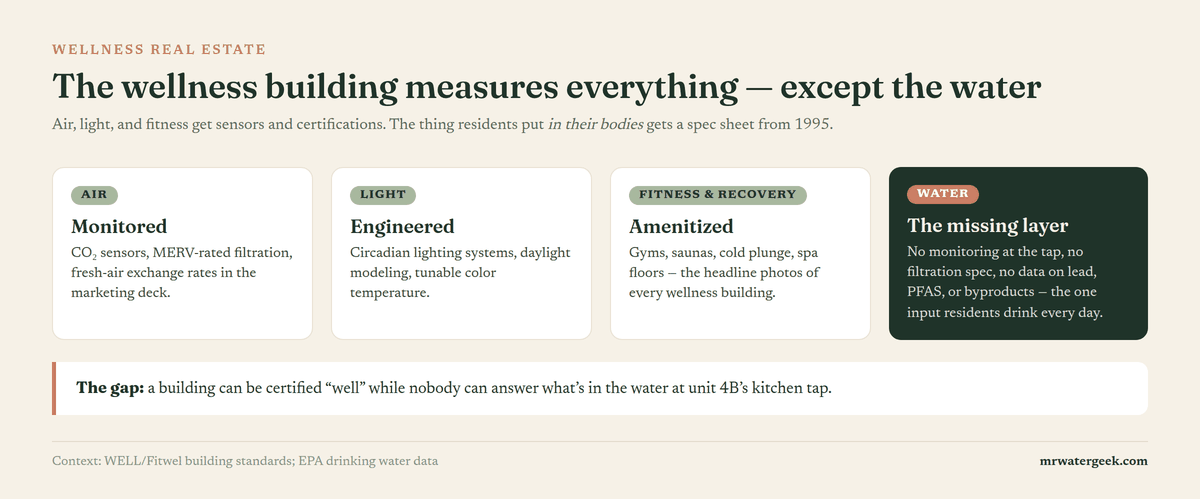
The wellness building industry — WELL-certified condos, Equinox residences, Delos-designed interiors — has gotten remarkably good at controlling the air you breathe, the light you see, and the materials that surround you. A $584 billion market in 2024, forecast to double to $1.1 trillion by 2029. But walk into almost any premium “wellness residence” in America, turn on the kitchen faucet, and you’re drinking the same municipal water as the apartment building next door — delivered through the same brass fixture that hasn’t fundamentally changed in 40 years.
Key Takeaways
Wellness buildings engineer air, light, and materials — but the kitchen faucet is still specced by finish and flow rate, not by what it does to the water. Nobody tests what comes out of your specific tap, through your specific plumbing. Start with your water quality report or a zip code check before spending anything — the gap between the legal limit and the health-based guideline is where the real signal lives.
You probably think carefully about what you eat. Maybe you read nutrition labels, buy organic when it matters, have opinions about processed food. Now think about the thing you consume more of than anything else, every single day — water. The gap between how seriously people treat food and how casually they treat the water coming out of their kitchen tap is enormous. And the wellness industry, for all its sophistication, has the same blind spot.
Free · 30 seconds
What’s actually in your tap water?
Your utility’s real numbers — free, by ZIP code.
Check my ZIP →What does the wellness building movement actually get right?
Give them credit — these buildings are much better than your standard apartment or office. The WELL Building Standard, developed by the International WELL Building Institute and backed by Delos, addresses ten categories of building performance: air, water, nourishment, light, movement, thermal comfort, sound, materials, mind, and community. Projects like 35 Hudson Yards in Manhattan (home to Equinox Hotel residences) market “ducted fresh air with multiple filtration points,” low-VOC materials, green cleaning protocols, and biophilic design. The Fitwel and RESET standards take similar approaches.
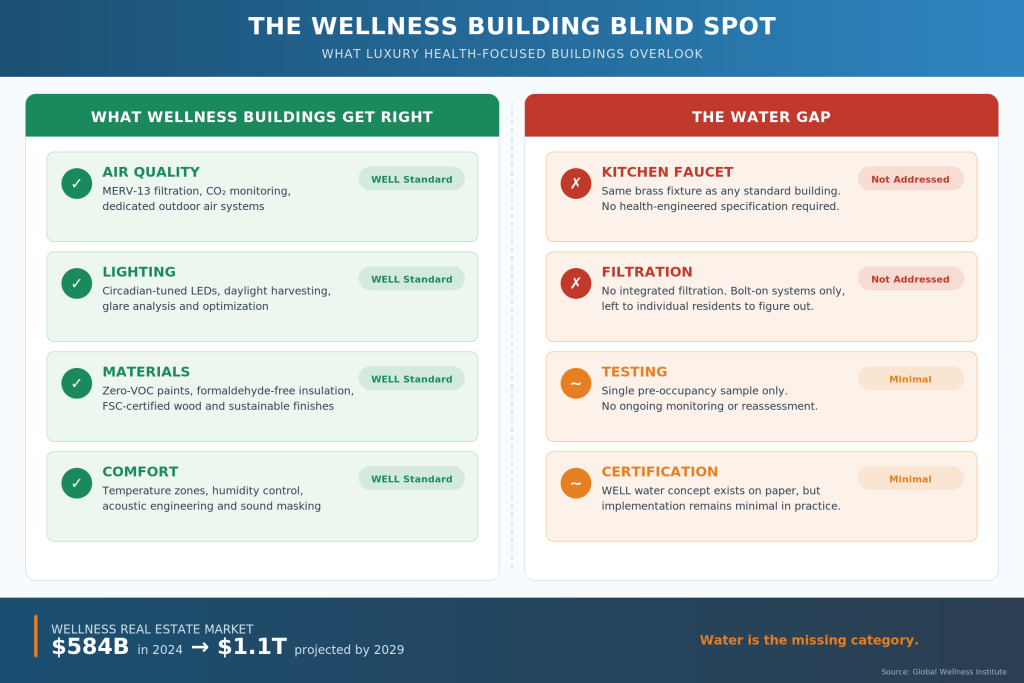
The air quality engineering in these buildings is legitimately impressive. MERV-13 filtration, CO2 monitoring, dedicated outdoor air systems, VOC testing of finish materials before occupancy — these are measurable, verifiable improvements over conventional construction. Light design has come equally far: circadian-tuned LED systems, daylight-harvesting controls, glare analysis. Materials science: formaldehyde-free insulation, zero-VOC paints, FSC-certified wood.
These aren’t marketing fictions. They’re real engineering decisions that affect health outcomes. The Air concept alone spans filtration, ventilation, contaminant management, and microbe control across more than a dozen features. Buildings that earn these certifications are materially different from conventional construction.
So when I say they have a blind spot, I’m not dismissing the work. I’m saying there’s one category where the engineering stops and the marketing takes over.
Where does water get left behind?
The WELL Building Standard does have a Water concept. It requires testing for turbidity, coliform bacteria, lead, and a list of regulated contaminants. It sets a lead threshold in the range of 5–10 µg/L — tighter than the EPA’s current action level of 15 ppb. On paper, it looks thorough.
In practice, here’s what typically happens: a developer installs the same plumbing fixtures they’d use in any Class A building, runs a water test at a single sampling point before occupancy, and checks the WELL water box. The faucet itself — the last thing the water touches before it reaches a resident’s glass — is specced the same way it’s been specced for decades: by finish, flow rate, and price point. Not by what it does to the water passing through it.
There’s a structural reason for this. In commercial and residential development, the plumbing spec is driven by the mechanical engineer and the plumber, not by the wellness consultant. The air system gets a dedicated design engineer. The lighting gets a circadian consultant. The water? The plumber picks the fixtures from the approved submittal list, the GC installs them, and nobody asks what’s happening at the molecular level between the supply pipe and the glass.
The incentive structure reinforces this. Air quality improvements are visible in marketing materials — “MERV-13 filtration” sounds impressive to a buyer who’s read about indoor air quality. Water quality improvements are invisible. You can’t photograph clean water. A buyer touring a $3 million wellness condo isn’t thinking about whether the kitchen faucet contains lead-bearing brass or whether the water that sat in it overnight leached anything detectable.
Not sure what’s in your water?
Check your ZIP code — free, takes 30 seconds.
What would “wellness water” actually look like?
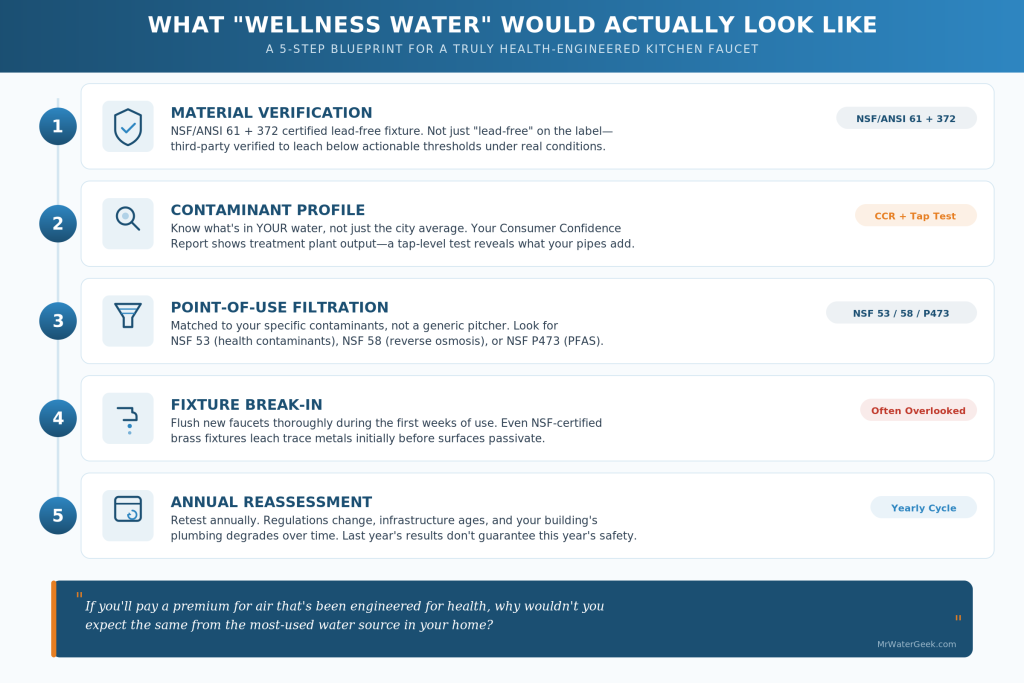
If you applied the same engineering rigor to a kitchen faucet that WELL-certified buildings apply to HVAC systems, you’d want to know a few things.
What’s the fixture made of — really? Most kitchen faucets are brass. From 1986 until 2014, “lead-free” brass could still contain up to 8% lead. The current standard (effective 2014) limits lead to a weighted average of 0.25% on wetted surfaces. That’s a massive improvement — and it’s still not zero. The NSF/ANSI 61 standard was revised in 2024 to tighten lead leaching limits to 1 microgram for faucets — five times more protective than before. Even compliant fixtures leach small amounts when new. [Cite: EPA; NSF/ANSI 61 & 372.]
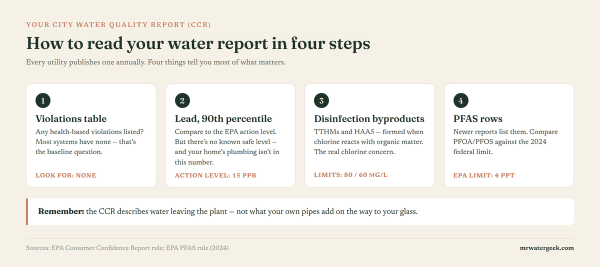
What’s in the water before it reaches the fixture? Your utility’s Consumer Confidence Report tests water at the plant and at select distribution points — not at your tap. The gap between those locations is where lead contamination, disinfection byproducts, and pipe-related contaminants accumulate. A 2025 meta-analysis in Environmental Health Perspectives found that people in the highest THM-exposure group were roughly 1.5× more likely to develop bladder cancer than those in the lowest-exposure group — and THMs form in the distribution pipes, not at the treatment plant.
Is the fixture doing anything about it? In almost every building — wellness-certified or not — the answer is no. A faucet delivers water. It doesn’t treat it. No standard kitchen faucet includes any form of filtration. If a building wants point-of-use water treatment, it’s a separate system plumbed in under the sink — a bolt-on, not an integrated feature.
That’s the blind spot. The wellness building industry has made air, light, and materials into engineered health systems. Water is still treated as plumbing.
Why does this matter beyond luxury buildings?
This isn’t just a problem for people buying $3 million condos. The disconnect between how we think about water and how we think about other health inputs runs through every household.
PFAS weren’t regulated at the federal level until 2024. Microplastics still aren’t. A USGS study found at least 45% of U.S. tap water contains one or more PFAS compounds. The EWG’s 2025 database update identified 324 contaminants across nearly 50,000 water systems — many detected at levels above health-based guidelines but below legal limits.
The regulatory framework was designed for acute safety — preventing outbreaks, keeping obvious toxins below immediate-danger thresholds. It wasn’t designed for the kind of long-term, low-level exposure that modern toxicology studies increasingly connect to chronic health outcomes.
The wellness building movement understood this distinction for air quality years ago. They recognized that “meets code” and “optimized for health” are different standards, and they built an entire industry around closing the gap. For water, that same gap is wide open — in a $2,000-a-month apartment and a $20,000-a-month penthouse alike.
[Not sure what’s in your water? →](https://mrwatergeek.com/water-quality/) Check your zip code at mrwatergeek.com/water-quality. It takes 30 seconds and tells you more than most water reports.
What can you actually do about it?
Start with information, not equipment. Look up your utility’s annual water quality report or check your zip codeto see what’s been detected. The gap between the legal limit and the health-based guideline for each contaminant is where the real information lives.
If you have specific concerns — lead in an older building, PFAS in your area, chlorine byproducts — point-of-use filtration matched to the right NSF certification addresses them. Match the technology to the contaminant, not the marketing to your anxiety.
And maybe start asking a question that nobody in the wellness industry seems to be asking: if you’ll pay a premium for air that’s been engineered for health, why wouldn’t you expect the same from the most-used water source in your home?
The kitchen faucet is the most-touched appliance in most homes. It’s the last thing your water contacts before you drink it. And it’s still specced like a plumbing part — not a health device. That’s a gap worth watching.
Frequently asked questions about water and wellness buildings
Does WELL certification cover drinking water? Yes — the WELL Building Standard includes a Water concept that requires testing for turbidity, coliform bacteria, lead, and a list of regulated contaminants. But testing typically happens once at a single sampling point before occupancy. It doesn’t cover what happens at your specific tap after move-in, through your specific plumbing, or account for water that’s been sitting in fixtures overnight. The certification checks the supply — not the point of use.
Do luxury or wellness apartments filter tap water? In most cases, no. Standard kitchen faucets — even in WELL-certified buildings — deliver water without treating it. If a building provides point-of-use water treatment, it’s a separate system plumbed in under the sink. Filtration is a bolt-on, not an integrated feature of the fixture. The faucet itself is still specced by finish, flow rate, and price point.
Does a kitchen faucet filter water? No standard kitchen faucet includes any form of filtration. A faucet delivers water from your plumbing to your glass — that’s it. To filter at the point of use, you need either an under sink filtration system or a faucet-mounted filter with NSF certification for the specific contaminants you want to address.
About the author: Shashank — 9 years at Kohler building water filtration. Mr Water Geek translates water science into clear decisions.
Your water tells a story. Find out what’s actually in it.
Free report by ZIP →