Most American tap water meets EPA safety standards — in 2023, 92% of the population served by community water systems had no reported violations of EPA health-based standards. But “meets federal standards”
and “nothing to worry about” aren’t the same statement. Whether you
actually need a water filter comes down to your answers to six specific
questions about your home, your water source, and what the regulations
actually cover. Answering these questions will help you figure out if
the water filtration industry is just trying to scare you into buying
something you don’t actually need, or if you should take action.
Key Takeaways —
Do you actually need one?
Over 90% of Americans on public water are served by systems with no health-based violations. If you’re
on municipal water, your home was built after 2014 with certified
plumbing, and your annual water quality report looks clean — you
probably don’t need a filter for safety. A $40 pitcher handles taste.
The real question is whether your specific situation has risk factors
the legal limits don’t fully cover: pre-2014 plumbing (lead), untested
PFAS, a private well, or vulnerable household members. Six questions
below. Answer them with your CCR in hand, not with fear.
Free · 30 seconds
Start with your actual water, not a guess.
Look up what your utility has detected by zip code — before you spend a dollar on a filter.
Is
your water actually unsafe, or does it just taste bad?
This is the first question because it changes everything that
follows.
Bad-tasting water is not the same as dangerous water. Your tap might
taste like a swimming pool, leave white spots on your glasses, or smell
faintly metallic, but still be perfectly safe to drink. Taste issues
come from chlorine
residual, dissolved minerals (calcium, magnesium, iron),
hydrogen sulfide (rotten-egg smell), tannins in surface-water-fed
systems, algae blooms affecting source water, or even the pH of the
water itself. None of these are health hazards at the levels found in
municipal water.
A $40 carbon pitcher filter handles most taste and odor issues. You
don’t need a $300 under-sink system or a $2,000 whole-house setup if
your only complaint is flavor.
On the other hand, contaminants you can’t taste, such as lead, PFAS,
chromium-6, nitrate, disinfection byproducts, are the ones that are
unsafe. You won’t know these are there without looking at your water
quality report or running a test.
What
does your water quality report actually say?
Every public water system publishes an annual Consumer Confidence
Report (CCR). This is your starting point — not marketing from filter
companies, not fear-based articles, not your neighbor’s opinion.
Pull your report (search “[your city] water quality report” or use
the EPA’s
CCR search tool) and look for three things:
Any contaminant where the detected level exceeds the MCLG
(health goal). The MCLG is the level below which there’s no
known health risk. For lead and several disinfection byproducts, that
goal is zero — meaning any detection is technically above the health
benchmark, even if it’s below the legal limit (MCL). If your water
contaminants are above healthy levels, this doesn’t mean your water is
poisoning you. It means the legal standard reflects what’s enforceable,
not what’s ideal.
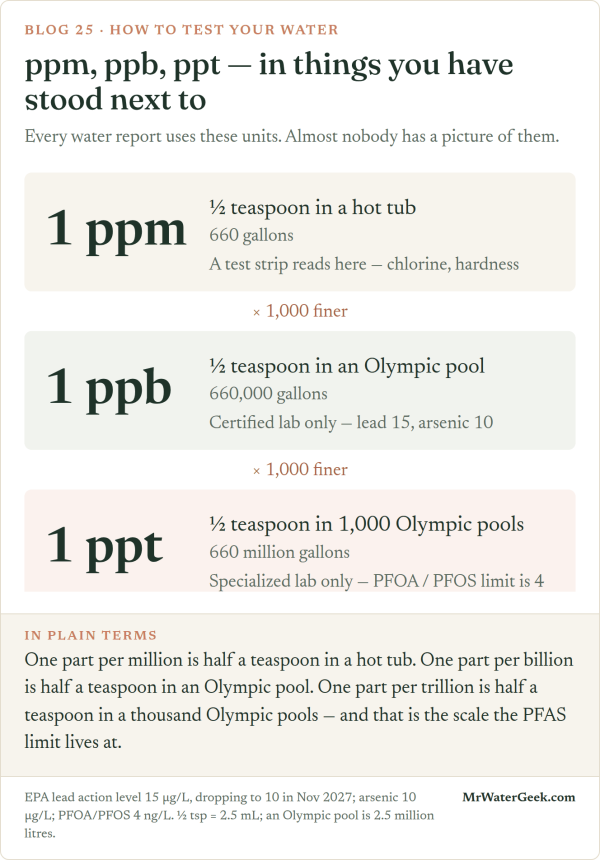
PFAS data — or the absence of it. The EPA set
enforceable limits of 4 ppt for PFOA and PFOS in 2024, but utilities
have until 2029 (potentially 2031) to comply. If your CCR doesn’t
mention PFAS, it probably hasn’t been tested yet. That’s not the same as
“no PFAS.” A USGS
study estimated at least 45% of U.S. tap water contains
detectable PFAS. (Source: USGS, 2023 national tap water study.)
Trend lines. If your utility has been creeping
toward the MCL for any contaminant over the past three years, pay
attention – even if they haven’t gone over the limit yet.
How old is your home’s
plumbing?
Your CCR tests water in the municipal distribution system. It doesn’t
test what happens between the water main and your faucet. That stretch
is where most lead and copper contamination originates.
The key dates to know: before 1986, there were no federal
restrictions on lead in plumbing materials at all. From 1986 to 2014, a
faucet could legally be sold as “lead-free” while containing up to 8%
lead in its brass components. The current “lead-free” standard,
effective January 2014, means the weighted average of wetted surfaces
must be ≤0.25% lead. (Sources: EPA, Lead-Free Requirements; NSF/ANSI 61 & 372.)
If your home was built before 2014 and you haven’t replaced the
faucet, it’s worth running a first-draw
test. Let the water sit in the pipes overnight, then test the
first liter that comes out in the morning. That sample captures whatever
has leached from your plumbing overnight.
If your home was built after 2014 with certified fixtures, your lead
risk from the faucet itself is low. Not zero — even compliant faucets
leach trace amounts during a break-in period — but low enough that most
people won’t need a lead-specific filter for this reason alone.
Are you on a private
well?
If yes, you’ll need to test the water yourself. Private wells are not
regulated by the EPA. No one else is testing your water – the quality of
your water is entirely your responsibility.
The CDC recommends
testing at least annually for total coliform bacteria, nitrates,
total dissolved solids, and pH. But those are just the baseline —
depending on your region, you may also need to test for arsenic
(Southwest, Upper Midwest, New England), radon (Northeast crystalline
rock aquifers), iron and manganese (Midwest), nitrate from agricultural
runoff (Central agricultural regions), or volatile organic compounds
near industrial sites.
About 1
in 5 private wells contain at least one contaminant at levels
exceeding health-based guidelines, according to the USGS. And few test regularly — by some estimates, fewer than half test with any frequency, and far fewer test every year. (Sources: USGS, groundwater quality; CDC, well testing.)
If you’re on a well and you haven’t tested in the past 12 months,
stop reading this article and go get a test. A filter recommendation
without a water test isn’t a recommendation – it’s just a guess.
Not sure what’s in your water?
Check your ZIP code — free, takes 30 seconds.
Do
you have specific health concerns in your household?
Certain household situations lower the threshold for when a filter
makes sense:
Infants and formula. Nitrate above 5 mg/L is a
concern for bottle-fed infants. Lead at any detectable level is a
concern for children under 6. If your home has either risk factor and a
young child, a certified
point-of-use filter is cheap insurance.
Pregnant women. Lead, PFAS, and disinfection
byproducts are all associated with adverse pregnancy outcomes in the
literature. If your CCR shows detections above the MCLG for any of
these, point-of-use filtration at the kitchen tap is a reasonable
precaution. (Sources: EPA, Lead in Drinking Water; CDC, Lead Prevention.)
Immunocompromised individuals. People on
chemotherapy, organ transplant recipients, or those with HIV/AIDS may
need additional microbial protection. NSF/ANSI 53-certified filters with
a 1-micron absolute rating can reduce Cryptosporidium and Giardia.
If nobody in your household falls into a higher-risk category and
your CCR looks clean, purchasing a water filtration system is
optional.
What are you
actually willing to maintain?
This is the question filter companies never ask because the answer
sometimes kills the sale.
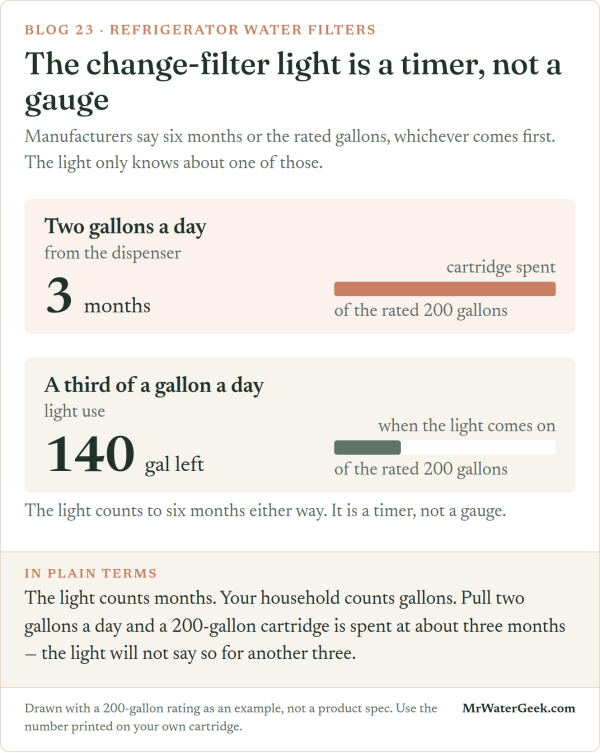
Every filter system requires maintenance. A carbon pitcher needs a
new cartridge every 2–3 months. An under-sink carbon filter needs
replacement every 6–12 months. A reverse osmosis system needs
pre-filter, post-filter, and membrane replacements on different
schedules – it also wastes 3–4 gallons of
water for every gallon it produces on older systems. A
whole-house system runs $850–$5,400 installed and costs $150–$500/year
to maintain. (Installed-cost figures are typical market estimates and vary by system and region.)
A filter that’s not regularly maintained is worse than no filter.
Carbon filters that are past their rated capacity can become a breeding
ground for bacteria. An expired RO membrane lets contaminants through
while you think you’re protected.
Be honest with yourself. If you won’t change the cartridge on
schedule, a simple faucet-mount filter you’ll actually maintain beats a
sophisticated system you’ll neglect.
So — do you need one?
Where the framework lands for most people:
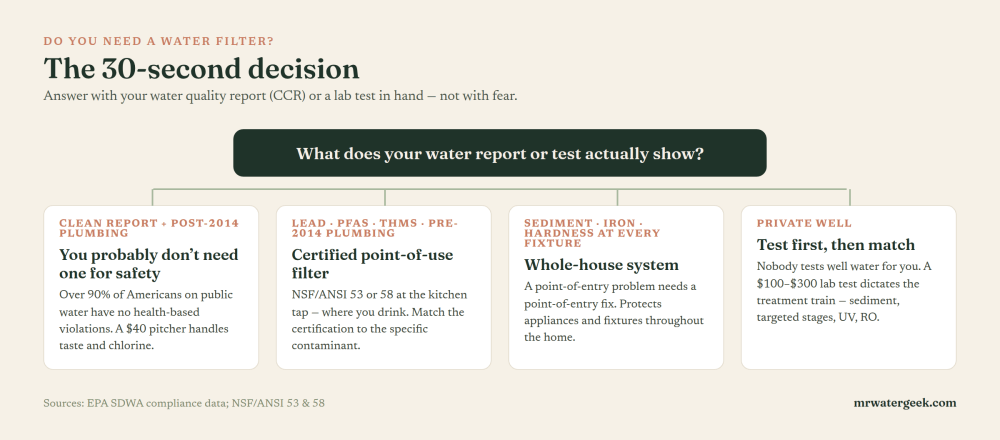
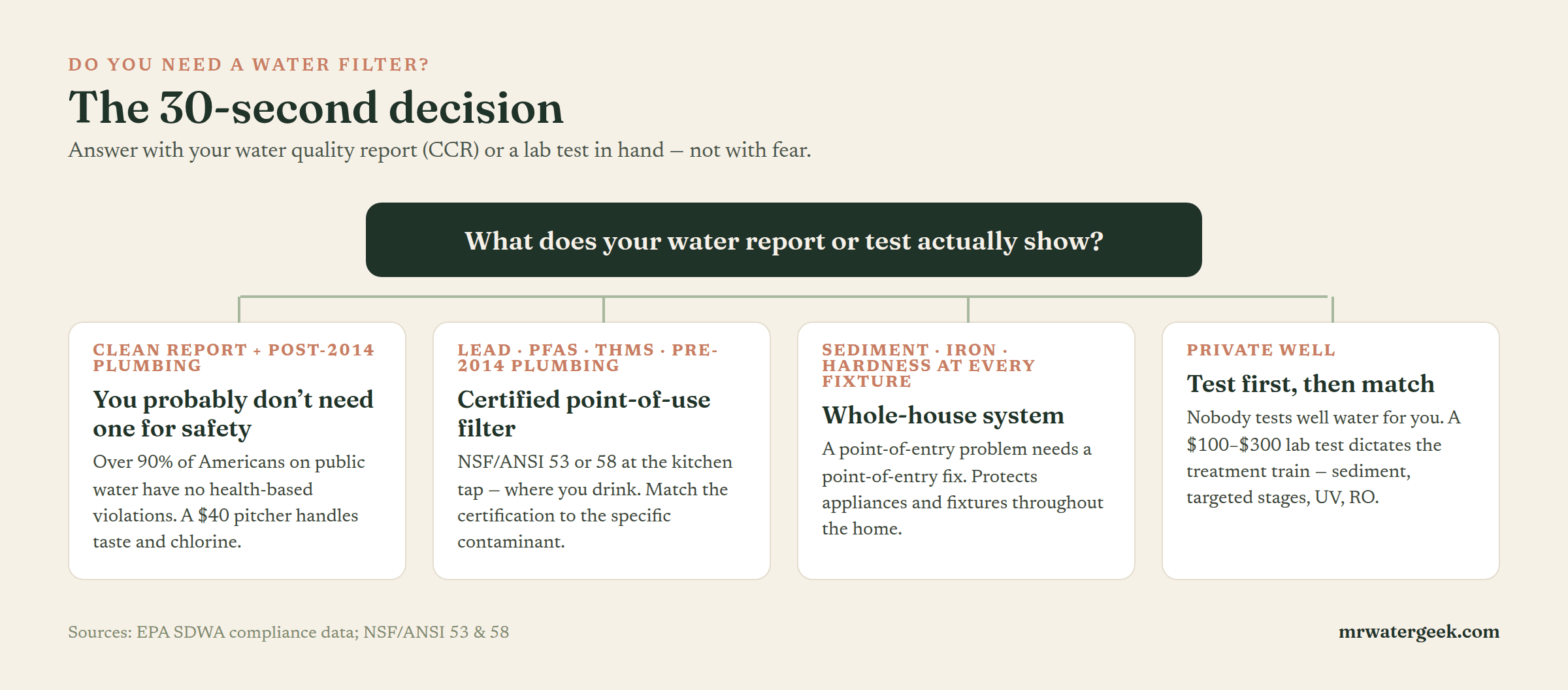
You probably don’t need a filter if: your home was
built after 2014 with certified plumbing, your CCR shows no contaminants
above the MCLG, you’re on municipal water with no PFAS detections, and
nobody in your household is in a higher-risk category. That’s most
people on municipal water.
A basic carbon filter makes sense if: your water
tastes or smells off, your CCR shows chlorine residual above 1 mg/L, or
you want a simple layer of protection without committing to a serious
system. Cost: $20–$60/year.
A certified point-of-use filter is worth it if: your
CCR shows lead, PFAS, or THMs above the MCLG, your home has pre-2014
plumbing, you’re on well water with known contaminant issues, or you
have vulnerable household members. Cost: $150–$400 for the unit,
$60–$120/year in replacement filters. Make sure whatever you buy carries
NSF/ANSI
53 certification for the specific contaminants you’re targeting
— not just “NSF certified” in general.
A whole-house system makes sense if: you have well
water with sediment, iron, or hardness issues affecting every fixture,
or your municipal water has system-wide problems that go beyond the
kitchen tap. Cost: $850–$5,400 installed, $150–$500/year to maintain. A whole-house carbon filter improves taste and handles sediment and hardness — it does not remove the lead your own plumbing adds downstream, or health contaminants like PFAS, which need a certified filter at the tap you actually drink from.
For most people on city water, this is more
system than you need.
The filtration industry benefits from peoples’ assumption that their
water is contaminated. For a lot of people, it isn’t. For some, it is –
and a $200 point-of-use filter at the kitchen faucet handles most of
those cases. The expensive, complex systems solve real problems for a
much smaller number of homes.
Answer the six questions with your water report in hand.
FAQ
Do I need a water filter if my city says the water is
safe? “Safe” means your utility met EPA legal limits during the
reporting period. It doesn’t mean your water is contaminant-free — the
MCL for lead allows up to 15 ppb (dropping to 10 ppb in November 2027),
even though the health-based goal is zero. Check your CCR for the gap
between detected levels and the MCLG. (Source: EPA, Lead and Copper Rule Improvements.)
Is bottled water safer than tap water? Bottled water
is regulated by the FDA under different (and in some cases less
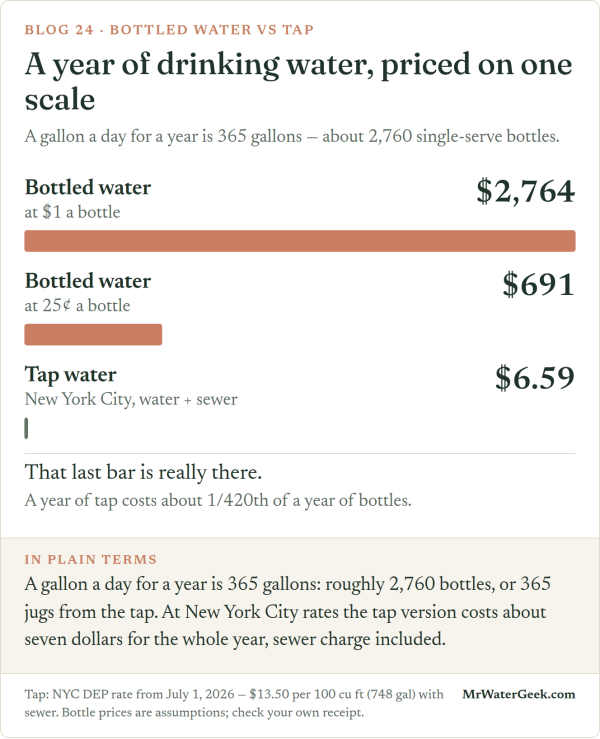
stringent) standards than municipal tap water. A 2020 Consumer Reports investigation found detectable PFAS in several bottled water brands. Unless the bottle
specifies an NSF/ANSI certification, you’re trusting marketing more than
testing – likely, your tap water is actually safer. (Source: Consumer Reports, PFAS in Bottled Water (2020).)
How do I know if my water filter is actually
working? Look for NSF/ANSI certification marks for the specific
contaminant you care about, not just
“NSF” in general. NSF/ANSI 53 covers health-effect contaminants
like lead and VOCs. NSF/ANSI 58 covers RO systems. Change filters on
schedule and test your water periodically to confirm.
What if I’m renting and can’t install anything under the
sink? Faucet-mount filters (like Brita or PUR) and gravity-fed
pitchers work without installation. Some carry NSF/ANSI 53 certification
for lead. They’re less effective than under-sink systems for PFAS, but
for lead and chlorine byproducts, they’re a real option for renters.
Is well water more dangerous than city water? Not
inherently — but city water is tested and regulated, and well water
isn’t. The USGS found contaminants exceeding health benchmarks in about
1 in 5 private wells. The risk depends entirely on your geology, your
well construction, and whether you actually test. (Source: USGS, groundwater quality.)
Shashank — 9 years at Kohler building water filtration. Mr Water
Geek translates water science into clear decisions.