A Berkey alternative is a gravity-fed or countertop water filter that covers what Berkey owners bought the system for — plumbing-free filtration, large batch capacity, and broad contaminant reduction. Searches for one spiked after EPA enforcement actions disrupted Berkey’s U.S. availability. The strongest options in 2026 fall into three groups: ceramic gravity systems, stainless-steel gravity units, and certified countertop filters. Which one fits comes down to your water and your reason for filtering it.
Key Takeaways — What Actually Replaces a Berkey?
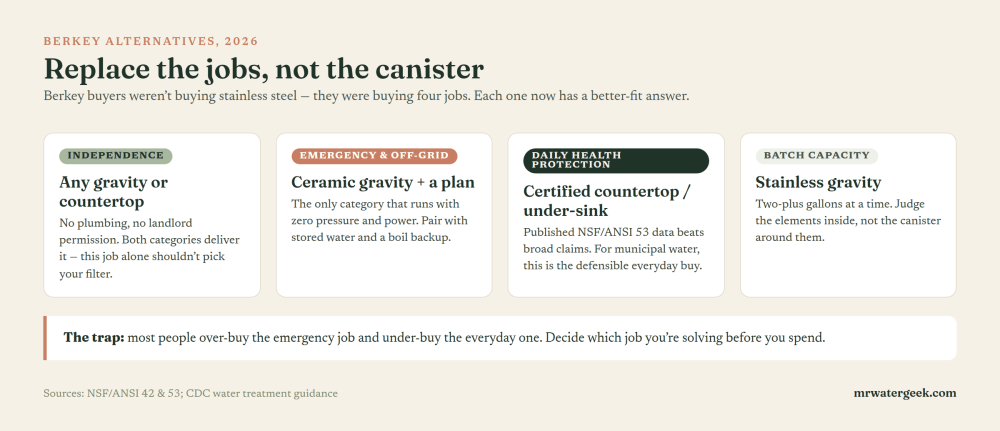
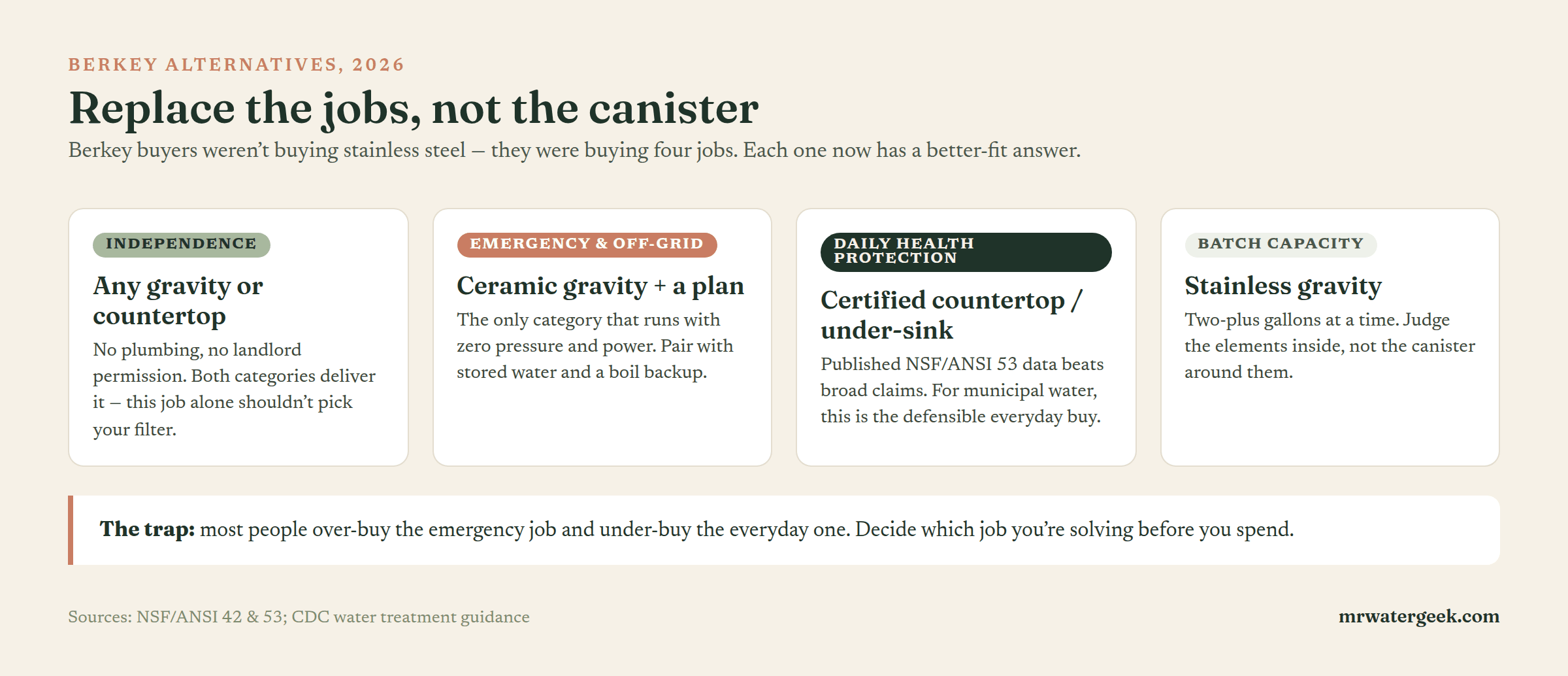
Nothing replaces “a Berkey” as an object — you replace the jobs it did. Sort them: countertop independence, batch capacity, off-grid resilience, contaminant claims. Most people over-buy on the emergency job and under-buy on the everyday one. A certified countertop filter handles daily health-effects reduction better than most gravity units, which often carry no third-party certification at all. Off-grid is a separate purchase. Decide which job you’re actually solving before you spend a dollar.
START WITH YOUR WATER, NOT A PRODUCT
The right alternative depends on what’s in your tap
Before you compare filters, see which contaminants your utility actually reports. It changes the answer.
What Did Berkey Customers Actually Value?
First, the situation that sent everyone here. In May 2023, the EPA issued a Stop Sale, Use, or Removal Order against Berkey’s manufacturer (New Millennium Concepts), taking the position that the silver-treated Black Berkey elements are unregistered pesticides — “pesticidal devices” — under FIFRA, the federal pesticide law. The company rejects that classification. Its first challenge was dismissed on procedural grounds, and the Supreme Court declined to hear the appeal in December 2024. A second suit, Berkey International v. EPA, is still active — the First Circuit Court of Appeals heard oral argument in October 2025, with a resolution expected sometime in 2026. Meanwhile, authentic Black Berkey elements haven’t been manufactured since the 2023 order; in November 2025 the company introduced a new gravity element, the Berkey Phoenix, with NSF certification still pending. That last detail is this article’s thesis in miniature: even the brand’s own comeback element has to earn certification before it’s a verified buy. This article takes no side in the dispute. What matters for a buyer is the practical fallout: years of unreliable availability, uncertain replacement elements, and open warranty questions — which left a large, loyal customer base shopping for a replacement.
Before recommending anything, it helps to name what that customer base was buying. In my experience it was rarely the stainless canister itself.
Six values show up again and again:
- Independence. No plumbing, no installation, no permission from a landlord. Fill the top, pour from the bottom.
- Emergency preparedness. A filter that works when the power and the pressure are both gone.
- Off-grid use. Cabins, RVs, travel, and questionable source water far from a municipal system.
- Large batch capacity. Filtering a couple of gallons at a time instead of a pitcher’s worth.
- Contaminant-reduction claims. The long list of substances the marketing said the elements addressed.
- Brand trust. A name people had recommended to each other for years.
Only one of those — contaminant reduction — is a laboratory question. The rest are about form factor and confidence. That distinction matters, because the alternatives market solves the form-factor jobs very well and the laboratory job unevenly.
Which Berkey Alternative Addresses Each Value?
No single product wins every column, so here’s the mapping, criterion by criterion.
- Independence: Any gravity system delivers this. So do countertop filters that connect to a faucet without permanent plumbing. If untethered operation is the whole point, gravity keeps the edge.
- Emergency preparedness: Only gravity units run with zero pressure and zero power. A countertop or under-sink filter needs water pressure to work, so it fails the exact scenario preppers buy for. For blackout-and-boil-water situations, gravity plus a stored-water plan is the real answer.
- Off-grid use: Ceramic gravity elements shine here. Ceramic can be cleaned and reused many times, and the pore structure physically strains out bacteria and protozoa — the pathogens that matter most when your source is a stream or rain barrel.
- Large capacity: Stainless-steel gravity systems hold the most, typically a couple of gallons in the lower chamber. Countertop systems trade batch size for continuous flow.
- Contaminant claims: Slow down here. A certified countertop filter with published NSF/ANSI 53 performance gives you verified reduction of specific health-effects contaminants. Many gravity systems make broad claims without that third-party backing.
- Brand trust: Trade brand loyalty for certification data. A certification mark is a claim someone independent tested. A brand name is a claim you’re taking on faith.
Ceramic, Stainless, or Countertop — How Do the Categories Compare?
Three categories cover almost every displaced Berkey buyer. Each has a real job it does best.
Ceramic gravity systems. A ceramic shell with a sub-micron pore structure, usually wrapped around a carbon core. The ceramic strains particulates and microorganisms; the carbon inside targets taste, odor, chlorine, and some organic chemicals. According to the CDC, ceramic and carbon media address different contaminant groups, which is why the two are combined. The standout advantage is cleaning — you can scrub and reuse a ceramic element rather than tossing it. The limit is that ceramic does little for dissolved metals or salts on its own.
Stainless-steel gravity systems. Same gravity principle, larger and more durable housing, swappable element types. These win on capacity and countertop presence. They’re the closest structural analog to what most people picture when they think “Berkey.” The elements inside still determine performance, so read what those elements are certified to do rather than trusting the canister.
Countertop systems. A housing that sits on the counter and connects to your faucet with a diverter, no drilling. The trade-off is plain: you give up zero-pressure operation, but you gain flow rate and, in the better units, real certification. For everyday municipal water where lead or disinfection byproducts are your concern, a certified countertop filter is usually the more defensible everyday buy.
MATCH THE FILTER TO THE THREAT
Lead, PFAS, and cysts need different media
A gravity system and a certified countertop unit don’t reduce the same things. Look up your water first, then pick.
| Category | Independence | Emergency / off-grid | Batch capacity | Certification |
|---|---|---|---|---|
| Ceramic gravity | Yes — no plumbing | Best — zero pressure/power; cleanable elements strain bacteria and cysts | Moderate | Element-dependent; many carry none — check for a standard number |
| Stainless gravity | Yes — no plumbing | Good — runs unpowered; performance depends on elements inside | Best — 2+ gallon lower chamber | Often uncertified claims — judge the elements, not the canister |
| Certified countertop | Yes — faucet diverter, no drilling | No — needs water pressure | Continuous flow instead of batches | Strongest — look for published NSF/ANSI 53 data |
The Harder Question: Should You Use Gravity Filtration at All?
After 9 years building filtration systems, I’ll say the thing the category rarely admits: gravity filtration is a compromise, and for a lot of people it’s the wrong one. Here are the trade-offs, unvarnished.
- Flow rate is slow. Gravity has no pressure behind it. You wait for water to seep through media, which is fine for a batch overnight and annoying when you want a glass now.
- Many systems carry no certification. A large share of gravity units are not NSF-certified for their health claims. NSF/ANSI 42 covers aesthetic effects — taste, odor, chlorine. NSF/ANSI 53 covers health effects like lead, VOCs, cysts, and PFAS. NSF/ANSI 58 covers reverse osmosis. If a gravity brand lists a long contaminant table with no standard number attached, treat it as a marketing claim, not verified performance. (The old P473 PFAS standard has been folded into 53 and 58, so ignore any current product still citing P473 as if it were live.)
- Cleaning is real work. Ceramic elements need periodic scrubbing; every gravity chamber needs regular washing to avoid biofilm in standing water.
- Footprint is significant. A two-chamber unit occupies real counter space and is tall enough to fight your cabinets.
None of that makes gravity useless. It makes it specific. If you have municipal pressure and your worry is lead or PFAS, a certified countertop or under-sink unit is faster, smaller, and backed by test data. Gravity earns its place when pressure and power can’t be assumed.
What Does a Real Off-Grid or Preparedness Setup Need?
If emergency and off-grid resilience is your actual reason — and for many former Berkey owners it was — then build for that job instead of buying one canister and hoping. A resilient setup has layers.
- Sediment pre-filtering. Cloudy source water clogs fine media fast. A cloth or coarse pre-filter extends element life dramatically.
- Microbial reduction you can trust. Sub-micron ceramic physically removes bacteria and protozoa. For viruses and truly unsafe sources, the CDC’s guidance for travelers is worth reading: filtration alone may not be enough, and a disinfection step (boiling or an approved chemical treatment) is the backstop.
- Stored water. A filter processes water; it doesn’t create it. Keep a stored volume so filtration is buying you safety, not your only water.
- Redundancy. Spare elements, a manual backup, and a boil option. Systems fail; plans shouldn’t.
Bought this way, a gravity system is one layer in a preparedness plan rather than the whole plan. That framing is where displaced Berkey buyers tend to make better decisions — and spend less doing it.
ONE LOOKUP SAVES A BAD PURCHASE
Know your contaminants before you commit
Pull your local report, see what’s actually there, and buy the filter that reduces it — not the one with the longest ad copy.
FAQ
What is the best Berkey alternative in 2026? There isn’t a single winner, because the best Berkey alternative depends on the job. For everyday municipal water, a certified countertop filter with published NSF/ANSI 53 data reduces health-effects contaminants with test backing. For off-grid or emergency use, a sub-micron ceramic gravity system is the stronger pick. Match the product to your water report and your scenario, not to a brand.
Are gravity water filters NSF-certified? Some are, many aren’t. A large portion of gravity systems make broad contaminant claims without third-party certification. Look for a specific standard number — NSF/ANSI 42 for taste and chlorine, 53 for lead, VOCs, cysts, and PFAS. No standard number attached to a claim means the claim wasn’t independently verified.
Does a Berkey alternative remove PFAS? Only if it’s certified to. The EPA finalized a national drinking water limit of 4 parts per trillion for PFOA and PFOS, and reducing to that level requires proven media — typically certified activated carbon or reverse osmosis. Confirm PFAS reduction under NSF/ANSI 53 or 58 rather than assuming a gravity element handles it.
Can a countertop filter replace a gravity system for emergencies? No. Countertop and under-sink filters need water pressure to work, so they fail during the exact power-and-pressure outage that preparedness buyers plan for. Gravity filtration is the one category that runs with no pressure and no power, which is why it stays relevant for off-grid and emergency use.
Is ceramic or carbon better in a gravity filter? They do different jobs, so good elements use both. Ceramic strains out sediment, bacteria, and protozoa by pore size. Carbon adsorbs chlorine, taste, odor, and some organic chemicals. Ceramic can be cleaned and reused; carbon eventually saturates and needs replacing. Neither removes dissolved lead or salts well on its own.
How do I know what my water actually needs? Start with your utility’s annual report, which lists detected contaminants for your system. Compare that list to what a filter is certified to reduce. If you’re on a well or an off-grid source, test the water directly. You can also review your city water quality report to see local detections before choosing.
Shashank — 9 years at Kohler building water products. Currently building the next generation of water health products.