A kitchen faucet water filter mounts on the end of your faucet and treats water as it leaves the spout. Most are certified to reduce chlorine taste and odor; some are also certified for lead and other health contaminants. They run cold water only, need cartridge changes on schedule, and won’t thread onto the pull-down or pull-out spray heads found in most modern kitchens.
Key Takeaways — Is a faucet filter worth it?
A faucet filter is the cheapest way to get certified filtration at the tap, and for plenty of homes that’s enough. The catch is fit: if your spray head pulls down or out, there’s nothing to screw it onto. Check the certification for the contaminant you actually have rather than the claim on the box, and swap the cartridge before it’s spent.
BEFORE YOU FILTER
Filter for what’s in your water, not what’s on the box
Pull the detections for your ZIP in about 30 seconds, then match a certification to them.
What a Kitchen Faucet Water Filter Actually Is
Strip the housing off and there are three parts: a threaded collar that replaces your aerator, a diverter valve, and a cartridge. The collar clamps the unit to the end of the spout. The diverter is a small lever or knob that decides whether water goes straight through, as it always did, or takes a detour through the cartridge on its way out.
That diverter is doing more work than it looks like. Cartridges are rated in gallons, and rinsing dishes or filling a pasta pot would burn through that rating in a week. The lever lets you spend cartridge life only on the water you drink.
The cartridge itself is almost always a carbon block — carbon powder compressed into a solid cylinder with pores small enough to catch particles and enough surface area to adsorb dissolved compounds. Because the block is dense and the housing is small, filtered flow comes out noticeably slower than the unfiltered stream. That slowdown isn’t a defect. It’s contact time, and contact time is what makes the block work at all.
NSF/ANSI 42, 53, 401, 58: Which Number Actually Matters
Every filter box wears a certification mark, and the mark alone tells you almost nothing. The number after it is the part that carries meaning, because each standard covers a different job.
| Standard | What it certifies | What it does not tell you |
|---|---|---|
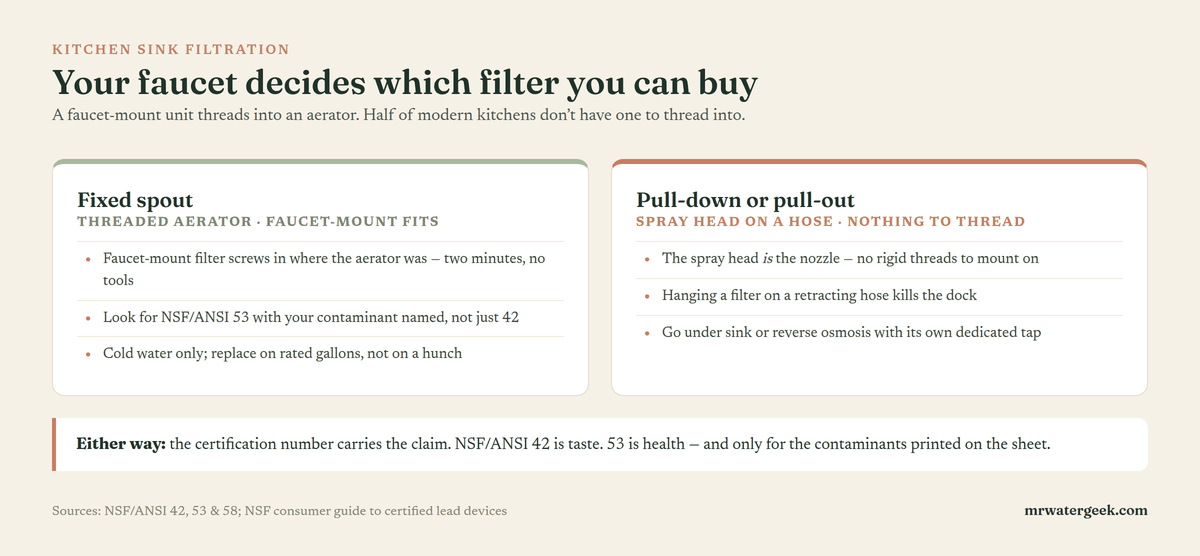
| NSF/ANSI 42 | Aesthetic effects — chlorine taste and odor, particulates | Anything about health contaminants. A 42-only filter can leave lead untouched. |
| NSF/ANSI 53 | Health effects — lead, cysts, VOCs, and PFAS when those compounds are specifically listed | Any contaminant not printed on the performance data sheet |
| NSF/ANSI 401 | Incidental compounds — pharmaceuticals, pesticides, and similar trace contaminants | Lead or the other classic health contaminants; it supplements 53 rather than replacing it |
| NSF/ANSI 58 | Reverse osmosis systems as complete units | Nothing about faucet-mounted filters — this standard covers a different category |
One standard you may still see referenced deserves a correction: NSF P473, the old PFAS protocol, has been discontinued. Its requirements were folded into NSF/ANSI 53 and 58. If a listing still leads with P473, it’s working from stale information. The current instruction is to look for NSF/ANSI 53 or 58 with the PFAS compounds you care about named on the sheet.
The practical move is boring and effective: get your water report first, find the contaminant you actually have, then look for that exact contaminant on the performance data sheet. Our guide to NSF certified water filters walks through reading one of those sheets.
The Fit Problem: Pull-Down and Pull-Out Faucets
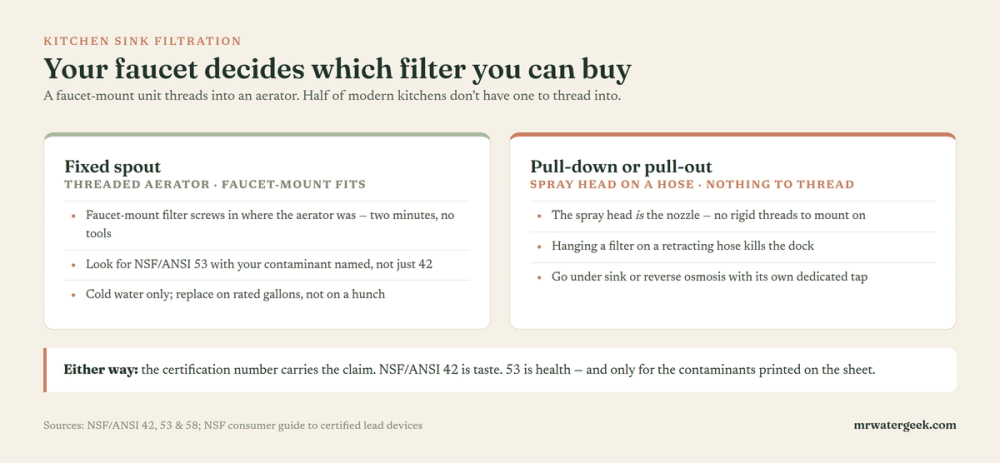
Most faucet filters get returned for one reason, and it isn’t performance. A faucet-mount unit needs a threaded aerator on a fixed spout. It unscrews the aerator, screws itself into those same threads, and hangs off the end of the faucet.
On a pull-down or pull-out faucet, that end doesn’t exist in the way the filter expects. The spray head is the nozzle, and it detaches from the spout on a hose. There’s nothing rigid to thread onto, and even if you forced an adapter, you’d have hung a half-pound of housing on a hose designed to retract under its own weight. The dock would stop seating and the retraction would sag.
Since pull-down is the default configuration in most kitchens sold today — see our breakdown of the types of kitchen faucets and the pull-down vs pull-out comparison — this rules out faucet-mount filtration for a large share of households before certification ever enters the conversation. If your spout is fixed and has a standard aerator, you’re a candidate. If your spray head pulls out of the spout, look at a plumbed-in option with its own dedicated tap instead.
Cold Water Only, and Why the Testing Temperature Matters
Faucet filters carry a cold-water-only instruction, and it isn’t a liability footnote. Certified performance is measured at a specific temperature. NSF’s consumer guidance on certified lead devices states that products in its listing are tested at 20°C/68°F and have not been tested for contaminant reduction at elevated temperatures.
So hot water through a faucet filter puts you outside the conditions the certification describes. You don’t know what the cartridge is doing, because nobody measured it doing anything there. Hot water also softens the binder holding a carbon block together and can drive off compounds the carbon had already captured.
With lead specifically, hot water is the wrong starting point regardless of filtration, since lead dissolves more readily at higher temperatures. That’s the same reason pediatric guidance says never to mix formula with hot tap water. Our lead filter guide covers the flushing and temperature rules in more detail.
Cartridge Capacity Is a Hard Limit, Not a Suggestion
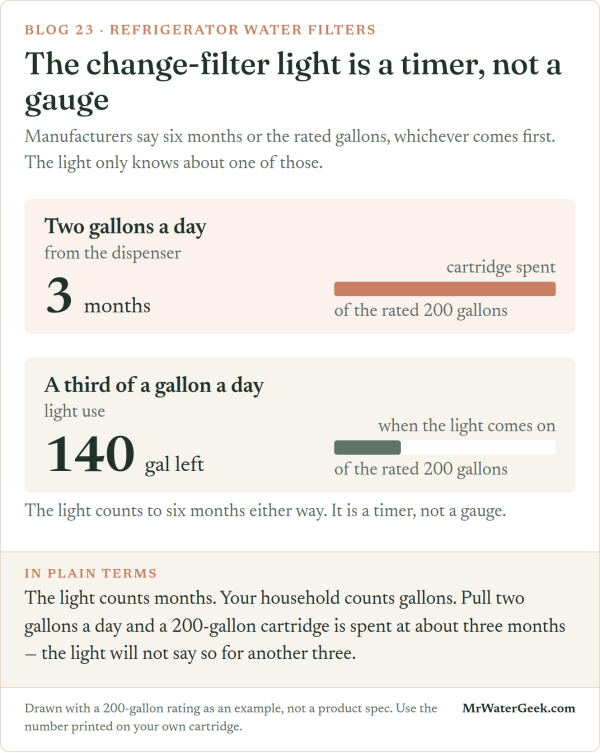
Every certified cartridge carries a rated capacity in gallons, and that number is the boundary of the tested claim. Past it, you’re running an uncharacterized filter. A carbon block that has adsorbed contaminants up to its capacity can begin releasing them back into the water, which means an overdue cartridge can perform worse than no cartridge at all.
Two more limits sit in the same NSF guidance and rarely make it onto packaging. Certified lead devices are tested against water containing up to 150 ppb of lead, and performance above that concentration hasn’t been evaluated — if your tap tests higher, a faucet filter is not the tool. And replacement cartridges have to be the ones the manufacturer specifies, because a third-party cartridge in a certified housing is an untested combination.
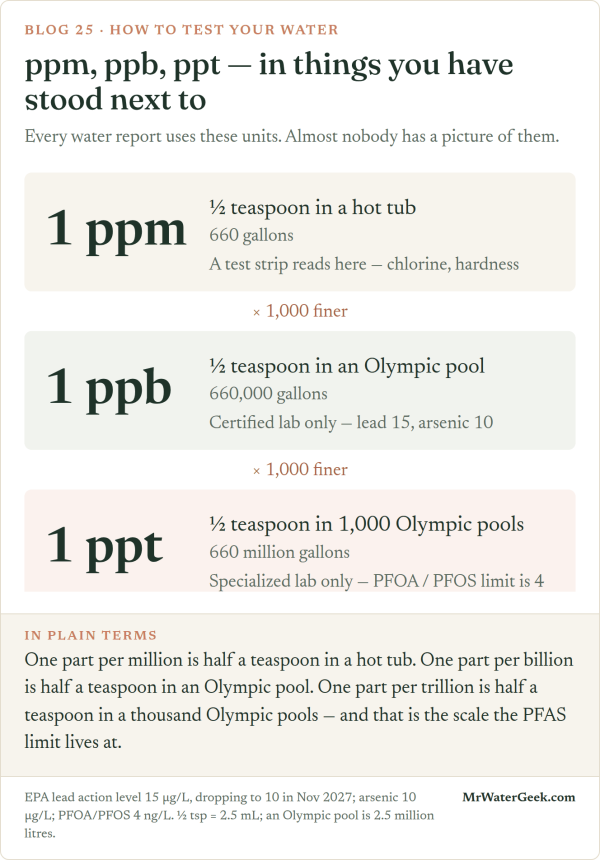
For context on the regulatory numbers: the EPA action level for lead is currently 15 ppb, dropping to 10 ppb in November 2027 under the Lead and Copper Rule Improvements. Both are triggers for utilities rather than health-based safety thresholds.
Faucet Filter vs Pitcher vs Under Sink vs RO
Faucet-mount is one of four realistic ways to get certified water at a kitchen sink, and the right one usually falls out of your faucet type and what you’re filtering for.
| Option | Works with a pull-down? | Lead certification available? | Flow | Best when |
|---|---|---|---|---|
| Faucet-mount | No — fixed spouts only | Yes, under NSF/ANSI 53 | Slow | You rent, you have a fixed spout, and you want certified water cheaply |
| Pitcher | Not applicable | Some models, under 53 | Batch, by the pitcher | One or two drinkers, no installation possible |
| Under sink carbon block | Yes, on its own tap | Yes, under 53 | Good | Most households; you want it plumbed in and out of sight |
| Reverse osmosis | Yes, on its own tap | Yes, under 58 with contaminants listed | Slow, tank-fed | Dissolved contaminants: PFAS, nitrate, high total dissolved solids |
START WITH THE REPORT
A certification only helps if it matches your contaminant
See what’s actually been detected where you live before you choose a cartridge.
When a Faucet Filter Is the Right Call
The case for one is strong in a specific set of circumstances: you have a fixed spout with a standard aerator, you’re renting or otherwise can’t modify plumbing, your water report shows a contaminant that a 53-certified cartridge handles, and you’re filtering drinking and cooking water rather than everything that comes out of the tap.
The case weakens fast outside that. A pull-down faucet rules it out mechanically. Contaminants above the tested range rule it out on performance. And if you’re filtering for a household rather than a person, the cartridge economics stop making sense — you’ll be replacing small cartridges often enough that a plumbed-in system with a larger block costs less per gallon within a year or two.
None of this makes faucet-mount filters bad hardware. It makes them a specific tool with a narrow, real fit. The mistake is buying one for a kitchen it was never going to attach to.
ONE LAST STEP
Know the contaminant before you buy the cartridge
Thirty seconds with your ZIP tells you which certification you’re actually shopping for.
FAQ
Do kitchen faucet water filters remove lead? Some do, and the label tells you which. A filter certified to NSF/ANSI 53 with lead named on its performance data sheet has been tested for lead reduction; a filter certified only to NSF/ANSI 42 has been tested for chlorine taste and odor and may do nothing for lead. The standard number and the contaminant list are what carry the claim.
Will a faucet filter fit a pull-down faucet? No. Faucet-mount filters thread into the aerator on a fixed spout, and a pull-down’s spray head detaches on a hose instead of presenting rigid threads. Adapters that promise otherwise also hang weight on a retraction system that wasn’t designed for it. With a pull-down or pull-out, use an under sink filter or reverse osmosis system with its own tap.
Do faucet filters remove PFAS? A few are certified for it. Look for NSF/ANSI 53 with the specific PFAS compounds listed on the sheet, since a general PFAS claim without that listing isn’t backed by certification. The older NSF P473 protocol has been discontinued and folded into standards 53 and 58, so a current listing should reference those instead.
Can you run hot water through a faucet filter? You shouldn’t. Certified performance is measured at 68°F, and no one has tested what the cartridge does at shower or dishwashing temperatures. Heat can also degrade a carbon block and release compounds it previously captured. Filtered taps are for cold water.
How often should you change the cartridge? On the manufacturer’s rated capacity, measured in gallons rather than months, since a household of five reaches that number far faster than a household of one. Running past the rating is the failure mode that matters: a saturated carbon block can release accumulated contaminants back into the water.
Is a faucet filter or an under sink filter better? Under sink wins on flow, cartridge life, and cost per gallon, and it fits any faucet because it runs to its own tap. Faucet-mount wins on price and on installing in two minutes with no tools, which matters if you rent. If your faucet is a pull-down, the choice is already made for you.
Shashank — 9 years at Kohler building water products. Currently building the next generation of water health products.
Tab 2
Verdict: Publish-ready after light linking. The strongest “certification literacy” piece in the cluster.