Microplastics are plastic fragments smaller than 5 millimeters, and the ones found in drinking water are usually 1–5 microns or smaller — far thinner than a human hair, which runs about 70 microns. Peer-reviewed studies have detected them in tap and bottled water worldwide, but the health evidence is still developing. A microplastics water filter that physically excludes particles — sub-micron mechanical media or reverse osmosis — is the reliable way to reduce them.
Key Takeaways — Do You Actually Need a Microplastics Filter?
The particles are real and they’re in most water we’ve tested for them — that part isn’t in dispute. What’s unsettled is whether the doses in drinking water hurt you. At the moment, the WHO’s stance is that there is no definitive proof that microplastics pose a significant risk to your health. Granted, this is not saying they’re definitively safe. If you want to reduce microplastics, ignore marketing adjectives and look at one number: the absolute micron rating. Sub-micron mechanical or RO removes them. A loose carbon pitcher mostly doesn’t.
KNOW YOUR WATER FIRST
Before you buy a microplastics filter, see what’s actually in your supply.
Enter your ZIP and we’ll pull the contaminants your utility has reported — so you filter for what you have, not what an ad told you to fear.
What Are Microplastics, Actually?
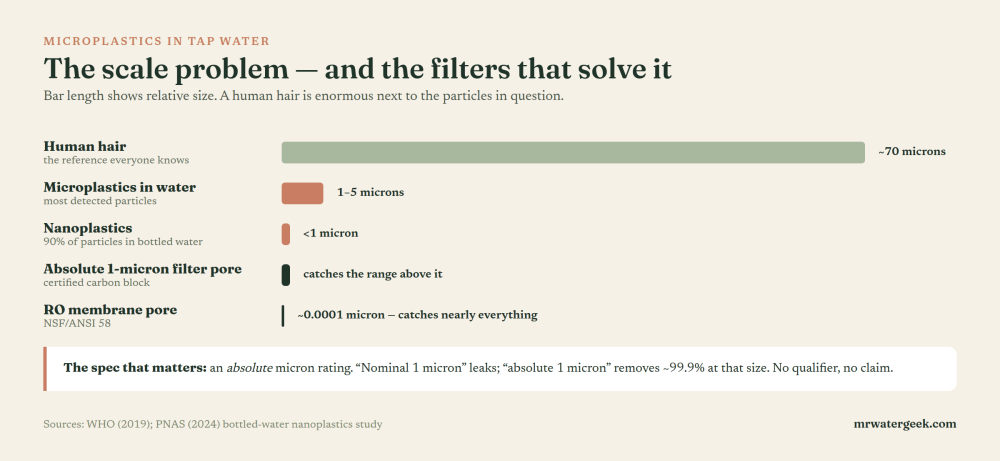
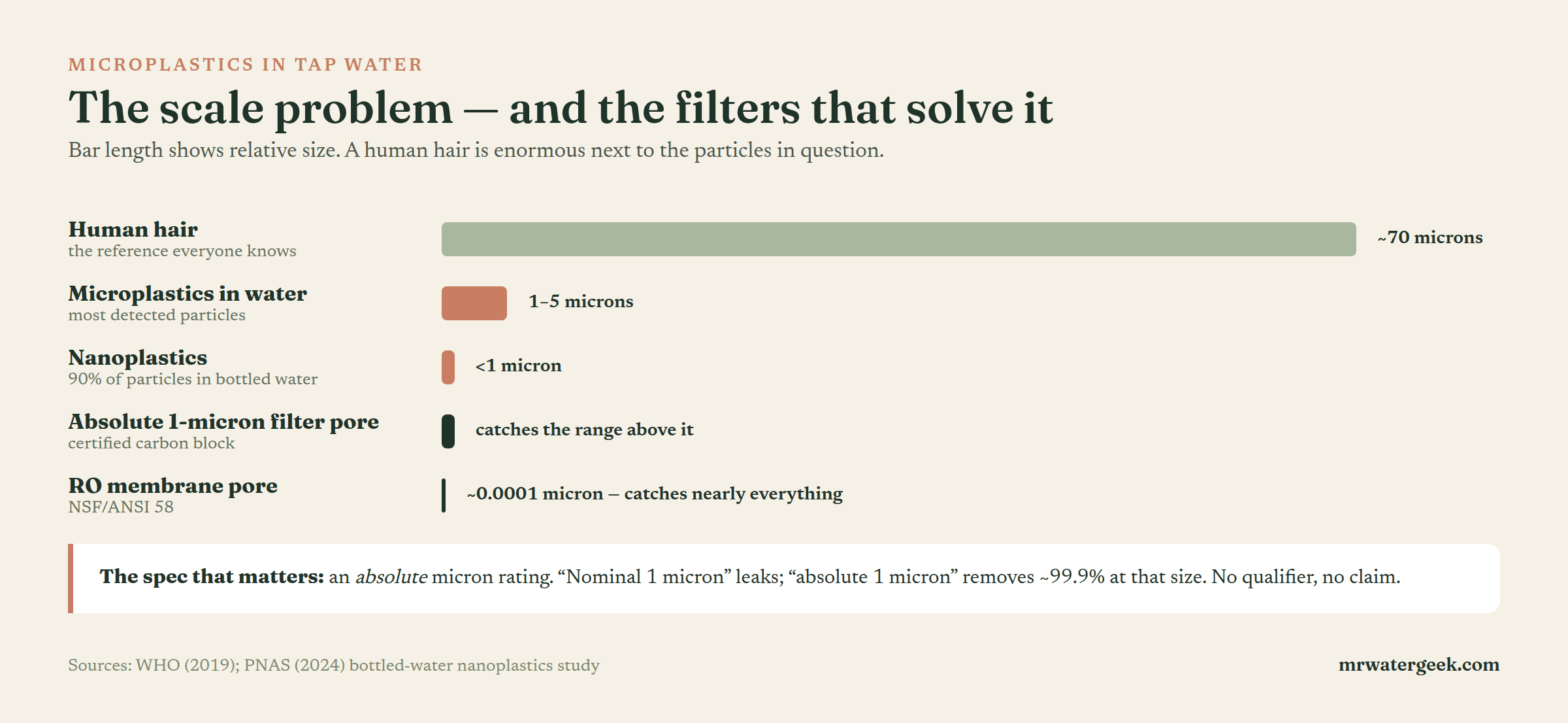
Microplastics is a catch-all term for plastic particles under 5 millimeters. That’s the upper bound scientists agreed on, and the WHO itself calls the cutoff “rather arbitrary.” The interesting range for drinking water sits much lower — particles a few microns across, down into the nanoplastic zone below 1 micron. For scale: a human hair is roughly 70 microns wide. The microplastics under discussion are often 1–5 microns. You are not going to see these. You cannot taste them. Measurement is a lab problem, not a kitchen one.
They arrive by two broad routes. Primary microplastics are manufactured small — think microbeads and industrial pellets. Secondary microplastics are the bigger story: larger plastic items breaking down under sunlight, heat, and abrasion until they’re dust. The sources that dominate the environmental load are less obvious than a floating water bottle:
- Tire wear. Every time a car brakes or corners, it sheds a fine mix of synthetic rubber and road particles. Peer-reviewed reviews rank vehicle tires among the largest single sources of microplastic released to the environment. (Tyre-wear review, 2023)
- Textiles. Synthetic fabrics — polyester, nylon, acrylic — release microfibers every wash cycle. Those fibers are the shape most commonly found in tap water samples.
- Packaging and degradation. Bottles, films, and containers weather into fragments. Opening, squeezing, and heating plastic packaging generates particles directly.
Chemically, most of what turns up is polyethylene, polypropylene, PET, and polystyrene — the everyday plastics. The shapes matter because filters catch particles by size and geometry, and a long thin fiber behaves differently than a compact fragment.
What Has Peer-Reviewed Research Actually Established?
Start with the document everyone should read before forming an opinion. In 2019 the World Health Organization published its assessment of microplastics in drinking water. The headline conclusion, in their words: microplastics in drinking water “pose a low concern for human health” based on the evidence available. They also flagged, plainly, that the data are limited and that more research is needed. (WHO, 2019)
That sentence cuts both ways. “Low concern” is not “no concern,” and “limited data” is not “proven safe.” The WHO’s own information sheet notes that conventional and advanced water treatment can remove more than 90% of microplastics, and that nanofiltration reaches particles well below a micron. So the exposure question and the treatment question have different answers: we can filter these particles effectively, but we don’t yet know precisely what they do inside the body.
Detection studies are further along than health studies. A 2018 peer-reviewed study in PLOS ONE (Kosuth et al.) found anthropogenic particles in 81% of global tap water samples across 14 countries — with U.S. samples showing the highest particle density of any country tested. The Orb Media investigation that supplied many of those samples reported that 94% of its U.S. samples contained particles. Since then, particle counts have climbed as instruments improved — which brings us to the 2024 result that reset the numbers. Using a new laser-based imaging method, researchers at Columbia and Rutgers reported an average of roughly 240,000 plastic particles per liter of bottled water, about 90% of them nanoplastics too small for older methods to see. (PNAS, 2024)
So where does the science stand? We are very good at proving the particles are present, and the counts keep rising as detection sharpens. We are not yet good at saying what a given daily dose does to human health — and the studies that could answer that, tracking real exposures in real people over decades, have barely begun. Both statements are true at once, and any source that gives you only one of them is selling something. If you want the same evidence-first treatment applied to a contaminant where the health data are firmer, compare this with our PFAS water filter guide.
Why Are Microplastics Harder to Measure Than PFAS or Lead?
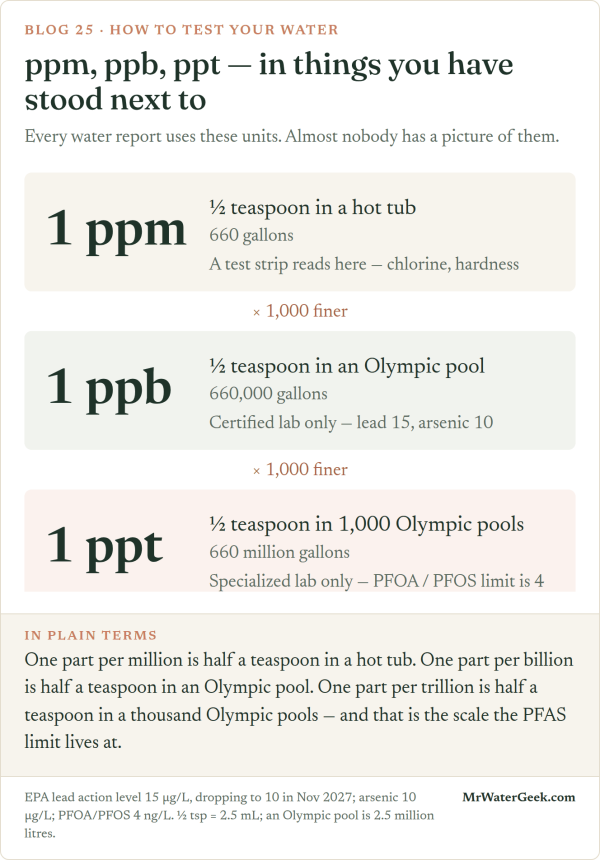
Lead has a number. The EPA action level is 15 parts per billion (dropping to 10 ppb in November 2027), measured by well-established methods, and two certified labs will hand you comparable results. PFAS now has enforceable federal limits down to 4 parts per trillion for PFOA and PFOS. Microplastics have none of that infrastructure, and it changes how you should read every scary headline.
Three problems compound each other. First, there’s no single standardized method — labs use different sampling, digestion, and identification techniques, so counts aren’t always comparable across studies. Second, results depend heavily on the size cutoff. A lab that counts down to 1 micron will report a fraction of what a lab counting to 0.1 micron finds in the same sample, which is exactly why the 2024 bottled-water numbers jumped an order of magnitude. Third, particle counting itself varies with technique and operator. A single microplastic result is a count under one method with one size floor — not a clean concentration you can enforce against. That’s why the WHO stopped short of setting a drinking-water guideline value and recommended against routine monitoring for now. Treat any specific particle count as directional, not gospel.
FILTER FOR WHAT YOU HAVE
Microplastics are one line on a longer list.
Pull your local water profile and see whether lead, PFAS, or disinfection byproducts deserve your filtration budget first.
Which Filtration Approaches Actually Reduce Microplastics?
Three technologies have a real physical basis for removing these particles. The common thread: the ones that work exclude particles by size, not by chemistry. Microplastics aren’t dissolved — they’re suspended solids, so you’re straining, not adsorbing.
1. Sub-micron mechanical filtration. A membrane or pleated filter with pores smaller than the particle physically blocks it. The number to hunt for on a spec sheet is the absolute micron rating — and this is the engineer’s nuance most buyers miss. A “nominal” 1-micron filter catches roughly 85–90% of particles at that size and lets the rest through. An “absolute” 1-micron filter is validated to remove around 99.9%. Same printed number, wildly different performance. A filter rated 0.2–1 micron absolute will physically exclude the great majority of microplastic particles that reach it. A filter that just says “1 micron” with no qualifier is telling you almost nothing.
2. Reverse osmosis. RO pushes water through a semi-permeable membrane with effective pores near 0.0001 micron — small enough to reject dissolved salts, which are thousands of times smaller than any microplastic. A microplastic particle has no path through that membrane, which is why the WHO noted membrane processes remove particles far below a micron. RO systems are certified under NSF/ANSI 58, and a well-maintained unit is the most complete option for these particles that exists at the kitchen tap.
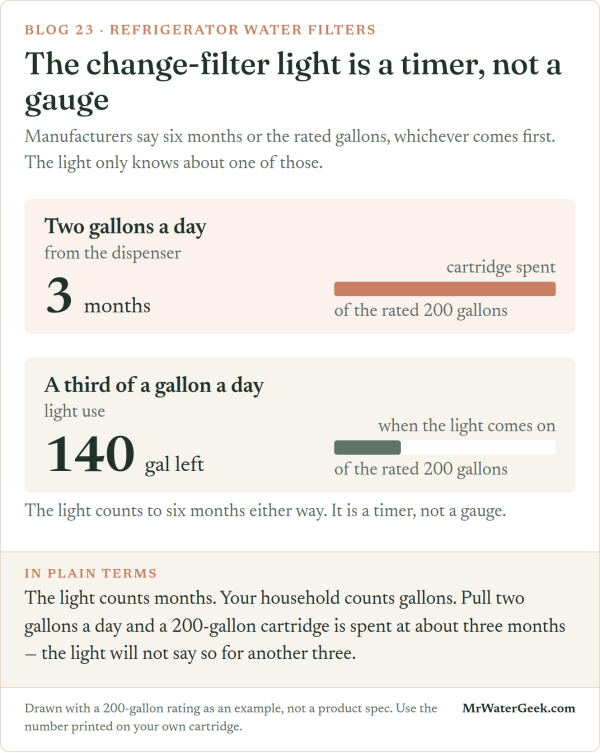
3. Activated carbon block. Not loose carbon granules — a block. A carbon block is compressed into a solid matrix that does double duty: it adsorbs chlorine, taste, and some organics, and its physical structure also acts as a depth filter. Quality carbon blocks carry an absolute micron rating in the 0.5–1 micron range, which puts them in the game for microplastics as a mechanical strainer, not because carbon chemistry attracts plastic. The distinction matters, because a loose-media pitcher shares the word “carbon” with a certified block and shares almost none of the performance.
By Filter Category: What Works and What Doesn’t?
Marketing blurs these together. Physics doesn’t. Category by category, by what you’d actually buy:
| Filter category | Reduces microplastics? | Why |
|---|---|---|
| Standard pitchers | Unreliable | Loose carbon + resin built for taste and chlorine; no meaningful absolute micron rating. A few newer pitchers add a rated mechanical stage — those can help. |
| Faucet-mount | Depends on the cartridge | Some use a carbon block with a stated sub-micron absolute rating; many publish no absolute rating at all. No rating, no claim. |
| Under-sink carbon block | Yes — the practical sweet spot | A 0.5–1 micron absolute block strains microplastics mechanically while improving taste, at a fraction of RO’s cost and water use. |
| Reverse osmosis (NSF/ANSI 58) | Yes — most complete | The membrane excludes microplastics along with dissolved contaminants. Trade-offs: wastewater, slower flow, remineralization for taste. |
| Whole-house | Rarely as sold | Most use 5–20 micron sediment stages tuned for grit, not 1-micron plastic. Only counts with a genuine sub-micron absolute stage — verify the spec. |
For most households the under-sink carbon block is the sensible middle — our lead filter guide walks through the same certified-block logic for a different contaminant. If your water profile also shows PFAS or high dissolved solids, RO’s trade-offs are worth it.
One cross-cutting rule: look for certification to NSF/ANSI standards, and know what each means. NSF/ANSI 42 covers aesthetic effects like taste and chlorine. NSF/ANSI 53 covers health-related contaminants. NSF/ANSI 58 covers reverse osmosis. A microplastics-specific claim should be backed by a stated absolute micron rating you can point to, not a vibe. Before any of this, it’s worth pulling your own city water quality report so you’re filtering against your real supply.
Is Bottled Water the Answer? (No.)
People reach for bottled water assuming it’s the clean alternative. The evidence points the other way. A 2018 peer-reviewed study in Frontiers in Chemistry tested 259 bottles across 11 major brands and 9 countries, and found plastic particles in 93% of them — averaging around 325 particles per liter, with some samples far higher. (Frontiers in Chemistry, 2018) Many of those particles were polypropylene, the material used in bottle caps.
Then 2024 raised the ceiling dramatically. The Columbia–Rutgers team, using a sharper imaging method, counted an average of about 240,000 particles per liter in bottled water — ten to a hundred times more than earlier studies, once nanoplastics below a micron were included. PET from the bottle itself and polyamide from the filtration used during bottling both showed up. (PNAS, 2024)
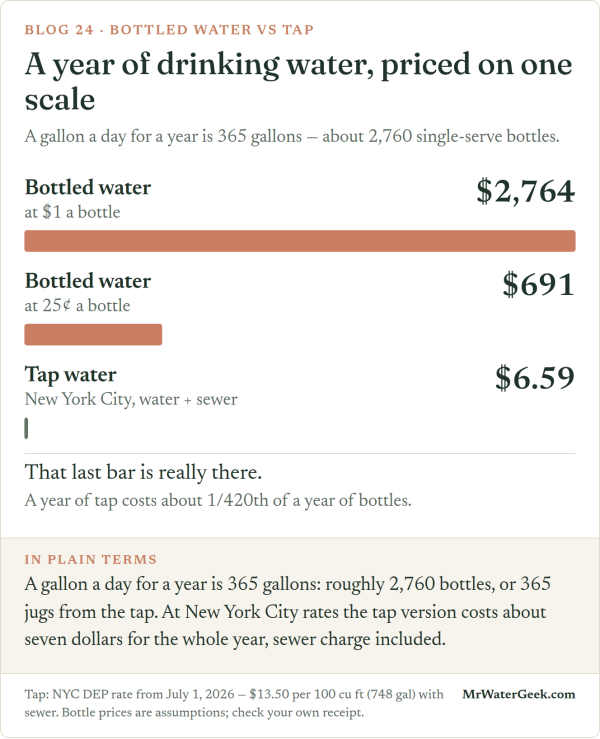
The plastic bottle is part of the exposure, not the escape from it. Filtered tap water through a certified sub-micron or RO system gives you a demonstrable barrier that a sealed plastic bottle can’t. Bottled water solves for convenience, not for particles.
MATCH THE FILTER TO THE WATER
Don’t guess — check what’s in your tap first.
Two minutes and your ZIP gets you the contaminant profile that tells you whether a sub-micron block, RO, or nothing at all is the right call.
FAQ
Do I need a microplastics water filter, or am I fine? That depends on how you weigh an unquantified risk. The WHO found no evidence of harm at current exposures, but its own assessment calls the data limited — the long-horizon studies that would actually settle the question are decades from maturing. If you want to reduce microplastics in the meantime, a certified sub-micron absolute block or reverse osmosis will do it. If your budget is limited and your water report shows lead or PFAS, address those first — the health evidence there is far stronger.
Does bottled water have fewer microplastics than tap? Usually more, not fewer. Peer-reviewed work found plastic particles in 93% of bottled water tested, and a 2024 study counted roughly 240,000 particles per liter once nanoplastics were included. The bottle and its cap contribute plastic directly. For microplastics in bottled water, the container is part of the problem.
Do standard pitcher filters remove microplastics? Not reliably. Most pitcher cartridges are built for chlorine and taste using loose carbon, with no absolute micron rating that would strain out 1–5 micron particles. A few newer pitchers add a rated mechanical stage and claim microplastic reduction — check for a specific stated rating rather than assuming.
Does boiling water remove microplastics? Not on its own — boiling doesn’t destroy plastic particles. Some research suggests that in hard water, boiling can trap microplastics inside limescale that then settles or gets strained out, but that’s inconsistent and depends on your water’s hardness. It’s not a substitute for a rated filter.
What micron rating do I need for microplastics? Look for an absolute rating of about 1 micron or below — 0.5 micron is better. The word “absolute” is doing the work: a “nominal” 1-micron filter leaks a meaningful fraction of particles at that size, while an absolute-rated one is validated to remove around 99.9%. A rating with no qualifier tells you little.
Is reverse osmosis overkill just for microplastics? Possibly, if microplastics are your only concern — a certified sub-micron carbon block reaches them at lower cost and without wastewater. RO makes sense when your water also carries dissolved contaminants like PFAS, nitrate, or high total dissolved solids, because then one system handles everything at once.
Shashank — 9 years at Kohler building water products. Currently building the next generation of water health products.