A water filter pitcher pours tap water through a cartridge of loose granular carbon using nothing but gravity. That design makes it cheap and portable, and it caps what the filter can do: most pitchers are certified for chlorine taste and odor rather than health contaminants, and the ones certified for lead say so explicitly on the box.
Key Takeaways — Are pitcher filters worth it?
For taste, yes, and that’s a real reason to own one. The problem is that most people buy a pitcher believing it handles lead or PFAS, and most pitchers were never tested for either. Read the certification, not the marketing. And whatever you buy, the cartridge is rated in gallons rather than months — a family of four burns through one far faster than the box implies.
BEFORE YOU BUY
A pitcher can only fix what it was tested for
Find out what’s actually in your water first — it takes about 30 seconds by ZIP.
What a Water Filter Pitcher Actually Does
Every pitcher works the same way. You fill a reservoir, water sinks through a cartridge under its own weight, and it collects in the lower chamber. No pump, no pressure, no plumbing.
What’s inside the cartridge is usually loose granular activated carbon, sometimes mixed with an ion-exchange resin. Granular carbon means separate particles with gaps between them, which matters more than it sounds. Water takes the path of least resistance, so some of it slips between granules with barely any contact at all. A compressed carbon block, the kind in an under sink filter, forces every drop through a solid porous wall instead.
Gravity compounds the difference. Under sink filters run on household pressure, roughly 40 to 60 psi, which pushes water through dense media at a controlled rate. A pitcher has only the weight of the water above the cartridge. That’s why filtering a pitcher takes minutes while a faucet runs immediately — and why pitcher cartridges are built loose enough to let water through at all.
None of this makes pitchers bad. It makes them a category with a ceiling. Ask a pitcher to improve taste and it does that well. Ask it to strip a dissolved health contaminant and you need to check whether that specific model was actually tested for the job.
What Pitchers Handle, and What They Don’t
The category is broad enough that blanket statements fail. Some pitchers carry serious health certifications; most don’t. Here’s how the common concerns break down.
| Concern | Typical pitcher | What decides it |
|---|---|---|
| Chlorine taste and odor | Handles it well | NSF/ANSI 42 — the certification nearly every pitcher carries |
| Lead | Only if certified for it | NSF/ANSI 53 with lead named on the performance data sheet |
| PFAS | Rarely | NSF/ANSI 53 with the specific PFAS compounds listed |
| Fluoride | No | Ordinary carbon does little; removal needs reverse osmosis or specialty media |
| Microplastics | Unreliable | Loose carbon has no absolute micron rating to strain particles |
| Hardness | No | Softening requires ion exchange with a regenerating resin bed |
The pattern is that the aesthetic job is nearly universal and every health job is conditional. A pitcher certified only to NSF/ANSI 42 has been tested for taste and odor and nothing else — it can leave lead completely untouched while making the water taste noticeably better, which is exactly the combination that misleads people. Our guide to NSF certified water filters covers how to read a performance data sheet properly.
The Capacity Math Nobody Runs
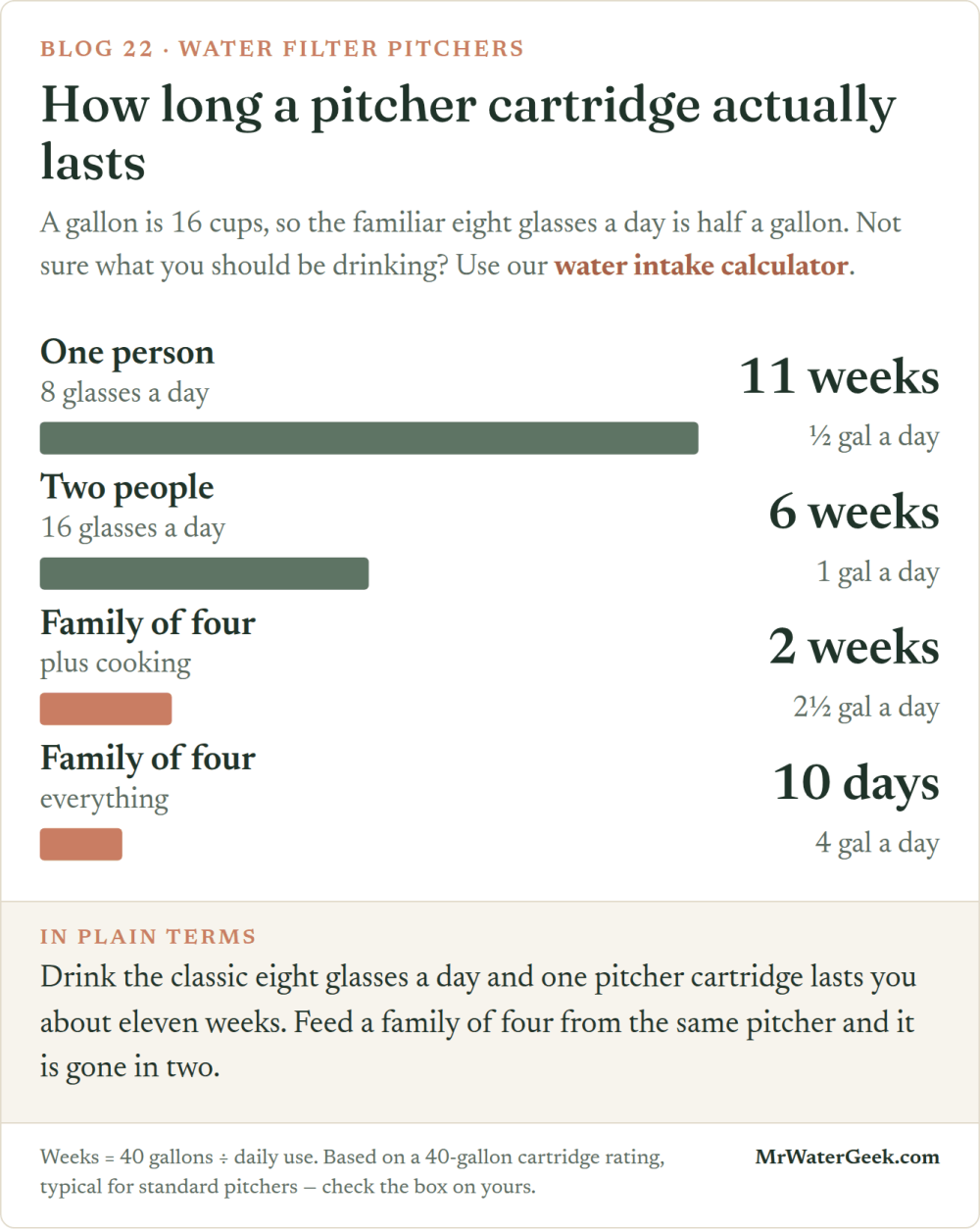
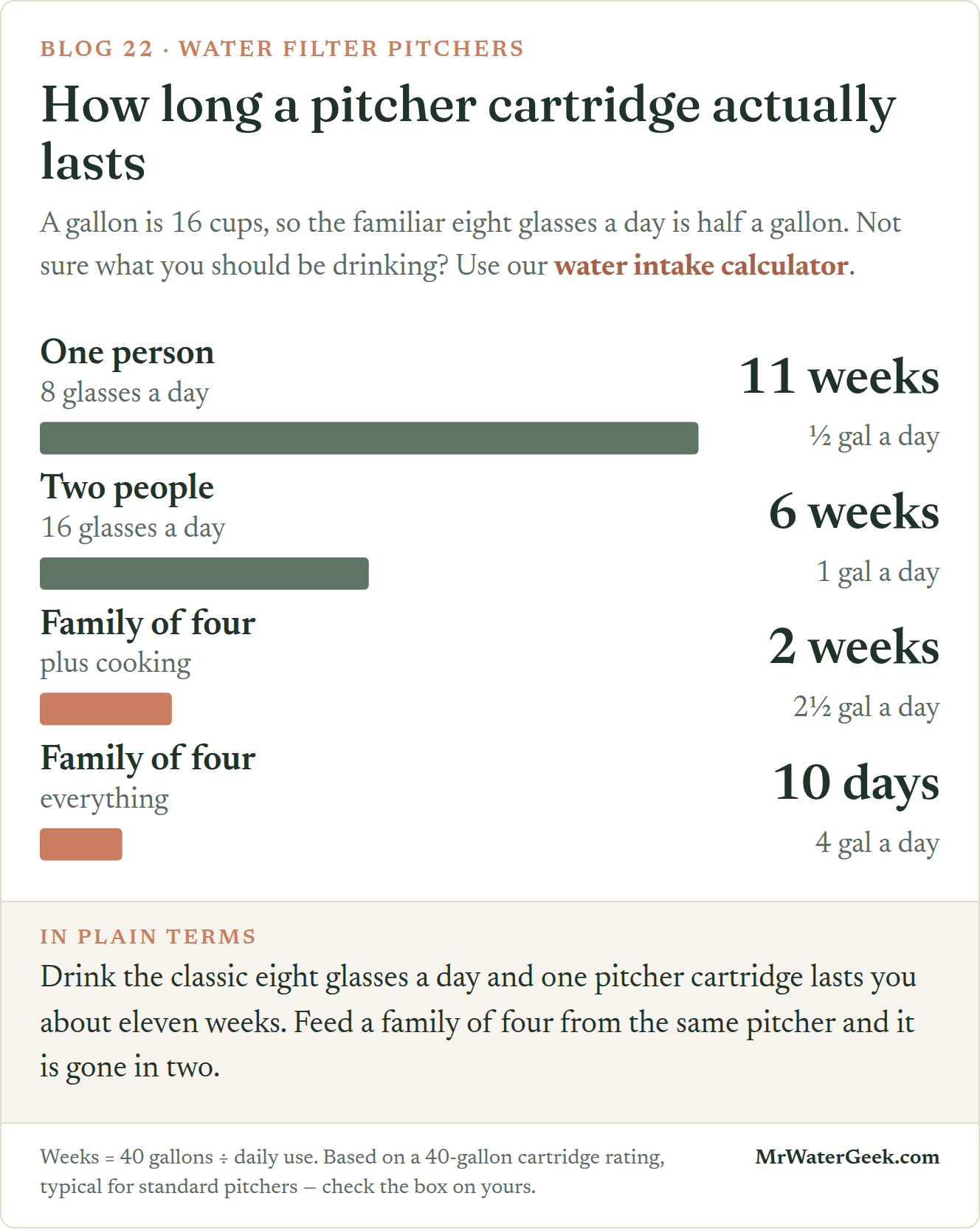
Cartridges are rated in gallons, not months, and the two only line up for a household of about one. Most standard pitcher cartridges are rated around 40 gallons. Manufacturers translate that into “about two months” using an assumed daily volume that may look nothing like yours.
| Household | Rough daily use | 40-gallon cartridge lasts |
|---|---|---|
| One person, drinking water only | ~0.5 gal | Around 11 weeks |
| Two people, drinking and coffee | ~1 gal | Around 6 weeks |
| Family of four, drinking and cooking | ~2.5 gal | Around 2 weeks |
| Family of four using it for everything | ~4 gal | Around 10 days |
Running past the rating isn’t a neutral act. A carbon cartridge that has adsorbed contaminants to its capacity can begin releasing them back into the water, so an overdue cartridge can perform worse than no cartridge at all. If a pitcher is your household’s main source of drinking and cooking water, budget for cartridges on a gallon basis and treat the calendar estimate as marketing.
MATCH THE FILTER TO THE PROBLEM
Which contaminant are you actually filtering for?
Your local report names what’s been detected. That’s the list your certification has to match.
The Reservoir Nobody Cleans
Pitcher ownership has one maintenance problem that gets almost no attention. A pitcher holds standing water at room temperature, often on a counter in daylight, for hours or days at a stretch. Every other filter in your house sits in a sealed pressurized line where water is moving.
Standing water at room temperature is where biofilm establishes itself — the slick film you can feel on the inside of a reservoir that hasn’t been washed in a while. It isn’t dangerous in a healthy household, but it will undo the taste improvement you bought the pitcher for, and it’s the most common reason a pitcher starts tasting stale before its cartridge is spent.
The fix is unglamorous: wash the reservoir and lid with soap and water weekly, let the parts dry fully before reassembling, and don’t top off old water with new. Refrigerating the pitcher slows the whole process considerably. If your pitcher has developed a taste that a fresh cartridge doesn’t fix, the cartridge was never the problem.
When a Pitcher Is Genuinely the Right Call
A pitcher is the right buy when the constraints are real. You rent and can’t modify plumbing. You want better-tasting water and your report shows nothing worse than chlorine. You’re one or two people, so the cartridge economics work. You need something portable — a dorm, an office, a rental you’ll leave in six months.
It stops being the right tool when your water report turns up something specific. If lead, PFAS, or nitrate is documented in your area, you want a device certified for that contaminant, and at that point a plumbed-in option costs less per gallon and delivers water at full flow. Our comparison of kitchen faucet water filters lays out how the categories stack up, and the lead filter guide covers the certified route if lead is your concern.
The mistake isn’t buying a pitcher. It’s buying one to solve a problem it was never tested against, and never checking which problem that was.
ONE LAST CHECK
Diagnose first, then pick the pitcher
Thirty seconds with your ZIP tells you whether a pitcher is enough or whether you need certification.
If you’re still deciding whether you need any filter at all, start with whether you need a water filter, then compare the plumbed-in options in our under sink filter guide.
FAQ
Do water filter pitchers remove lead? Only the models certified for it. Look for NSF/ANSI 53 with lead named on the performance data sheet, which a minority of pitchers carry. A pitcher certified only to NSF/ANSI 42 has been tested for chlorine taste and odor, and it can improve the taste of leaded water without reducing the lead at all.
How often should you change a pitcher filter? By gallons, not by the calendar. Most standard cartridges are rated around 40 gallons, which a single person may take eleven weeks to reach and a family of four can hit in two. Running past the rating matters, because a saturated carbon cartridge can release contaminants it previously captured.
Are pitcher filters better than tap water? For taste, usually yes. For health contaminants, only if the model is certified for the specific contaminant your water contains. If your water report is clean and you simply dislike the chlorine, a pitcher is a sensible purchase. If it shows lead or PFAS, a pitcher is the wrong category unless it carries that certification.
Why does my filtered water taste stale? Usually the reservoir rather than the cartridge. Pitchers hold standing water at room temperature, which lets biofilm develop on the plastic surfaces. Wash the reservoir and lid weekly, dry them fully, avoid topping off old water with new, and keep the pitcher refrigerated if you can.
Do pitcher filters remove fluoride? No. Ordinary activated carbon does very little for fluoride, which is dissolved and chemically stable. Removing it takes reverse osmosis or specialty media such as activated alumina, neither of which fits in a gravity-fed pitcher.
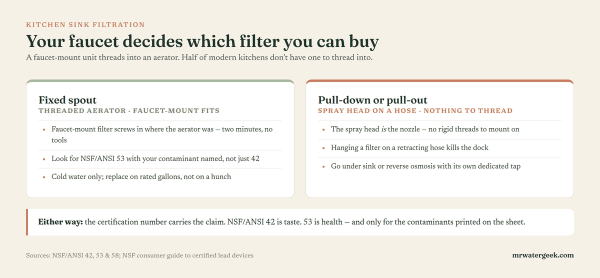
Is a pitcher or a faucet filter better? A faucet-mount filter gets more contact time under household pressure and doesn’t hold standing water, so it generally outperforms a pitcher on both fronts. The catch is fit: faucet-mount units need a fixed spout with a threaded aerator and won’t attach to a pull-down faucet. A pitcher works with any sink and any lease.
Shashank — 9 years at Kohler building water products. Currently building the next generation of water health products.