
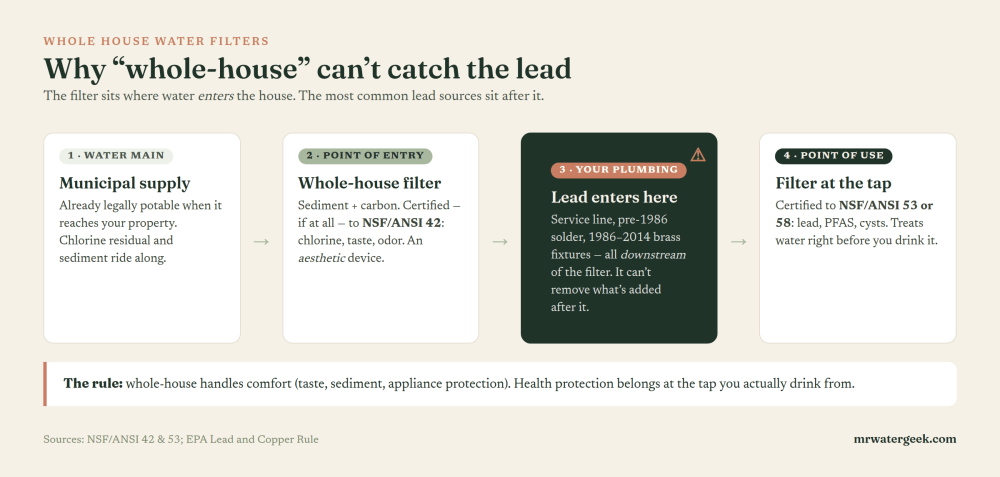
A whole house water filter (also called a point-of-entry or POE system) installs on your main supply line and treats every drop of water entering your home — every shower, every toilet flush, every load of laundry. It’s easy to assume that “whole-house” means “fully protected.” It doesn’t. Most whole-house systems are built to do one thing well — reduce chlorine and sediment so your water tastes and smells better — and they’re certified, if at all, for aesthetics (NSF/ANSI 42), not health (NSF/ANSI 53). They make every tap more pleasant. What they mostly don’t do is remove the contaminants that actually threaten health — and they can’t touch the lead your own pipes add after the water leaves the filter. For well water with sediment, iron, or hardness, a whole-house system is exactly the right tool. For everyone else, the risk isn’t wasting money — it’s the false confidence that the water is now “clean.” This guide is about the gap between “filtered” and “safe.”
Key Takeaways — Does “whole-house” actually protect you?
“Whole-house” sounds like total protection. It isn’t. A standard whole-house filter is an aesthetic device — certified to NSF/ANSI 42 for chlorine and taste, rarely to NSF/ANSI 53 for health effects like lead and PFAS. It can’t touch the lead your own pipes add downstream. Well water with iron, sediment, or hardness? Buy it. Drinking-water safety? That job belongs at the tap. Read the certification, not the label.
Free · 30 seconds
Before you size a system, find out where your problem actually is.
Look up what your utility has detected by ZIP code — it usually tells you whether you have a whole-house problem or a kitchen-tap problem.
What does a whole-house water filter actually do?
A whole-house system (also called point-of-entry or POE) installs on the main water supply line where it enters your home. Every gallon of water, hot or cold, that passes through your plumbing goes through the filter first.
The most common configurations:
Sediment + carbon. A sediment pre-filter (typically 5-micron) catches particles, followed by a granular activated carbon (GAC) or catalytic carbon tank that reduces chlorine, chloramine, some VOCs, and taste/odor compounds. That’s the standard “whole-house water filter” most people picture. It improves the general quality and taste of all water in the home. Systems run $600–$1,500 for the equipment; professional installation adds $300–$800. The carbon media lasts 5–10 years depending on water volume and chlorine levels; the sediment filter needs replacement every 3–6 months. (Installed-cost figures are typical market estimates and vary by system and region.)
Water softener (ion exchange). Removes hardness minerals — calcium and magnesium — and replaces them with sodium. Softeners are specific to hardness above 7 GPG where scale buildup damages appliances, clogs pipes, and leaves residue on everything. Water softeners don’t remove health-effect contaminants. Salt-free conditioners are an alternative for moderate hardness (below 10 GPG). They make minerals less likely to form scale but don’t actually remove them, and no NSF certification standard exists for salt-free conditioning. (Reference: NSF/ANSI 44, water softeners.)
Iron / manganese removal. Oxidizing filter systems (air injection, greensand, birm) that convert dissolved iron and manganese into solid particles that can be trapped and backwashed out. These are necessary for well water with iron above 0.3 mg/L (orange staining) or manganese above 0.05 mg/L (black staining). Iron and manganese at levels this high are a genuine whole-house problem, because the staining affects laundry, toilets, showers, and fixtures throughout the home.
Whole-house RO. Yes, these exist. They cost $4,800–$8,000+ installed, require a storage tank (because RO is slow), and waste significant water. They’re rare in residential settings for good reason: the cost-per-gallon is dramatically higher than a point-of-use RO at the kitchen tap, and you don’t need RO-quality water in your toilets. The primary use case is extreme water quality situations like very high Total Dissolved Solids (TDS) well water, severe contamination, or off-grid systems treating surface water.
Why doesn’t “whole-house” mean “protected”?
Here’s the assumption the category quietly encourages: the whole house is filtered, so the water must be clean. It’s an easy leap to make, and it’s wrong.
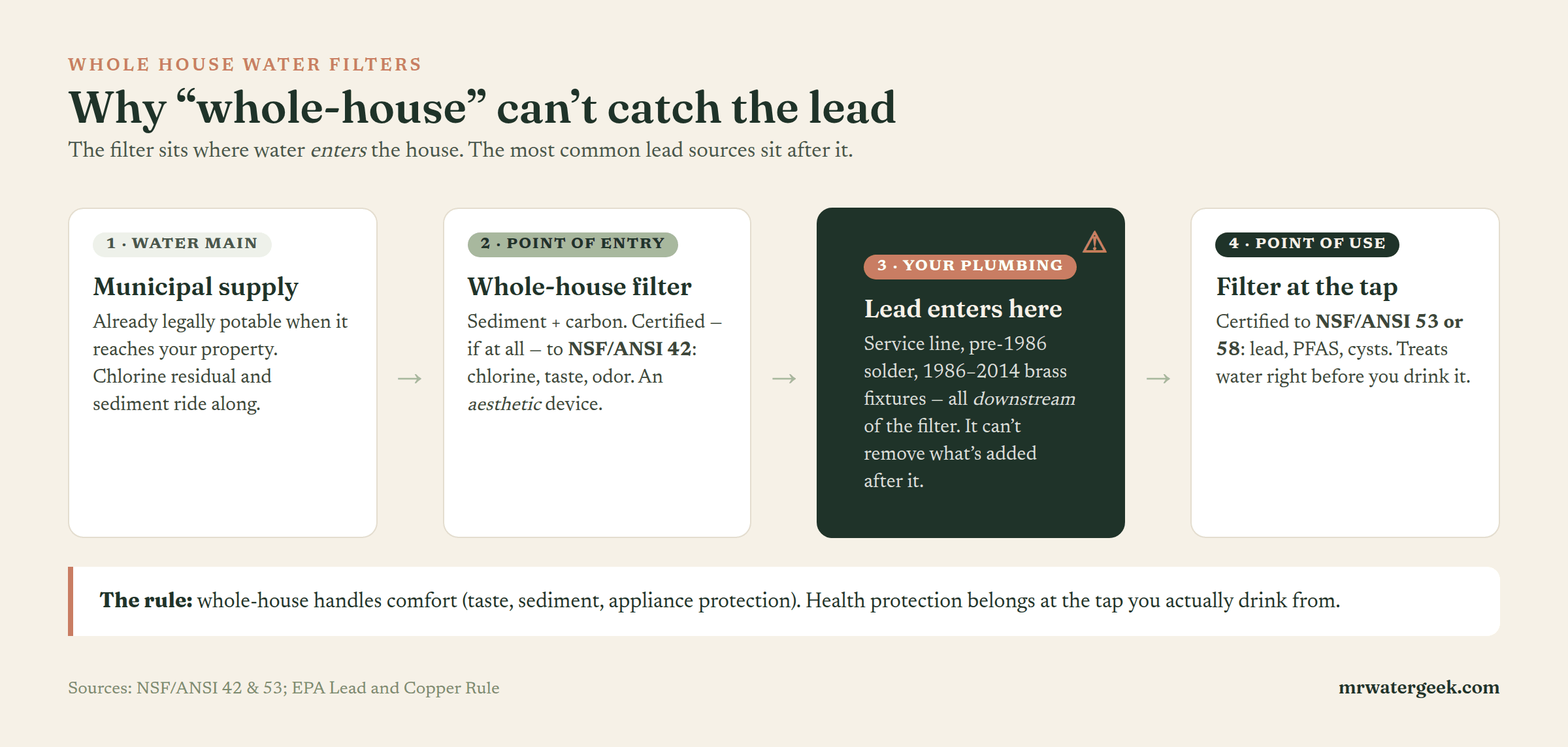
A standard whole-house system is a sediment filter plus a carbon tank. Its job is chlorine, sediment, and taste/odor — real improvements you’ll notice in every shower and glass. But those are aesthetic improvements, and that’s exactly how they’re certified: to NSF/ANSI 42 (aesthetic effects). The standard that covers contaminants with an actual health effect — lead, VOCs, cysts, PFAS, chromium — is NSF/ANSI 53, and whole-house systems are rarely certified to it. Achieving 53-level reduction at whole-house flow rates is hard, because the water moves through the media too fast for the contact time health-contaminant removal requires. Plenty of whole-house systems carry no full-system certification at all — just “tested to NSF standards,” which is not the same as certified. A handful of purpose-built systems are the exception — a few premium whole-house units carry genuine NSF/ANSI 53 or 58 certification — but they’re rare, and priced like it.
To be clear about what this does and doesn’t mean: if you’re on municipal water, your water was already legally potable before it reached your filter. The whole-house system didn’t make it safe — it made it taste better. The trouble starts when that taste improvement gets read as a health guarantee it was never designed to be.
And for the contaminants that matter most, the whole-house filter is in the wrong place anyway. Lead is the clearest example: it enters your water from your own service line, solder, and faucet brass — downstream of a filter mounted where the water enters the house. A whole-house filter can’t remove a contaminant that’s added after it. PFAS needs contact time and specific media most whole-house carbon doesn’t provide. Disinfection byproducts keep forming in your pipes after the filter. The one job you’d most want “whole-house” to cover is the one it structurally can’t.
How to check yours in ten seconds: read the certification claim. If it says “reduces chlorine, taste, and odor,” that’s NSF/ANSI 42 — aesthetic. It tells you nothing about lead, PFAS, or VOCs. A better-tasting glass of water is not a safer one.
When does a whole-house system make sense?
There are legitimate scenarios where whole-house treatment is the right approach. These scenarios all share a common thread: the problem affects water at every fixture, not just the kitchen tap.
Well water with sediment, iron, or hardness. If your well water test shows sediment, elevated iron/manganese, or hardness above 7 GPG, these are whole-house problems. Sand will wear out your dishwasher. Iron will stain your laundry. Scale will calcify your water heater. You need treatment at the point of entry before the water reaches any appliance or fixture.
Municipal water with aggressive chlorine/chloramine. If your water has a strong chlorine taste and smell in every shower, every glass, every pot of pasta, and your CCR confirms high residual chlorine or chloramine, a whole-house carbon filter makes the entire home more pleasant. The distinction here is that chlorine residual isn’t a health hazard at municipal levels. The real concern with chlorine is its byproducts — trihalomethanes and haloacetic acids that form in distribution pipes when chlorine reacts with organic matter naturally present in water. These byproducts can carry health risks after prolonged ingestion. But because those byproducts matter when ingested, not through bathing, a point-of-use filter at the kitchen tap addresses the health dimension without needing whole-house treatment.
Homes with extensive older plumbing. If your home has galvanized steel pipes, copper pipes with lead solder (pre-1986), or a lead service line, every fixture in the home could be contributing contaminants. In this case a whole-house strategy has a role, but the most effective intervention is often replumbing, not filtering. A whole-house carbon filter won’t remove lead that your pipes add after the filter. The physics don’t work — the contaminant enters downstream of the treatment.
Rural properties with surface water or spring sources. Homes using surface water like creeks, springs, or cisterns need whole-house disinfection at minimum — ideally UV combined with sediment and carbon filtration. That’s a public health question, not a preference question.
Free tool
Whole-house or under-sink? Let your water data decide.
See the contaminants reported for your address, then match the fix to the problem — not the marketing.
When is a whole-house system overkill?
More often than the industry wants you to think.
You’re on municipal water and your CCR looks clean. If your water quality report shows all contaminants below the MCLG and you have post-2014 plumbing, a whole-house filter is solving a problem you don’t have. If you want the peace of mind of filtered drinking water, a $200–$400 under-sink carbon filter with NSF/ANSI 53 certification gives you better contaminant reduction at the kitchen tap than most whole-house systems can achieve, because the water contact time through a point-of-use filter is longer and more targeted.
Your concern is lead or PFAS. Lead enters your water via your actual plumbing system — service lines, solder joints, and faucet brass. A whole-house filter installed at the point of entry can’t remove lead that leaches from pipes after the water has passed through it. The lead contamination happens between the filter and your faucet. The only effective treatment is point-of-use: a certified filter at the kitchen tap that treats the water right before you drink it. The same logic applies to PFAS — while whole-house carbon can reduce PFAS levels, a point-of-use RO or carbon system certified under NSF/ANSI 53 or 58 is more effective and dramatically cheaper per gallon for the water you actually consume.
You rent, or you live in a condo/apartment. Whole-house systems require access to the main water line and, usually, homeowner permission plus a plumber. If you don’t own the property or don’t have access to the point of entry, a whole-house system isn’t an option. A point-of-use filter like a faucet-mount, countertop, or under-sink filter is your only practical path. Roughly a third of U.S. households are renters, and whole-house filtration isn’t available to most of them. The industry barely acknowledges this. (Source: U.S. Census Bureau, Housing Vacancies and Homeownership survey.)
You’re worried about shower water. The internet is full of claims about chlorine absorption through the skin during showers. The data is less dramatic than the marketing suggests. Chlorine at municipal levels is not a significant health exposure through bathing. Shower filters (a $20–$40 KDF or vitamin C filter at the showerhead) can reduce chlorine if the sensation bothers you or you have sensitive skin, but they’re a comfort purchase, not a health intervention. A whole-house system to eliminate shower chlorine is spending $2,000+ for what a $30 showerhead filter can approximate.
How do whole-house and point-of-use costs compare over time?
The numbers matter because the cost difference is substantial, and it compounds over 10 years.
| System | Initial cost | Annual maintenance | 10-year cost |
|---|---|---|---|
| Whole-house sediment + carbon | $900–$2,300 | $100–$250 | $2,000–$4,800 |
| Under-sink carbon (NSF 53-certified) | $150–$400 | $60–$120 | $750–$1,600 |
| Under-sink reverse osmosis | $300–$700 | $80–$180 | $1,100–$2,500 |
| Whole-house softener + carbon + point-of-use RO | $2,500–$5,000 | $300–$600 | $5,500–$11,000 |
The point-of-use system costs less because it treats less water. You only need high-quality contaminant removal at the kitchen tap, where you fill your glass, make coffee, cook, and prepare baby bottles. You don’t need it at the garden hose. The whole-house approach treats every gallon equally, including the 70%+ that goes to toilets, laundry, and outdoor use.
For homes that actually need whole-house treatment (well water with iron, high sediment, extreme hardness), the cost is justified because the problem is whole-house. For homes where the issue is drinking water quality on municipal supply, the math tilts heavily toward point-of-use.
What about the “what if I’m missing something” fear?
That fear is the real driver behind most whole-house purchases on municipal water. It’s not that the data says people need it — it’s that whole-house filtration feels more protective. If you filter everything, you can’t miss anything. Right?
Not exactly. A whole-house carbon system reduces chlorine and some VOCs effectively across the home. It does not provide meaningful reduction of lead (which enters downstream), PFAS (which requires higher contact time and specialized media), or disinfection byproducts (which continue forming in your pipes after the filter). For the contaminants that actually matter for health, a targeted point-of-use system with specific NSF certification is more protective than a general whole-house carbon filter.
The “belt and suspenders” approach — whole-house carbon plus point-of-use at the kitchen tap — exists and isn’t unreasonable if the budget allows. The whole-house handles chlorine, sediment, and general water quality everywhere, while the point-of-use handles the health-critical contaminants where you drink. But understand which part does which job: the point-of-use system is doing the heavy lifting on health protection. The whole-house system is providing comfort and appliance protection.
How do you decide what you actually need?
Start with two questions.
What did your water test or CCR show? If the answer is “sediment, iron, hardness,” that’s a whole-house problem. If the answer is “lead, PFAS, THMs, or another health-effect contaminant,” that’s a point-of-use problem. If the answer is “both,” you might need both — but the point-of-use filter is the priority, because it’s the one protecting the water you drink.
Do you own your home? If you rent, whole-house filtration is off the table. Focus on the best point-of-use system for your situation. If you own, you have the full range of options — but “having the option” doesn’t make it the right option.
The filter industry’s business model rewards selling larger, more expensive systems. Whole-house filters carry higher margins than under-sink filters, and installation creates a recurring professional service relationship. The incentive is to make you feel like the bigger system is always the better system.
Sometimes it is. For a well-water home with iron staining, hard water, and sediment, a whole-house system isn’t just appropriate — it’s necessary, and nothing at the kitchen tap will fix a problem that’s staining every fixture in the house. But for a family on city water in a home built in 2018, worried about PFAS and lead? A $300 under-sink RO with NSF/ANSI 58 certification treats every glass of water they drink, and the $3,000 whole-house system they almost bought would have missed the lead from their own pipes anyway.
The question isn’t “which system is better.” It’s “where is the problem, and where should the solution be?”
Before you buy
Don’t pay for coverage you don’t need.
Check what’s actually in your water by ZIP code, and spend on the problem you have — not the one the marketing invented.
FAQ
Do I need a whole-house water filter if I have city water? Usually not for health reasons. Municipal water is treated and tested. If your CCR shows compliance and your home has post-2014 plumbing, a point-of-use filter at the kitchen tap is more targeted and cost-effective. Whole-house makes sense on city water mainly for chlorine taste/odor throughout the home, or to protect appliances from scale if you have hard water.
What’s the difference between a whole-house filter and a water softener? A whole-house filter (typically carbon) reduces chlorine, sediment, and some chemicals. A water softener (ion exchange) removes hardness minerals and replaces them with sodium. They solve different problems and are often installed together. Softeners don’t remove contaminants; filters don’t remove hardness. If you need both, they’re separate systems installed in sequence. (Source: NSF International, standards for water treatment systems.)
Can a whole-house filter remove lead? It can reduce lead in the incoming water supply, but it cannot remove lead your own plumbing adds after the filter. If your concern is lead from internal pipes, solder, or faucet brass — the most common lead source in homes — a point-of-use filter at the kitchen faucet is the effective solution. (Sources: EPA, Lead and Copper Rule; NSF/ANSI 53.)
Does a whole-house filter make my water “safe”? It makes it cleaner-tasting, not certified-safe. A standard whole-house system is an aesthetic device — typically certified to NSF/ANSI 42, rarely to the health-effects standard NSF/ANSI 53. It won’t remove downstream lead and doesn’t reliably handle PFAS or disinfection byproducts. Read the certification claim: “reduces chlorine, taste, and odor” is an aesthetic rating, not a health one.
How long does a whole-house water filter last? Sediment pre-filters: 3–6 months. Carbon media tanks: 5–10 years depending on water volume and contaminant load. Softener resin: 10–20 years with proper salt maintenance. UV lamps (if installed): annual replacement. The system as a whole, with proper maintenance, can last 15–20 years.
Is a whole-house water filter worth it for well water? In most cases, yes — specifically for sediment, iron/manganese, and hardness, which affect every fixture and appliance in the home. But pair it with a point-of-use system at the kitchen tap for health-effect contaminants like arsenic, nitrate, or bacteria. The well water filtration guide covers the full diagnostic approach. (Reference: CDC well water testing guidance; EPA private well guidance.)
Shashank — 9 years at Kohler building water filtration. Mr Water Geek translates water science into clear decisions.


