Somewhere under a kitchen sink near you, a membrane is doing something no carbon filter can do. It is straining out dissolved metals, nitrate and PFAS. That makes reverse osmosis the most capable point-of-use treatment you can buy for a home. It is also slow. It sends several gallons down the drain for every gallon it makes. And if the only thing wrong with your water is the taste of chlorine, it is overkill.
Key Takeaways — Is a reverse osmosis system worth it?
If your water report or your lab test names nitrate, arsenic, a radionuclide or PFAS, RO is the right tool. Little else will do. If your complaint is that the water tastes like a swimming pool, slow down. You are about to spend several hundred dollars. You will also send several gallons a day down the drain. All to filter things that might not be in your water at all. The question isn’t whether RO works. It’s whether you have anything for it to remove.
BEFORE YOU SPEND ANYTHING
Find out what’s actually in your water
Your utility already publishes what it detected. Pull yours by ZIP in about 30 seconds.
What Reverse Osmosis Actually Does
The EPA describes it plainly. Pressure forces water through a semi-permeable membrane. Out come two streams: treated water, and reject water. Everything the membrane won’t pass goes down the drain. The system also uses tap water to flush the contaminants stuck on the membrane, and that is where a lot of the water goes.
What makes RO different from every other filter in your house is the size of the opening. The CDC puts the numbers side by side. Microfiltration works at about 0.1 micron. Ultrafiltration at 0.01. Nanofiltration at 0.001. Reverse osmosis at 0.0001. At that scale the membrane isn’t straining particles out of water at all. Water is dissolving through the membrane while dissolved ions are turned away. That’s why RO can take out sodium, nitrate and fluoride, which a carbon block cannot touch.
Why There Are Four Cartridges, Not One
A residential under sink system is usually four stages. Here is the surprise: two of them exist to protect the third, not to clean your water.
| Stage | What it’s for |
|---|---|
| Sediment pre-filter | Catches particles. Per the EPA, the pre-filters are there to extend the life of the carbon and the membrane. |
| Carbon pre-filter | Removes chlorine, which the EPA notes can damage some RO membranes. |
| RO membrane | The actual separation. Where the treatment happens. |
| Post carbon filter | The last thing the water passes on its way to the faucet. |
The carbon pre-filter is the one worth understanding. Most residential membranes are thin-film composite polyamide. Peer-reviewed work on membrane chemistry describes what chlorine does to them. The amine groups oxidize. The layer decomposes. Separation performance degrades. So on municipal water, a neglected carbon pre-filter doesn’t merely stop filtering. It lets chlorine reach the membrane and chemically destroy the most expensive part of the system. That is the practical reason to keep to the schedule. Almost nobody selling these systems explains it.
What an RO System Is Certified For
RO systems are certified under NSF/ANSI 58. That is a different standard from NSF/ANSI 53. Standard 53 is usually applied to carbon filters, but it can be used for any filter. Under 58, exactly one contaminant claim is mandatory: total dissolved solids. Everything else is optional, tested individually, and listed individually.
The optional claims are a long list: arsenic, hexavalent and trivalent chromium, nitrate and nitrite, lead, cadmium, barium, cyst, fluoride, copper, turbidity, VOCs, asbestos, perchlorate, radium and selenium. A system carrying the mark is not certified for all of them. It is certified for whichever ones appear in its listing. That is why the listing is the thing to read, not the box. Our guide to NSF certified water filters walks through one of those entries. The databases themselves are public: NSF at info.nsf.org/Certified/DWTU and WQA at wqa.org/find-products.
Two details in that list are easy to misread. The first is arsenic, and it needs a little chemistry. Arsenic shows up in water in two forms. Chemists call them arsenate (the “pentavalent” form, often written As(V)) and arsenite (the “trivalent” form, As(III)). Think of them as the same element wearing two different coats. Arsenate carries a charge that an RO membrane can catch, so RO’s certified arsenic claim covers arsenate only. Arsenite is the more toxic of the two and slips through more easily, which is why the EPA notes that it generally has to be converted to arsenate first, by oxidation or a pH adjustment, before RO will reliably remove it. Here is the catch for well owners: arsenite is common in exactly the kind of low-oxygen groundwater where people buy RO for arsenic in the first place. So if your lab report shows arsenic, ask the lab which form it is, or ask for a test that separates the two, before you decide an RO system is the fix.
Second, certification attaches to the complete system as tested. NSF states that only complete systems are eligible to make contaminant reduction claims. So a third-party replacement cartridge is not covered by the listing the original carried.
The PFAS Gap Nobody Mentions
This one deserves its own section. It is counterintuitive, and it comes straight from the government.
NSF’s PFAS reduction claim certifies that a system brings total PFAS below 20 parts per trillion. The EPA’s drinking water limit for PFOA and PFOS is 4 parts per trillion. The certification is set five times higher than the federal standard. The EPA says so in its own rulemaking. Point-of-use devices are not currently a compliance option. Why? Because the rule requires treatment below the current NSF/ANSI certification standard for PFAS removal. Washington State’s health department puts it to consumers directly. Today’s PFAS filter certifications, it notes, do not show that a filter will remove PFAS down to the levels the EPA has now set.
That is a gap in the paperwork, not in the hardware. Researchers sampled 73 North Carolina homes and measured what the filters actually did. Every under sink dual-stage and reverse osmosis filter they tested showed near-complete removal of every PFAS compound evaluated. Carbon filters managed roughly 60 to 70 percent on long-chain compounds and only about 40 percent on short-chain ones. That difference is the mechanism behind RO’s advantage. The same study found something worth knowing if you own a whole-house carbon system. Some of them showed increased PFAS levels in the filtered water.
So RO does the job. It just isn’t certified to the number you might assume. If PFAS is your reason for buying, ask the manufacturer what their own testing shows at 4 ppt. Don’t read the certification as a promise.
MATCH THE TOOL TO THE PROBLEM
See what your utility has detected
RO is the right answer for a short list of contaminants. Check whether any of them are on yours.
How Much Water Goes Down the Drain
Most buyers are surprised by how much water an RO system wastes. And, confusingly, when brands do state a water-waste figure, there are usually two different numbers in play: one used for marketing and one that describes actual performance. Here is how to tell them apart.
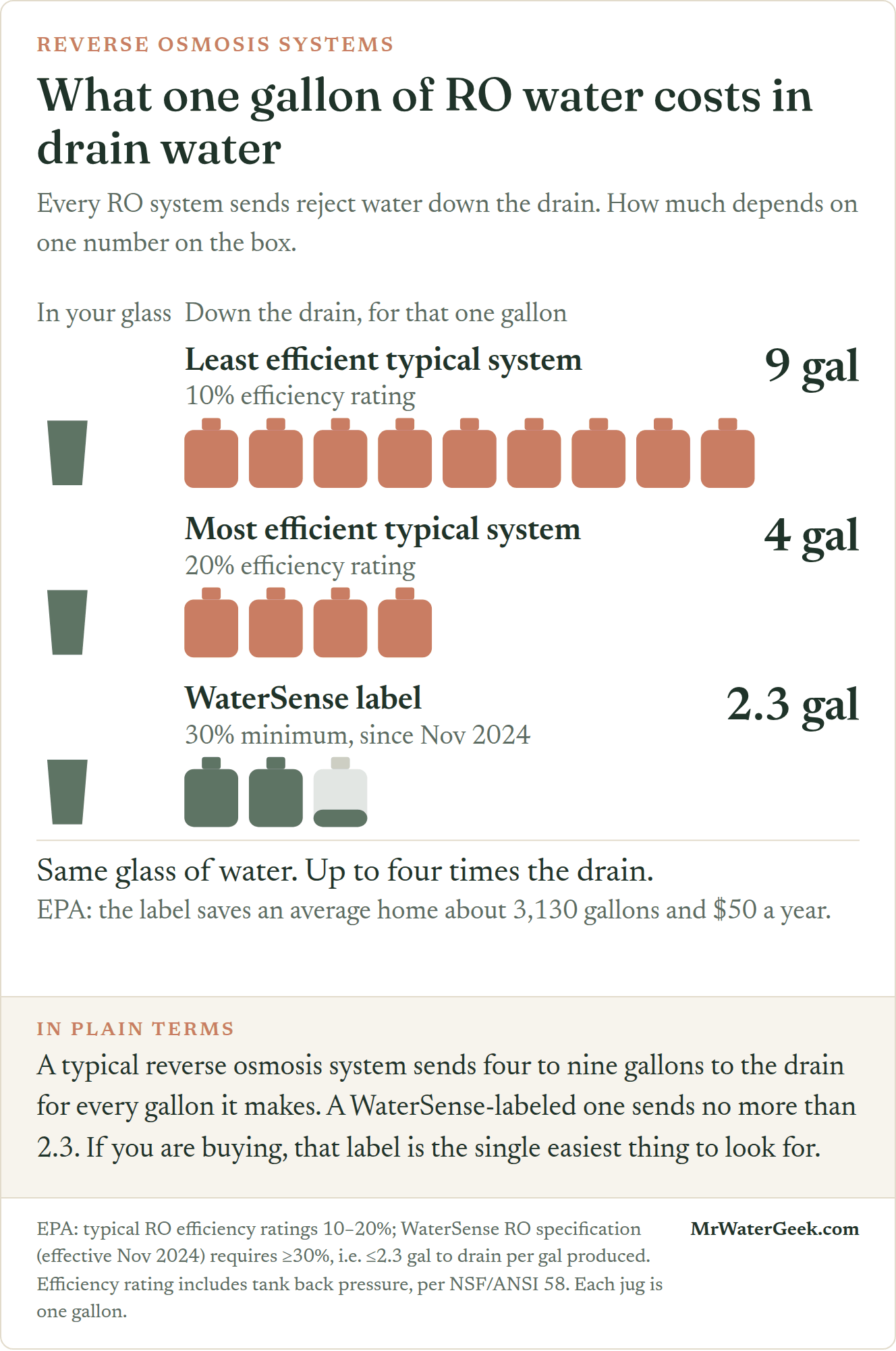
NSF/ANSI 58 defines two different figures. The recovery rating is measured with the storage tank bypassed. The efficiency rating is measured under something like normal use, with the tank’s back pressure included. That second one describes your kitchen. The EPA reports that typical efficiency ratings run 10 to 20 percent. That means roughly four to nine gallons to drain for every gallon delivered. A typical system, the EPA says, generates five or more gallons of reject water per gallon of treated water.
There is a better tier. The EPA’s WaterSense specification for RO systems, effective November 2024, requires a minimum efficiency rating of 30 percent. That is no more than 2.3 gallons to drain per gallon produced. By the EPA’s own arithmetic, moving between those tiers saves an average household a few thousand gallons and roughly fifty dollars a year. If you’re buying, the WaterSense label is the single easiest thing to look for.
Why It’s Slow, and Why There’s a Tank
The membrane produces water far more slowly than a faucet delivers it. So the system fills a small storage tank between draws. The EPA is direct about it. Most point-of-use RO units produce water slowly, so a storage tank is needed to provide adequate water at the tap.
The tank also explains a behavior that confuses people. As the tank fills, its pressure rises toward the incoming water pressure. The EPA calls this back pressure. The pressure difference across the membrane is what drives production. So as the tank fills, production slows, and the ratio of drain water to product water gets worse. That’s the reason for the automatic shutoff valve. It’s also why a failed shutoff valve means a system running to drain continuously.
The practical version: RO refills a tank. Draw a large pot of water and you will out-run it and wait. Low household pressure makes all of this worse.
What Maintenance Actually Involves
| Task | Interval (EPA) |
|---|---|
| Replace pre-filters | Every six months |
| Replace the membrane | Every one to five years, depending on water quality and use |
| Drain the storage tank | About every two weeks |
| Sanitize the tank | Annually |
| Replace the shutoff device | If a malfunction is detected |
Draining the tank every couple of weeks is the one that surprises people. It appears in EPA guidance and in almost no sales material. Minnesota’s health department reports the volume-based version manufacturers often give. Replace filters after 500 gallons or every six months, whichever comes first. The same department puts a point-of-use system at $300 to $1,500 to install. Add $100 to $200 in replacement parts every year or two. A well-maintained system, per the EPA, can last fifteen years.
Bacteria are the reason the intervals matter as much as performance. Washington State’s health department notes that bacteria can grow on a filter that isn’t replaced regularly. The CDC frames maintenance as necessary to keep a filter working and to prevent germs growing in it. Unfortunately, most cartridge filters give you no warning when they’re spent. So you need to stay on top of when to replace them. Time is your first guide. But pay attention to the taste and smell of your tap water too. When either of those changes, there’s a chance one or more of your cartridges are spent.
What Installation Involves — and One Code Trap
An under sink RO needs three things: a cold water connection, somewhere to put the tank, and a drain connection. That last one is where the parts in the box may not match your local code.
Minnesota’s health department is explicit. The waste line must enter the sewer plumbing through an approved air gap or air gap device. Direct connections are not approved backflow prevention. Saddle fittings are prohibited for drain pipes under Minnesota rules. Many under sink RO kits ship with a drain saddle. Plumbing codes are adopted state by state, and locally. So check your own code before trusting what came in the box. The air gap requirement, by the way, is why air gap faucets exist, and why they gurgle.
If you rent, treat this as a landlord conversation rather than a weekend job. A permanent drain connection governed by plumbing code is not something you can undo on move-out day.
Does RO Strip the Minerals Out?
Yes. The interesting part is what health authorities actually say about it. The WHO’s expert report on calcium and magnesium in drinking water is clear. Point-of-use reverse osmosis and distilling devices remove virtually all the minerals from the input water. Using them, it adds, may reduce your overall intake of nutrient minerals.
Then it declines to panic. The WHO sets no minimum mineral concentration for drinking water. Its hardness document says there isn’t enough data to suggest a minimum or a maximum, so it proposes no guideline values. Most dietary calcium and magnesium comes from food. The WHO puts the typical contribution from water at 5 to 20 percent. On adding minerals back to desalinated or RO water, the WHO’s verdict is carefully hedged: adverse effects are unlikely, and positive benefits are possible.
One consequence is more concrete than the mineral question, and it gets less attention. RO removes fluoride along with everything else. If your household drinks and cooks only from an RO tap, on a fluoridated supply, that is a real change. It’s worth a word with your dentist rather than with a filter salesman. We’ve written separately about what removes fluoride.
When RO Is the Right Answer, and When It Isn’t
The CDC gives the rule. Test your water. Then choose a filter that removes the harmful germs or chemicals you are concerned about. RO is worth the money when the problem is a dissolved ion that carbon cannot hold.
| Your situation | Is RO the right tool? |
|---|---|
| Nitrate above the limit on a private well | Yes. Carbon does nothing for nitrate, and boiling concentrates it. |
| Arsenic | Yes, if it’s arsenate (the pentavalent form). Arsenite (trivalent) usually needs oxidation first. |
| Radium, uranium, gross alpha | Yes. The EPA rates RO at least 90 percent effective for radionuclides. |
| PFAS | Yes — the strongest performer measured in real homes, with the certification caveat above. |
| High TDS or salty-tasting well water | Yes. TDS reduction is the one claim every certified system carries. |
| Lead only | Works, but a carbon block certified to NSF/ANSI 53 is cheaper and faster with no waste stream. |
| Cysts only | No. NSF/ANSI 53 carries a cyst claim. |
| Chlorine taste and odor | No. That’s NSF/ANSI 42 territory — a pitcher or faucet filter. |
| Hard water and scale | No. RO treats one tap; scale is a whole-house problem. |
| Bacteria on a well | No. Under NSF/ANSI 58 the only microbiological claim is cyst reduction. |
That last row matters. RO is not a disinfection system. A membrane breach is silent, and there is no disinfectant residual downstream of it. On a well with confirmed bacterial contamination the answer is disinfection, not a membrane.
If you’re weighing RO against the simpler options, we’ve covered under sink systems, water filter pitchers and refrigerator filters on their own terms. And if you haven’t tested yet, start with how to test your tap water. Buying treatment before testing is how people end up with the wrong device.
FAQ
Does reverse osmosis remove PFAS? Yes. In peer-reviewed sampling of 73 homes, under sink RO systems removed nearly all of every PFAS compound evaluated. One caveat: NSF certification for PFAS is set at 20 parts per trillion, while the EPA’s limit for PFOA and PFOS is 4. So the certification is not a promise of compliance-level removal.
How much water does reverse osmosis waste? The EPA reports typical efficiency ratings of 10 to 20 percent. That is roughly four to nine gallons to drain per gallon delivered. WaterSense-labeled systems must reach at least 30 percent, meaning no more than 2.3 gallons per gallon.
How often do you change reverse osmosis filters? The EPA says pre-filters every six months, and the membrane every one to five years depending on water quality and use. Manufacturers often specify 500 gallons or six months, whichever comes first. Keeping to the pre-filter schedule is what protects the membrane from chlorine.
Does reverse osmosis remove minerals, and does that matter? It removes virtually all of them, per the WHO. But the WHO sets no minimum mineral level for drinking water, and most dietary calcium and magnesium comes from food. Its position on adding minerals back: adverse effects are unlikely, and positive benefits are possible. The more concrete change is fluoride, which RO also removes.
Is reverse osmosis better than a carbon filter? For dissolved ions like nitrate, arsenic and fluoride, yes. Nothing else in a home will do it. For chlorine taste, cysts or lead alone, a certified carbon filter is cheaper and faster, wastes no water, and needs no drain connection.
DON’T GUESS
Check what’s in your water first
RO is the right answer for a specific short list. Find out whether you’re on it.
Shashank — 9 years at Kohler building water products. Currently building the next generation of water health products.