Three filtration technologies reliably remove PFAS from drinking
water: activated carbon block (specific grades — not all carbon works),
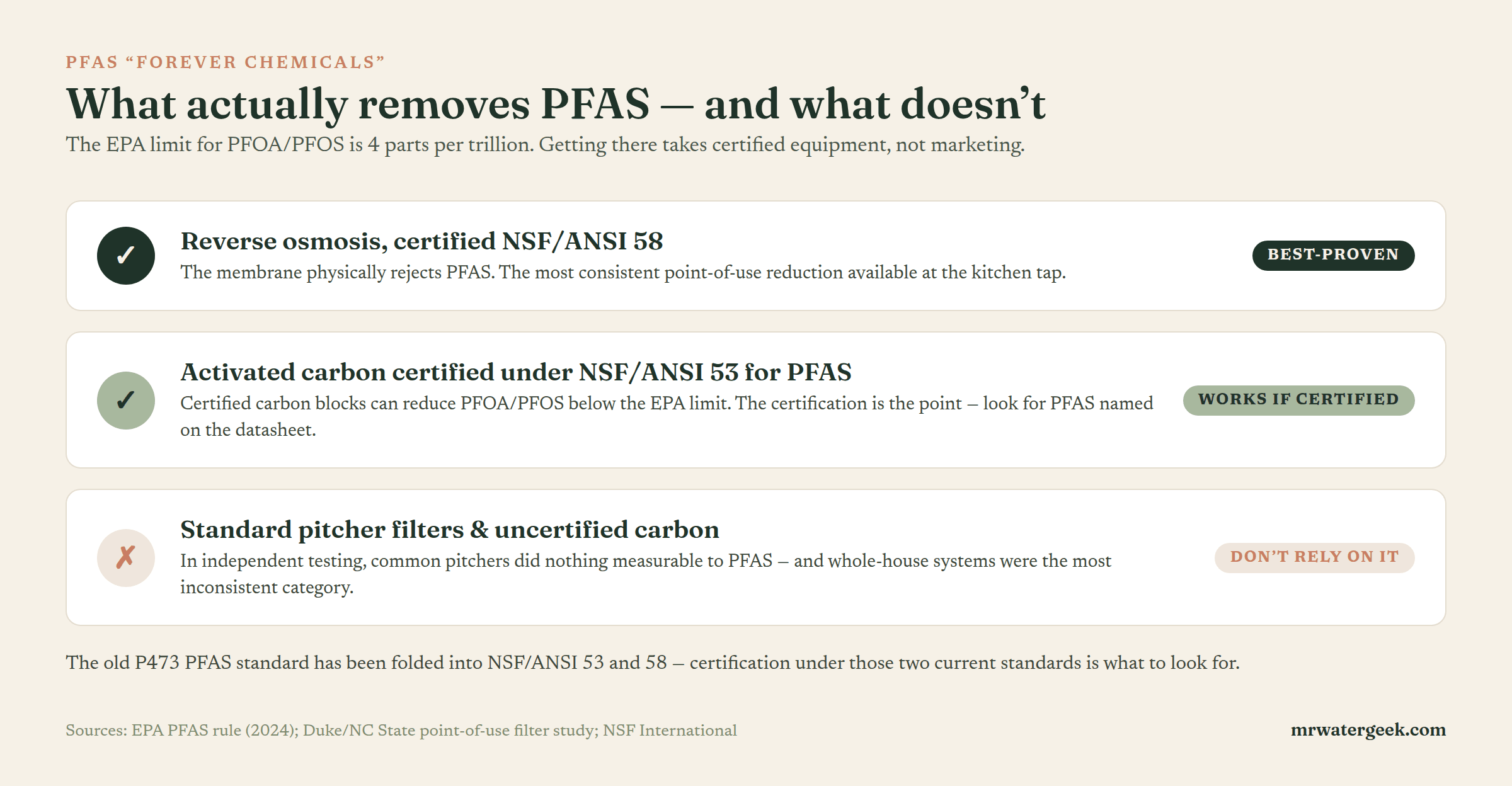
reverse osmosis, and ion exchange resin. The EPA’s
2024 rule set enforceable limits at 4 parts per trillion for
PFOA and PFOS — the two most studied forever chemicals. A filter
verified to NSF/ANSI
53 (carbon and anion-exchange systems) or NSF/ANSI
58 (reverse osmosis) for PFAS reduction is the only reliable way
to confirm a product does what it claims.
Key Takeaways — What actually removes PFAS?
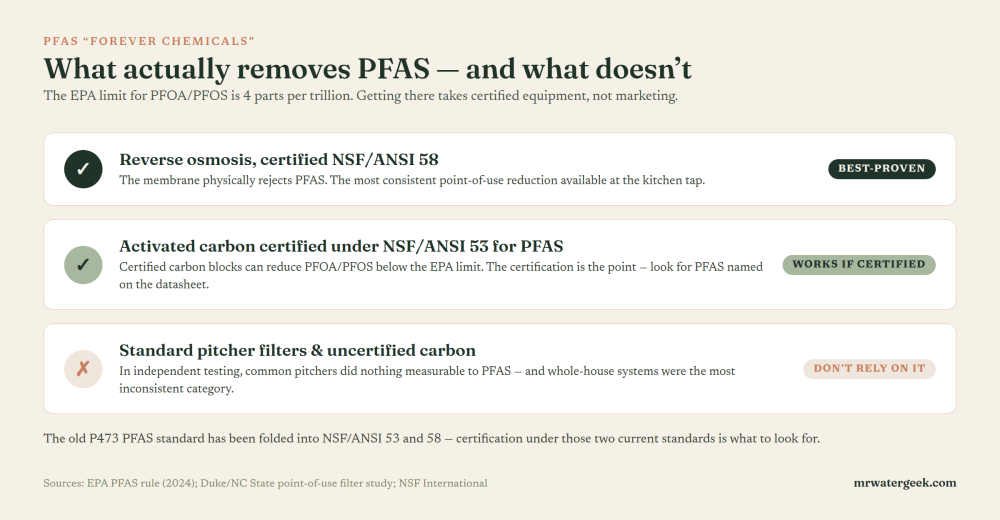
Standard pitcher filters — the kind most households already own — do
nothing measurable to PFAS. A Duke/NC State study tested common
point-of-use filters and found activated-carbon filters removed 73% of
PFAS on average — but with huge variation. Whole-house systems were the
most inconsistent, and a few actually showed higher PFAS in treated
water than in untreated tap. Three technologies have
certification-backed evidence: activated carbon block (but only specific
grades with the right pore structure and density — not all carbon is
equal here), reverse osmosis (94% or more reduction across both
long-chain and short-chain compounds), and ion exchange resin
(particularly effective for the shorter-chain PFAS that carbon struggles
with). If you want one system and don’t want to think about carbon
grades, RO certified to NSF 58 gives you the broadest coverage
available. For carbon block, look for NSF/ANSI 53 with the specific PFAS
compounds listed — “reduces contaminants” on the box is not
verification.
Free · 30 seconds
What’s actually in your tap water?
Enter your zip code and find out in 30 seconds — before you spend anything on a filter.
What are PFAS, and why are they in your water?
PFAS — per- and polyfluoroalkyl substances — are a class of more than
14,000 synthetic chemicals per
EPA’s CompTox database built around carbon-fluorine bonds, one
of the strongest bonds in organic chemistry. That bond is why they don’t
break down. Not in soil, not in water treatment, not in your body. The
nickname “forever chemicals” isn’t marketing — it’s chemistry.
They’ve been manufactured since the 1940s for nonstick coatings,
water-resistant fabrics, food packaging, and firefighting foam (AFFF).
Decades of industrial use and disposal put them into groundwater,
surface water, and eventually into municipal drinking water supplies. A
USGS
study estimated at least 45% of U.S. tap water contains
detectable levels of one or more PFAS compounds. Near military bases,
airports, and industrial sites with AFFF use, contamination can be
orders of magnitude higher.
The health concerns are cumulative, not acute. You won’t feel sick
from drinking PFAS-contaminated water today. The research links
long-term exposure to thyroid disruption, immune system effects, certain
cancers (kidney, testicular), reproductive issues, and elevated
cholesterol. The Agency
for Toxic Substances and Disease Registry (ATSDR) maintains the
most current summary of health evidence. The concern is proportional to
the duration and level of exposure — which is exactly why the EPA
finally set enforceable limits.
What changed with the EPA’s 2024 PFAS rule?
In April 2024, the EPA finalized the first-ever National
Primary Drinking Water Regulation for PFAS. The key numbers:
– PFOA: 4.0 parts per trillion (ppt) MCL
– PFOS: 4.0 parts per trillion (ppt) MCL
– PFHxS, PFNA, HFPO-DA (GenX): Originally included
in a hazard index approach
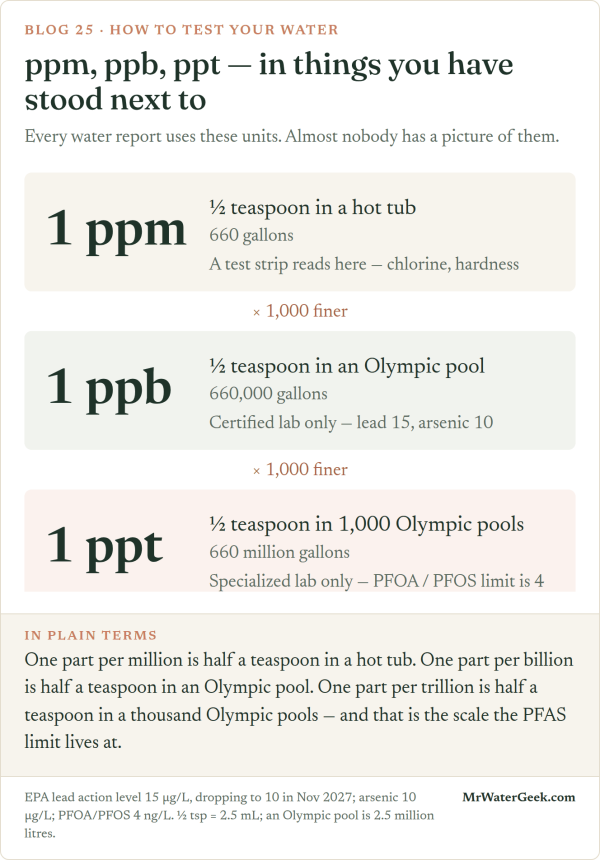
To put 4 ppt in perspective: one part per trillion is roughly
equivalent to a single drop in 20 Olympic swimming pools. These are
among the most stringent drinking water standards the EPA has ever set
for any contaminant.
There’s a significant caveat as of mid-2026. The EPA has proposed
extending the compliance deadline for PFOA and PFOS from 2029 to
2031 for utilities that request an exemption. During the extension, 12
ppt acts as a trigger, not a target: systems whose samples come in at or
above 12 ppt must implement at least two of six specified control
measures, while systems between 4 and 12 ppt only have to notify the
public that they’re operating under an exemption. In other words, water
can legally sit above the 4 ppt MCL for years while the extension runs.
The agency has also proposed
rescinding regulations for PFHxS, PFNA, and GenX entirely.
What this means for you: even if the regulation is fully implemented,
your utility may not be testing for — or treating — PFAS for several
more years. Your Consumer
Confidence Report likely doesn’t include PFAS data yet. If you
want to address PFAS at the point of use, the filtration decision is
yours to make now.
Why do most standard water filters fail at PFAS?
This is where the marketing gets misleading. A basic activated carbon
pitcher filter — the kind most households own — was never designed for
PFAS removal. A Duke
University/NC State study tested point-of-use filters and found
activated-carbon filters (pitchers and refrigerator units) removed 73%
of PFAS on average but varied wildly — from complete removal in some
cases to no measurable reduction in others. Whole-house systems were the
most inconsistent, and a few actually showed higher PFAS levels in the
treated water than in the incoming tap water. The lesson isn’t “carbon
never works” — it’s “uncertified carbon is unpredictable.”
The reason is physics. PFAS molecules are small, polar, and resistant
to adsorption on loosely packed granular activated carbon. The standard
activated carbon used in most pitcher filters and basic faucet-mount
units doesn’t have the pore structure, density, or contact time to
capture them.
What does work is a different question — and the answer depends on
the grade of carbon, the system design, or using an entirely different
filtration mechanism.
Which filtration technologies actually remove PFAS?
Three approaches have peer-reviewed and certification-backed evidence
for PFAS reduction. Each works differently, and each has trade-offs.
1. Activated carbon block — specific grades matter
Not all carbon is equal. The distinction between carbon that works
for PFAS and carbon that doesn’t comes down to three factors: the grade
of carbon, the density of the block, and the contact time.
Carbon grade: Carbon type matters — surface area,
pore-size distribution, and how the carbon is manufactured all affect
PFAS capacity, and studies show meaningful performance differences
between coconut-shell and bituminous-coal carbons depending on which
PFAS compounds are present and their chain length. The practical
takeaway for a homeowner isn’t the feedstock — it’s whether the finished
filter carries an NSF/ANSI 53 PFAS claim.
Block vs. granular: Carbon formed into a dense solid
block forces water through a longer path with more surface contact than
loose granular carbon in a pitcher or faucet-mount cartridge. This
extended contact time is critical. PFAS adsorption is slower than
chlorine adsorption — the carbon needs time to capture the
molecules.
Contact time: Granular activated carbon systems
typically need 10+ minutes of empty bed contact time (EBCT) for
effective PFAS removal. Carbon block filters in under sink systems
achieve this through density and pressure rather than bed depth.
A carbon block filter certified
to NSF/ANSI 53 for PFAS has been independently tested and
verified. Without that certification, “activated carbon” on a label
tells you nothing about PFAS performance. (Source: NSF International.)
2. Reverse osmosis — the broadest removal
RO systems push water through a semi-permeable membrane with pore
sizes around 0.0001 microns — small enough to reject most dissolved
contaminants, including PFAS. Independent testing has consistently shown
94% or
more reduction for both long-chain and short-chain PFAS. The
Duke/NC State study found RO to be the most consistently effective
technology across all PFAS compounds tested.
RO doesn’t just reduce PFAS. It addresses lead, arsenic, nitrate,
chromium-6, and most other dissolved contaminants simultaneously. If
you’re in an area with multiple water quality concerns, RO handles the
broadest spectrum in a single system.
The trade-offs are real: RO produces wastewater at a 3:1 to 4:1 ratio
(three to four gallons wasted per gallon filtered), strips beneficial
minerals along with contaminants (requiring remineralization for taste),
and operates under pressure that limits flow rate. Modern under sink RO
units with tankless designs and permeate pumps have improved the
efficiency ratio to closer to 2:1, but the waste-water reality
remains.
For PFAS specifically, RO is the most reliable single-technology
solution. If you want one system that addresses PFAS and you don’t want
to think about carbon grade or contact time, RO with
NSF 58 certification is the clearest path. (Source: NSF/ANSI 58.)
3. Ion exchange resin — the emerging option
Anion exchange resins are the third proven approach, and for
short-chain PFAS specifically, they may be the most effective. Ion
exchange works by swapping PFAS anions for harmless chloride ions on a
resin bead. The process is different from adsorption — instead of
trapping molecules on a surface, it replaces them through chemical
exchange.
The advantages over activated carbon are measurable. Research
has shown that anion exchange resins can treat significantly
greater volumes of PFAS-contaminated water than equivalent amounts of
granular activated carbon before breakthrough. They also require shorter
contact times — typically 2–5 minutes EBCT versus 10+ minutes for GAC.
For short-chain PFAS compounds (which are harder for carbon to capture),
ion exchange performs particularly well.
The technology is less common in residential systems than carbon or
RO. It’s more established at the municipal treatment level and in
commercial applications. Some residential under sink systems now
incorporate ion exchange cartridges as part of a multi-stage design,
often paired with carbon block for a combined approach.
The trade-off: single-use resins need replacement (you can’t
regenerate them at home), and availability in consumer-grade formats is
still limited compared to carbon block and RO options.
How do you evaluate a PFAS filter by category?
Different housing situations call for different filter formats.
Here’s what each category can and can’t do for PFAS:
Pitcher filters
Most standard pitchers (Brita, PUR, ZeroWater basic models) are not
certified for PFAS removal and showed no
measurable reduction in testing. A few specialty pitchers use
denser carbon blocks or proprietary media that claim PFAS reduction —
but verify the specific NSF certification before trusting the claim. The
small cartridge size limits contact time, which is the critical variable
for PFAS. If a pitcher is your only option, look for one certified
to NSF/ANSI 53 with the specific PFAS compounds listed. Most
pitchers won’t qualify.
Faucet-mount filters
Similar limitations to pitchers. The cartridge is small, contact time
is short, and most faucet-mount units are certified only to NSF 42
(taste and odor — chlorine) and sometimes NSF 53 (health effects —
lead). Very few carry NSF/ANSI 53 certification for PFAS reduction
specifically. The physical constraints of the format — a cartridge the
size of your thumb that water passes through in seconds — work against
effective PFAS adsorption.
Under sink carbon block systems
This is where carbon block starts working for PFAS. The cartridges
are larger (typically 10–20 inches), water pressure forces longer
contact through denser media, and the system can be designed with
PFAS-specific carbon grades. Multi-stage systems that pair a sediment
pre-filter with a high-grade carbon block main filter and a polishing
stage can achieve strong PFAS reduction — if independently
certified.
Look for NSF/ANSI 53 certification listing the specific PFAS
compounds reduced and the percentage. “Reduces PFAS” without a standard
number and compound list is not verification. (Source: NSF International.)
Under sink reverse osmosis
The most effective residential format for PFAS, period. A quality RO
system certified to NSF
58 reliably reduces PFAS by 94% or more. If your area has
confirmed PFAS contamination and you want the strongest point-of-use
protection available, under sink RO is the category to evaluate.
Modern units are more compact and less wasteful than earlier
generations. Some pair the RO membrane with carbon pre-filtration and
remineralization post-filtration — addressing taste while maintaining
contaminant removal. Installation typically requires under-cabinet space
and a separate dispensing faucet or connection to your existing faucet’s
cold line.
Whole-house systems
Whole-house PFAS treatment is technically possible — some systems use
large-format GAC or ion exchange cartridges rated for the full-home flow
rate. But the cost is substantially higher ($2,000–$5,000+ installed),
the maintenance burden is greater, and for most households, PFAS is a
drinking-water concern rather than a bathing-water concern. Point-of-use
at the kitchen tap is typically the more practical and cost-effective
approach.
If you have well water with confirmed PFAS contamination, whole-house
treatment may be warranted. Talk to a water treatment professional — not
a door-to-door salesperson — and request documentation of the system’s
PFAS testing and certifications before committing.
Not sure if PFAS is in your water?
Check your ZIP code — free, takes 30 seconds.
How do you test for PFAS at home?
Your city water
quality report probably doesn’t include PFAS data yet — most
utilities haven’t started mandatory testing. To know what’s actually in
your water, you have two options.
Lab testing services. Companies like Tap Score and
Cyclopure offer PFAS-specific water test kits for residential use. You
collect a sample, mail it in, and receive a lab report showing
concentrations of individual PFAS compounds. Costs typically range from
$150–$350 for a comprehensive PFAS panel. This gives you the most
actionable data.
Your ZIP-code water report. Look up your utility’s detected contaminants by zip code. The underlying data now includes PFAS results from nearly 50,000 water systems, so it tells you what your utility has detected in system-wide testing — though it won’t reflect your specific tap. Contamination clusters near military bases, airports, and industrial sites that used AFFF foam, so proximity to those is a useful risk signal.
EPA action levels. Under the 2024 rule, the EPA set
MCLs at 4.0 ppt for PFOA and 4.0 ppt for PFOS individually. If your lab
results show either compound above 4 ppt, you have a clear signal to
filter. If they show PFAS presence below 4 ppt, you’re within legal
limits but may still want to reduce exposure — the MCLG for both
compounds is zero, meaning the EPA considers no level risk-free.
What should you do if your zip code has PFAS contamination?
A framework, not a sales pitch:
Step 1: Confirm the data. Check your ZIP-code water report and your
utility’s records. If PFAS has been detected in your system, understand
which compounds and at what levels.
Step 2: Test your own tap. System-wide data is an
average. Your specific plumbing, your distance from the treatment plant,
and your water-use patterns all affect what reaches your glass. A lab
test of your kitchen tap water gives you the number that actually
matters.
Step 3: Match technology to contaminant. If the
concern is primarily PFOA and PFOS (the most common and best-studied
compounds), a certified carbon block system may be sufficient. If you’re
seeing a broader range of PFAS including short-chain compounds, RO gives
you the widest coverage. Check the filter’s certification —
specifically, which PFAS compounds are listed and to what reduction
percentage.
Step 4: Verify before you buy. Search the NSF product
database for the specific filter you’re considering. Confirm it
carries NSF/ANSI 53 (or 58 for RO) certification with PFAS compounds
listed. A claim on Amazon is not the same as an entry in the NSF
database. We cover how to
verify NSF certifications in a separate guide.
Step 5: Replace cartridges on schedule. PFAS removal
performance degrades as the filter media saturates. Follow the
manufacturer’s replacement interval — and if your water has
higher-than-average PFAS levels, consider replacing earlier. An expired
carbon block isn’t just less effective for PFAS; it can release
previously captured contaminants back into the water.
How you can tell at home — without a lab
You can’t see, taste, or smell PFAS. Unlike chlorine (which has an
obvious pool smell) or iron (which turns water orange), PFAS
contamination is invisible at the concentrations found in drinking
water. A TDS meter won’t detect them — PFAS don’t meaningfully affect
total dissolved solids readings.
This is exactly why PFAS requires either lab testing or a proactive
filtration approach. You can’t observe your way to an answer. If your
area has known PFAS contamination — near a military base, airport, or
industrial site that used AFFF foam — the reasonable approach is to
filter first and confirm with testing.
One thing you can observe: if you’re already using a pitcher filter,
check the manufacturer’s specifications. If the unit isn’t certified to
NSF/ANSI 53 for PFAS, it’s providing chlorine taste improvement and
possibly lead reduction, but it is almost certainly not addressing
PFAS.
PFAS regulation is a moving target. The EPA’s 2024 rule was the
first step, but compliance extensions and potential rescission of some
compound limits mean the regulatory picture is still forming. What isn’t
changing: the chemistry. PFAS don’t break down, the health research
continues to accumulate, and the filtration technologies that work today
will still work regardless of what regulators decide. The question isn’t
whether to wait for your utility to comply — it’s whether point-of-use
filtration makes sense for your household right now. For a growing
number of people, it does.
Your water tells a story. Find out what’s actually in it.
Frequently asked questions about PFAS water filters
What is the best water filter for PFAS removal? An
under sink reverse osmosis system certified
to NSF 58 offers the broadest and most consistent PFAS reduction
— typically 94% or more across both long-chain and short-chain
compounds. If you don’t want RO’s wastewater trade-off, a high-grade
carbon block filter certified to NSF/ANSI 53 for specific PFAS compounds
is the next-best option. (Sources: NSF International; Herkert et al., Environ. Sci. Technol. Lett. (2020).)
Does a Brita filter remove PFAS? Standard Brita
pitchers are not designed or certified for PFAS removal. Independent
testing has shown that some standard pitcher filters provide no
measurable PFAS reduction. Check the specific model’s NSF certifications
— if it doesn’t list NSF/ANSI 53 with PFAS compounds, it’s not
addressing them. (Source: Herkert et al., Environ. Sci. Technol. Lett. (2020).)
Does boiling water remove PFAS? No. PFAS are
thermally stable compounds that don’t break down at boiling
temperatures. Boiling water can actually concentrate PFAS by evaporating
the water while leaving the chemicals behind. Filtration — not heat — is
the path to reduction. (Source: EPA, PFAS drinking water regulation.)
How do I know if my water has PFAS? Your annual water
quality report may or may not include PFAS data yet. Check your ZIP-code water report for system-level data. For your specific
tap, a mail-in lab test from Tap Score or Cyclopure costs $150–$350 and
provides compound-specific results. (Source: USGS, 2023 national tap water study.)
Which NSF certification covers PFAS? PFAS reduction
is certified under NSF/ANSI
53 (for carbon block and anion-exchange filters) and NSF/ANSI 58
(for reverse osmosis). An older protocol, NSF P473, was the standalone
PFAS test — it has since been discontinued and folded into NSF/ANSI 53
and 58, so current products list PFAS as a named claim under those
standards. When you check a filter, look for NSF/ANSI 53 or 58 with PFOA
and PFOS explicitly listed among the reduction claims — not just “NSF
certified.” (Source: NSF International.)
Does reverse osmosis remove PFAS? Yes. RO membranes
with pore sizes around 0.0001 microns reject PFAS effectively.
Independent research shows 94% or more reduction for both PFOA/PFOS and
shorter-chain PFAS. An RO system certified to NSF 58 is the most
reliable single-technology solution for household PFAS filtration. The
trade-off is wastewater production (typically 2:1 to 4:1 ratio) and
mineral stripping that affects taste. (Sources: Herkert et al., Environ. Sci. Technol. Lett. (2020); NSF/ANSI 58.)
Are whole-house PFAS filters worth it? For most
howseholds, no. PFAS is primarily a drinking-water and cooking-water
concern — bathing exposure is minimal compared to ingestion.
Point-of-use filtration at the kitchen tap ($200–$800 installed) is more
practical and cost-effective than whole-house treatment
($2,000–$5,000+). The exception: well water with confirmed PFAS
contamination, where treating the entire supply may be warranted. (Source: EPA, PFAS drinking water regulation.)
How often should I replace a PFAS filter? Follow the
manufacturer’s replacement interval, which is typically every 6–12
months depending on the system and your water usage. PFAS adsorption
capacity decreases as the filter media approaches saturation. If your
water has PFAS levels near or above the EPA MCL of 4 ppt, consider
replacing on the shorter end of the interval — a saturated filter can
release previously captured contaminants. (Source: NSF International.)
About the author: Shashank — 9 years at Kohler
building water filtration. Mr Water Geek translates water science into
clear decisions.