Bottled water and tap water are regulated by two different agencies under two different laws: the FDA handles bottled water, the EPA handles public water systems. FDA’s contaminant limits track EPA’s closely, and in a few places they differ for structural reasons. What bottled water buys you is portability and consistency, not an automatic safety upgrade.
Key Takeaways — Is bottled water safer than tap?
Not inherently, and the FDA has never claimed it is. The two are held to comparable standards, and a lot of bottled water starts as municipal tap water that’s been treated further. Where bottled genuinely wins is when your own supply is compromised or unknown — a boil advisory, an untested well, travel. Where it loses is cost per gallon, by a margin most people would find uncomfortable if they added it up.
BEFORE YOU STOCK UP
Find out what you’re actually switching away from
Most people buy bottled without ever reading their own water report. Yours takes 30 seconds.
Two Agencies, Two Rulebooks
Tap water from a public system falls under the Safe Drinking Water Act, administered by the EPA. Bottled water is legally a food, so it falls under the Federal Food, Drug, and Cosmetic Act, administered by the FDA.
The two are deliberately coupled. When the EPA sets a limit for a contaminant in drinking water, the FDA either adopts that limit for bottled water or determines the standard isn’t necessary for bottled products. So the baseline is comparable rather than identical, and the differences that exist usually have a physical explanation rather than a regulatory gap.
| Tap water | Bottled water | |
|---|---|---|
| Regulator | EPA, under the Safe Drinking Water Act | FDA, under the Food, Drug, and Cosmetic Act |
| Legal category | A public utility service | A packaged food |
| Lead limit | 15 ppb action level, set to account for leaching from pipes | 5 ppb, because lead pipes aren’t part of bottling |
| What you get told | An annual report naming every detection | A label naming the type and source |
| Where contamination enters | Mostly the distribution system and your own plumbing | Mostly the container and the bottling process |
That lead row is the most instructive line in the table. Bottled water’s limit is stricter not because the water is inherently cleaner, but because the pathway that puts lead in tap water — service lines, old solder, brass fixtures — doesn’t exist between a bottling plant and a sealed bottle. The tap limit is set where it is precisely because it has to account for your house. Which is also why it tells you nothing about your specific kitchen: the number describes the system, not your faucet.
What the Label Actually Tells You
The words on a bottled water label are legally defined, and they describe origin and treatment rather than quality. None of them is a ranking.
| Label term | What it legally means |
|---|---|
| Spring water | Water that flows naturally to the surface from an underground formation |
| Artesian water | Water drawn from a pressurized aquifer |
| Mineral water | From an underground source, containing at least 250 ppm total dissolved solids |
| Purified water | Water treated by distillation, reverse osmosis, or filtration — the source is often a municipal supply |
| Well water | Drawn from a drilled hole tapping an aquifer |
The row worth pausing on is purified. It’s a processing description, not a source description, and a great deal of purified bottled water begins as the same municipal tap water that comes out of a faucet somewhere. That’s not a scandal — reverse osmosis genuinely produces very clean water, and the process is the product. But if the reason for buying is a belief that bottled comes from somewhere fundamentally different, purified is the label that contradicts it.
What Bottled Water Doesn’t Escape
One category gets worse rather than better in a bottle. Peer-reviewed work has found plastic particles in the large majority of bottled water tested, and a 2024 study counting nanoplastics put the figure per liter far higher than earlier estimates. The bottle and its cap contribute plastic directly, which is a pathway tap water doesn’t have.
The framing we use throughout applies here too: the health significance of that exposure is not well established, and the World Health Organization’s review called the risk low while stating plainly that the evidence base is limited. It isn’t a reason for alarm. It is a reason to stop treating bottled water as the cleaner option by default. Our full guide to microplastics in tap water covers what’s actually been measured and which filtration approaches address particles.
COMPARE FAIRLY
You can’t compare bottled to your tap without reading your tap
Pull the detections for your ZIP, then decide what you’re actually buying away from.
The Cost You’re Actually Paying
Municipal water is billed by the thousand gallons. Bottled water is billed by the bottle. Putting them in the same unit is where the comparison stops being close.
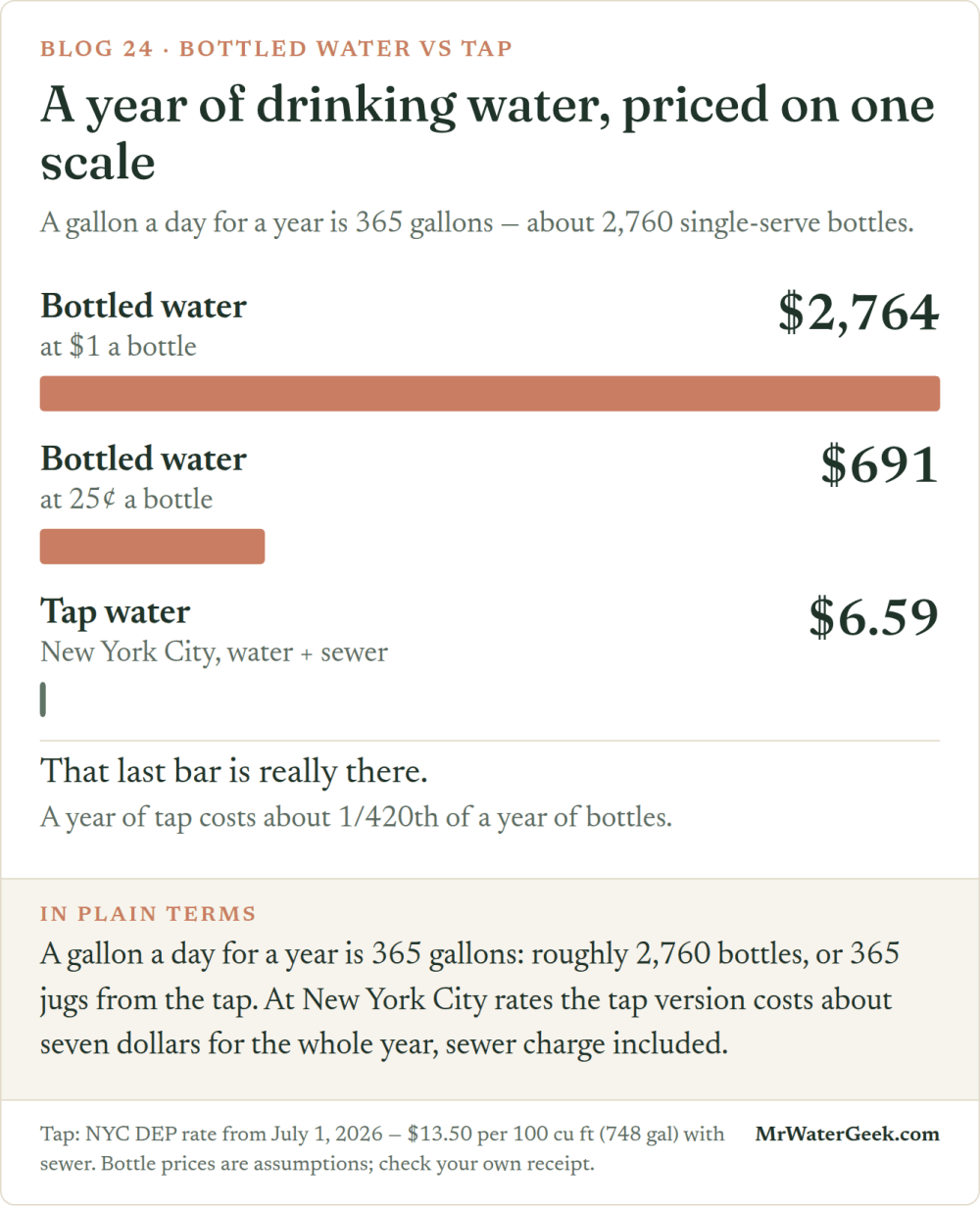
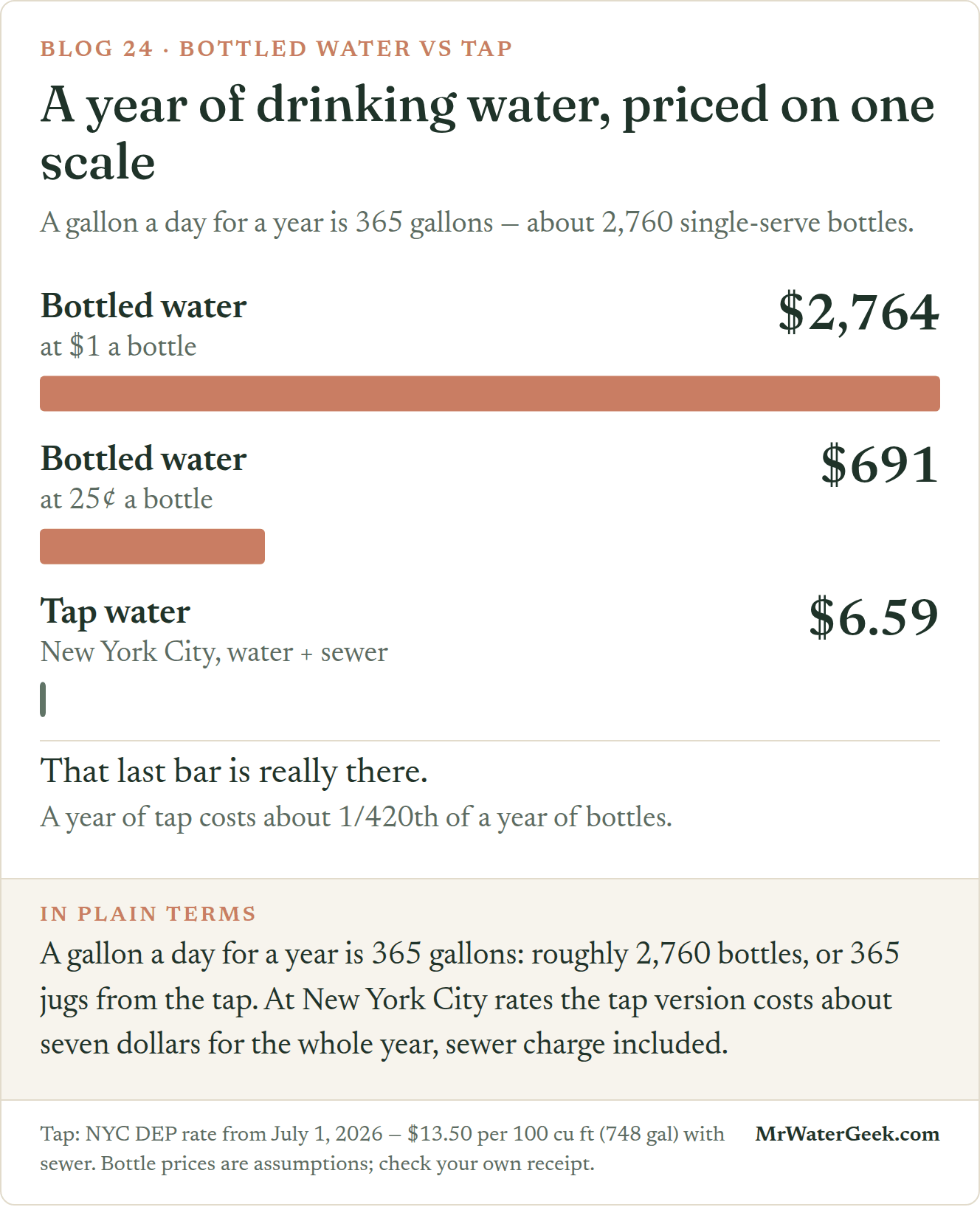
A household drinking a gallon a day from bottles is buying roughly 365 gallons a year at retail bottled prices. The same volume from the tap costs a fraction of one percent of that, and a certified point-of-use filter — cartridges included — adds a modest annual cost on top while treating far more water than you’ll ever drink.
A worked example makes the shape of it clear. New York City publishes a rate of $13.50 per 100 cubic feet including sewer, and 100 cubic feet is 748 gallons — so 365 gallons from the tap costs about $6.59 for the year, sewer charge included. The same 365 gallons is roughly 2,760 single-serve bottles. Even at a quarter a bottle that is several hundred dollars against a figure that rounds to a rideshare fare. Run your own numbers rather than taking a generic multiple: check your water bill for the rate per thousand gallons, then check what you actually pay per bottle. The gap is usually large enough that the filter pays for itself inside the first year, which is the practical argument for filtration over bottled for daily household use.
When Bottled Water Is the Right Call
There are real cases, and they’re about your supply rather than about bottled water being superior.
A boil advisory or a known contamination event. When the utility tells you not to drink the water, bottled is the correct answer until they say otherwise.
An untested private well. Wells aren’t covered by the Safe Drinking Water Act, and testing is the owner’s responsibility. Until you have results, bottled is a reasonable bridge — and testing is the actual fix.
Infant formula in specific circumstances. Pediatric guidance points to low-fluoride bottled water, labeled purified, deionized, demineralized, or distilled, for part of the time when powdered formula is a baby’s daily main nutrition. Our article on what pediatricians tell parents about tap water covers that nuance.
Travel, emergencies, and anywhere without a tap you trust. Portability is a genuine feature and no filter replaces it.
What doesn’t hold up is bottled water as a permanent household substitute chosen on the belief that it’s categorically safer. If that’s the reason, the cheaper and better-evidenced move is to find out what your own water contains and filter for that specific thing.
THE CHEAPER FIRST STEP
Read your own report before you buy another case
It’s free, it takes 30 seconds, and it tells you whether switching is solving anything.
FAQ
Is bottled water safer than tap water? Not inherently. The FDA regulates bottled water and generally adopts the EPA’s contaminant limits, so the baseline standards are comparable. Bottled water helps when your own supply is compromised or unknown; it doesn’t provide a categorical safety upgrade over a municipal system meeting its standards.
Is bottled water just tap water? Some of it, yes. Water labeled “purified” is defined by its treatment — distillation, reverse osmosis, or filtration — rather than its source, and a great deal of it starts as municipal supply. Spring, artesian, mineral, and well water are defined by where they come from instead.
Why is the lead limit lower for bottled water? Because the pathway differs. The EPA’s 15 ppb action level for tap water accounts for lead leaching from service lines, solder, and brass fixtures between the plant and your glass. Bottling has no such plumbing, so the FDA sets a 5 ppb limit that reflects what should be achievable without it.
Does bottled water contain microplastics? Peer-reviewed testing has found plastic particles in most bottled water sampled, generally at higher counts than tap, since the bottle and cap contribute directly. The health significance remains unsettled — the WHO rates the risk low while noting the evidence base is limited — but bottled is not the lower-particle option.
Is bottled water better for infant formula? Only in specific cases. Pediatric guidance suggests rotating in low-fluoride bottled water — labeled purified, deionized, demineralized, or distilled — when powdered formula is a baby’s main daily nutrition, and recommends bottled or boiled water when the household source is a well or otherwise uncertain. Otherwise a lead-free cold tap is the standard advice.
Is filtered tap water cheaper than bottled? By a wide margin for daily household use. Municipal water is billed per thousand gallons while bottled is billed per bottle, and a certified point-of-use filter adds a modest annual cartridge cost while treating far more water than a household drinks. For travel and emergencies the calculation is different, because portability is what you’re paying for.
Shashank — 9 years at Kohler building water products. Currently building the next generation of water health products.