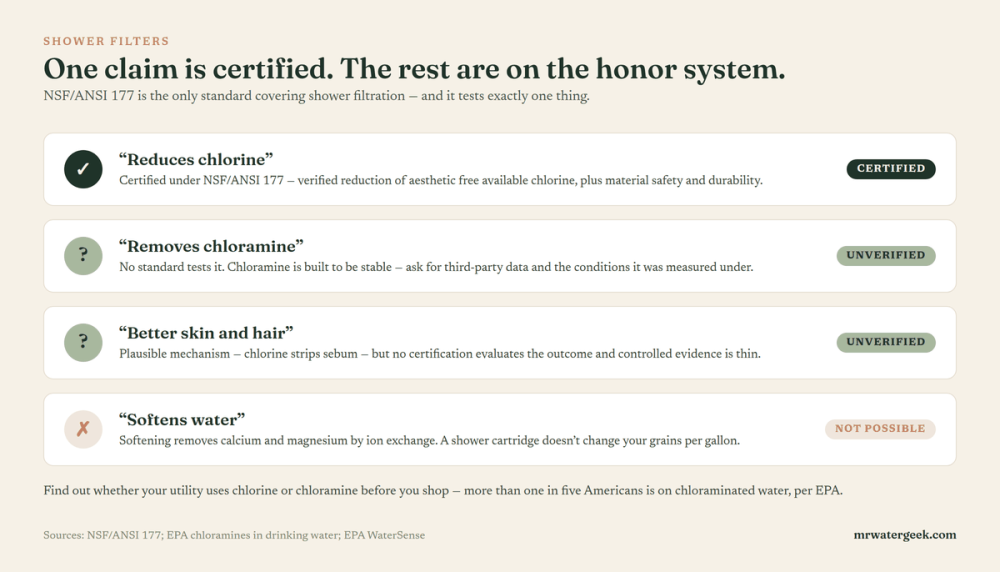
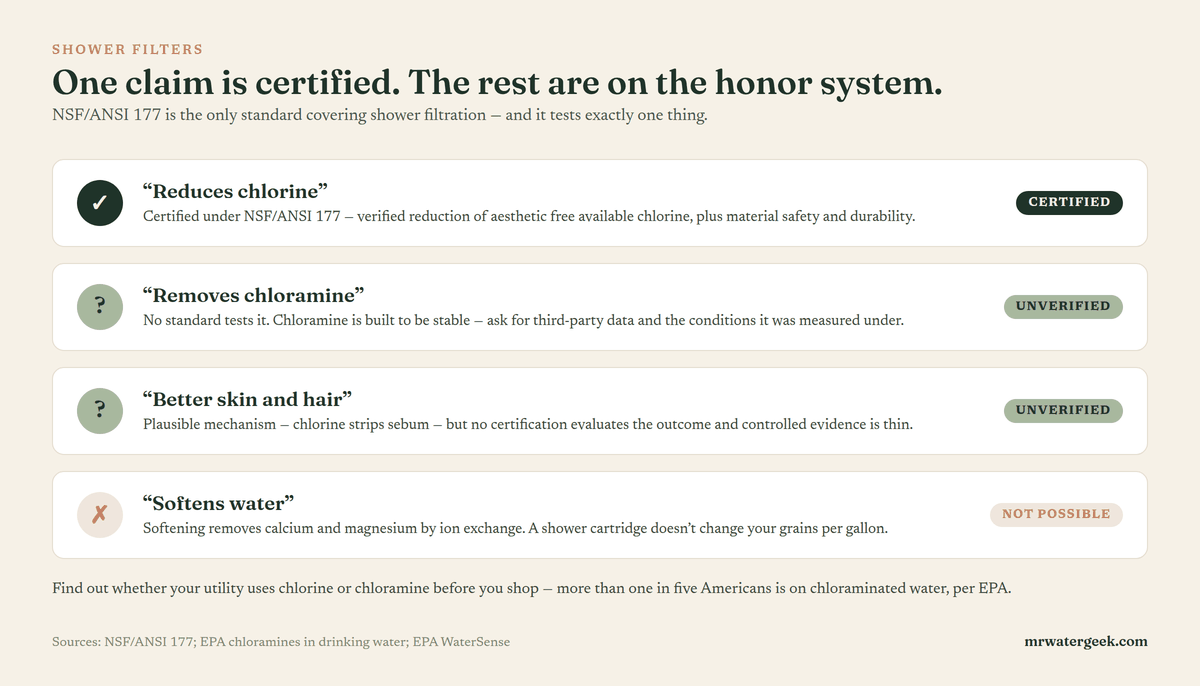
A shower filter is a cartridge that installs between your shower arm and your shower head, usually packed with copper-zinc granules, carbon, or both. One third-party standard covers the category — NSF/ANSI 177 — and it certifies a single thing: reduction of free available chlorine. Claims about chloramine, hardness, skin, or hair sit outside any existing certification.
Key Takeaways — Do shower filters actually work?
For chlorine, yes, and there’s a certification that proves it. For everything else the industry advertises, there’s no standard testing any of it, which isn’t the same as saying those claims are false — it means nobody independent has checked. Find out whether your utility uses chlorine or chloramine first, because that single fact decides whether a shower filter is doing much of anything.
START HERE
Chlorine or chloramine? It changes the answer
Your local report names the disinfectant your utility uses. Pull it by ZIP in about 30 seconds.
What a Shower Filter Is and What’s Inside It
Physically it’s simple: a housing that threads onto the shower arm, with the shower head threading onto the other end. Water passes through media inside on its way to the spray face. Some models build the media into the shower head itself; the plumbing logic is the same either way.
Two media dominate. KDF is a copper-zinc alloy in granular form that reduces free chlorine through a redox reaction — the chlorine is chemically converted rather than adsorbed, which is why the media tolerates hot water better than carbon does. Activated carbon adsorbs chlorine and organic compounds onto its pore structure. Plenty of cartridges layer both, and some add calcium sulfite, which also handles chlorine chemically.
The design constraint on all of them is time. A shower head runs at up to 2.5 GPM under the federal standard, or 2.0 GPM for one carrying the EPA’s WaterSense label, which does cover shower heads. Every drop gets a fraction of a second inside a cartridge smaller than a coffee mug. A drinking water filter gets far more contact time with far less water. That physical reality caps what a shower cartridge can accomplish, no matter what’s printed on it.
NSF/ANSI 177: The Only Standard That Covers Shower Filters
There are no federal regulations governing residential shower filters, which makes third-party certification the only independent check on a manufacturer’s claims. For this category, that check is NSF/ANSI 177, and its scope is narrow. Certification covers material and construction safety, product design and durability, and verified reduction of aesthetic free available chlorine in shower water.
Aesthetic is the operative word. The standard treats chlorine as a taste-and-odor issue, the same way NSF/ANSI 42 does for drinking water. It does not certify chloramine reduction. It does not certify heavy metals. It does not evaluate any claim about skin or hair.
Which means a shower filter’s marketing splits cleanly into two piles: the chlorine claim, which a certification can back, and everything else, which rests on the manufacturer’s own testing. That’s not automatically a reason to disbelieve the rest. It’s a reason to ask who measured it and under what conditions, and to weigh the answer accordingly.
Chlorine vs Chloramine: The Fact That Decides Everything
Utilities disinfect with one of two things, and shower filters were built around the first. Free chlorine is reactive and dissipates as water travels. Chloramine is chlorine combined with ammonia, and utilities use it because it’s more stable — the EPA notes that chloramines provide longer-lasting disinfection as water moves through pipes, and that more than one in five Americans drinks water treated with them.
That stability is precisely what makes chloramine harder to strip out. The bond doesn’t break as readily, so media sized for free chlorine at shower flow rates is working against chemistry it wasn’t designed for. Some products claim chloramine reduction anyway, and some may well achieve a measure of it — but with no standard testing the claim, there’s no certified way to compare one against another.
So the sequence is: find out which disinfectant your utility uses before you shop. It’s named in your annual water quality report, and our guide to reading your city water quality report shows where. On chlorine, a 177-certified filter does a documented job. On chloramine, you’re buying an uncertified claim, and you should price it accordingly. For the underlying chemistry of disinfection byproducts, our chlorine and byproducts guide goes deeper.
Heat Is the Variable Nobody Designs Around
Drinking water filters are tested cold. NSF’s guidance on certified filtration devices states plainly that listed products are tested at 20°C/68°F and have not been tested for contaminant reduction at elevated temperatures, and it names shower and bath water as the example.
A shower runs at roughly 40°C. Heat changes how adsorption behaves — carbon holds compounds less tightly as temperature climbs, which is part of why carbon-only shower cartridges lose effectiveness faster than their drinking water counterparts. It’s also the reason KDF’s redox chemistry became the default media here: a chemical conversion is less temperature-sensitive than adsorption.
The practical consequence is that shower cartridges have shorter useful lives than their gallon ratings suggest, and that a cartridge rated on cold-water testing is being asked to perform somewhere it was never characterized. Replace on the manufacturer’s schedule and treat a sudden return of chlorine smell as the real end-of-life signal.
What About Skin and Hair?
This is why most people buy a shower filter, so it deserves a straight answer: the mechanism is plausible and the evidence is thin.
Plausible, because chlorine is an oxidizer and oxidizers strip sebum, the natural oil layer on skin and hair. People with eczema, sensitive skin, or color-treated hair have real reasons to reduce that exposure, and dermatology generally recognizes that harsh water conditions can aggravate existing skin conditions.
Thin, because there isn’t a body of controlled research establishing that residential shower filtration produces measurable improvements in skin or hair outcomes. No certification evaluates the claim. Most of what’s offered as proof is customer testimony, which is genuine experience but can’t separate the filter from the twelve other things that change about someone’s routine at the same time.
My read: if chlorine bothers your skin, a certified filter addresses a documented cause at modest cost, and trying it is reasonable. What I wouldn’t do is treat it as established that a shower filter will fix a skin condition, or spend at the top of the market on that expectation. If you have a persistent skin problem, that’s a conversation with a dermatologist, not a plumbing purchase.
Shower Filters Don’t Soften Water
Hard water and chlorinated water are separate problems with separate solutions, and shower filter marketing blurs them constantly.
Hardness is dissolved calcium and magnesium, measured in grains per gallon. Softening means removing those minerals, which requires ion exchange and a resin bed with a regeneration cycle — a system considerably larger than anything that fits on a shower arm. A shower cartridge doesn’t change your grains per gallon. If a package says it softens water, that word is being used loosely.
Anything sold as a “conditioner” belongs in a separate category too: those alter how minerals crystallize rather than removing them, and the hardness number stays where it was. We cover the distinction in our guides to salt-free water softeners and water softener alternatives. If scale on the glass and film in your hair are the complaints, the fix is upstream of the bathroom.
DIAGNOSE FIRST
Chlorine, chloramine, or hardness?
Three different problems, three different fixes. Your ZIP tells you which one you have.
What to Check Before You Buy
Take the claims on the package one at a time and ask what’s actually behind each.
| Claim on the box | What backs it | What to verify |
|---|---|---|
| “Reduces chlorine” | NSF/ANSI 177 certification | A 177 listing for the model — not “made with NSF-certified materials,” which is a different statement |
| “Removes chloramine” | No standard covers this claim | Ask for third-party test data and conditions; treat it as unverified until you see them |
| “Softens water” | Nothing — softening requires ion exchange | Your hardness in grains per gallon before and after; it won’t change |
| “Removes heavy metals” | No shower standard evaluates this | Whether any cited testing was done at shower temperature or cold |
| “Better skin and hair” | Not a certified claim anywhere | Reasonable to try on the chlorine mechanism; judge the result yourself over a month |
ONE LAST THING
The shower is one tap of many
See everything that’s been detected where you live — then decide where filtration is worth it.
FAQ
Do shower filters actually work? For free chlorine, yes, and NSF/ANSI 177 certification documents it. For chloramine, hardness, heavy metals, or skin and hair benefits, no standard tests the claim, so performance varies by product with no independent way to compare. Which disinfectant your utility uses is the single biggest factor in whether you’ll notice a difference.
What does NSF/ANSI 177 certify? Material and construction safety, product design and durability, and verified reduction of aesthetic free available chlorine in shower water. It treats chlorine as a taste-and-odor matter rather than a health contaminant, and it covers nothing else. A model certified to 177 has been independently verified on chlorine and on nothing beyond it.
Will a shower filter help with chloramine? Possibly, but no certification covers chloramine reduction, so any claim rests on the manufacturer’s own testing. Chloramine is more stable than free chlorine by design, which makes it harder to remove in the fraction of a second water spends inside a shower cartridge. Check your water report for which one your utility uses before buying.
Do shower filters soften hard water? No. Hardness is dissolved calcium and magnesium measured in grains per gallon, and removing it takes ion exchange with a regenerating resin bed — equipment far larger than a shower cartridge. A filter can reduce chlorine in hard water, but your hardness number stays exactly where it was.
How often should you replace a shower filter cartridge? On the manufacturer’s schedule, typically every six months or by gallons, and sooner if chlorine smell returns. Shower cartridges work at higher temperatures than the cold conditions filters are tested under, and heat shortens the useful life of carbon media in particular, so the rating tends to be optimistic rather than conservative.
Is a shower filter or a whole house filter better? A whole house system treats every fixture and gives water far more contact time with much larger media, so it handles chlorine more thoroughly and consistently. A shower filter is cheaper, installs in five minutes with no plumbing, and treats the one tap where chlorine contact is longest. For renters, the shower filter is often the only option available.
Shashank — 9 years at Kohler building water products. Currently building the next generation of water health products.
Tab 2
Verdict: Accurate, admirably honest, publish-ready after linking. Best example in the cluster of separating a certified claim from marketing claims.