Pediatric and public-health bodies broadly consider U.S. tap water safe for children, with real caveats. The American Academy of Pediatrics and CDC focus on lead in home plumbing, careful formula preparation, and appropriate fluoride levels. For most families, testing your water and running the cold tap before use matters more than any single filter you buy. Specifics depend on your home and your source.
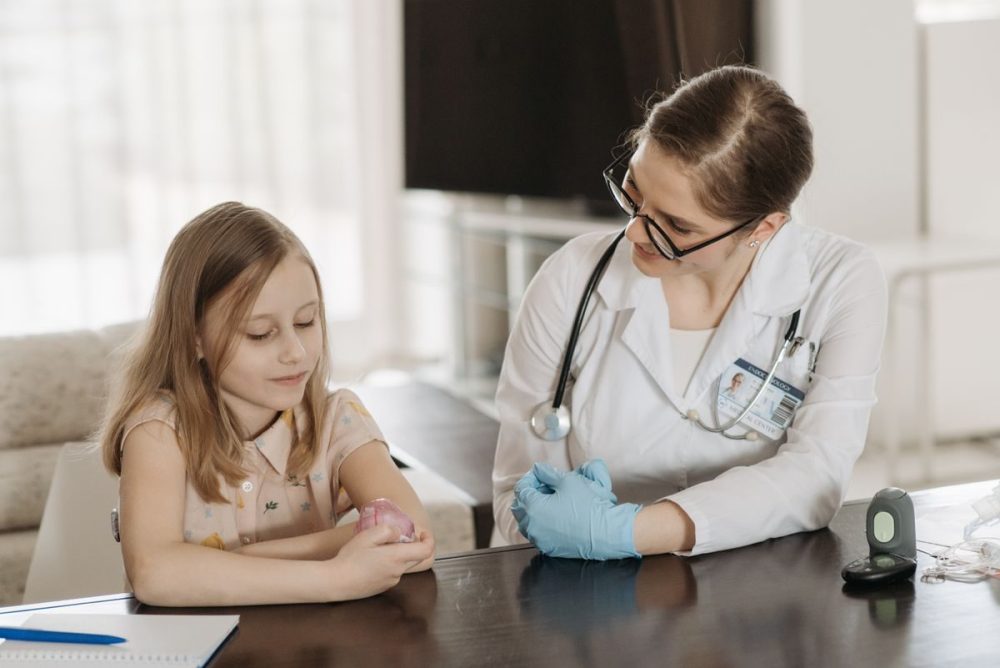
This article summarizes public health guidance and is not medical advice. Talk to your pediatrician about your child’s specific situation.
Key Takeaways — What do pediatricians actually worry about?
Lead is the guidance’s center of gravity, because there is no known safe blood level for a child and old plumbing is the usual culprit. For infants, formula water gets extra scrutiny: use a lead-free cold source, and vary fluoride exposure if you mix powdered formula daily. PFAS and microplastics are watched carefully but the evidence is still developing. Test your specific water first, then filter for what you actually find.
KNOW BEFORE YOU FILTER
See what’s in your water before you filter for your kids
Pull your local water quality report by ZIP in a few seconds — lead, PFAS, and more.
Lead: the one they emphasize most
If you read only one section of pediatric water guidance, this is it. The CDC states plainly that there are no safe levels of lead in the blood, and that even low levels are linked to developmental and learning effects that can be permanent. That framing is deliberate. It means the goal isn’t “under the limit,” it’s “as close to zero as you can reasonably get.”
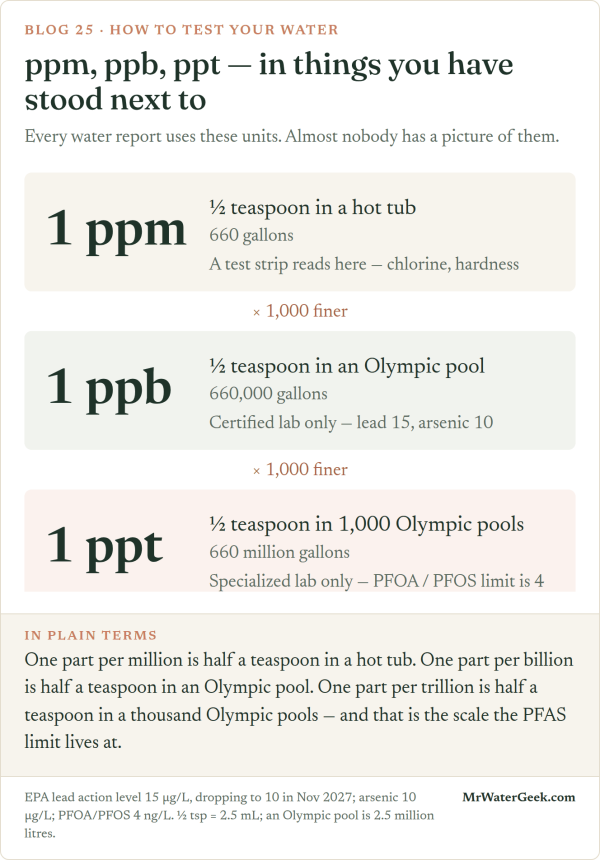
The EPA’s action level for lead is 15 parts per billion (dropping to 10 ppb in November 2027 under the Lead and Copper Rule Improvements), but that’s a regulatory trigger for utilities, not a health-based safety threshold. Lead rarely comes from the treatment plant. It leaches from service lines, older solder, and brass fixtures inside your own home, which is why two houses on the same street can test very differently.
The AAP’s practical advice on lead in tap water is refreshingly concrete. If a cold tap has sat unused for more than six hours, run it 15 to 30 seconds before drinking or cooking. Never use hot tap water for drinking or for mixing formula, since lead dissolves more readily in hot water. And because you can’t see, taste, or smell lead, the only way to know is to test. If your water does carry lead, the AAP points to filters independently certified to reduce it — our lead filter guide covers what that certification means in practice.
Breast milk, PFAS, and what we don’t yet know
On this one, science is still catching up. PFAS — the “forever chemicals” — can pass from a mother’s body into breast milk, and researchers have called for routine monitoring of both breast milk and infant formula as data accumulates. A peer-reviewed perspective in Environmental Health Perspectives argued it’s time to start monitoring PFAS in breast milk and formula, precisely because exposure during infancy is understudied.
Read that carefully before you react. The presence of PFAS in breast milk does not mean pediatricians are telling mothers to stop nursing. The AAP and CDC continue to regard breastfeeding as highly beneficial; the research points toward reducing PFAS in the water supply and in what parents drink, not toward abandoning breast milk. The EPA now enforces a drinking-water limit of 4 parts per trillion for PFOA and PFOS, a sign of how seriously the exposure is taken even as the infant-specific science develops. If PFAS is documented in your area, filtering the water a nursing or pregnant parent drinks is a reasonable, evidence-aligned step.
Formula-prep water: the detailed part
Here guidance gets specific, because infants drink far more water per pound of body weight than adults. Start with a lead-free cold source, following the flushing and hot-water rules above. For families on private wells or any source of uncertain safety, the standard advice is to boil water and let it cool before mixing, then discard prepared formula that’s been sitting out.
Fluoride adds one wrinkle. The CDC notes that formula needing to be mixed with fluoridated water can increase the chance of mild dental fluorosis if it’s a baby’s main source of nutrition day after day. Their suggestion isn’t to eliminate fluoride, it’s to use low-fluoride bottled water (labeled purified, deionized, demineralized, or distilled) some of the time to lower that risk. Ready-to-feed formula, which contains little fluoride, sidesteps the issue entirely for parents who prefer it.
START WITH FACTS
Is there lead or PFAS in your formula water?
Your utility’s report tells you what’s been detected locally — the right place to start before mixing a single bottle.
Fluoride: the balanced position
Fluoride tends to get flattened into a fight, and pediatric guidance sits in the calmer middle. At recommended low levels, fluoride prevents tooth decay, and the AAP has publicly reaffirmed its support for those levels as a caries-prevention measure. Cavities remain one of the most common chronic conditions of childhood, which is the benefit side of the ledger. That reaffirmation wasn’t routine: it came amid the biggest shake-up in fluoride policy in decades — a September 2024 federal court ruling ordered the EPA to begin regulating fluoridation under the Toxic Substances Control Act (a decision the agency is appealing), and Utah and Florida moved to restrict community fluoridation in 2025. Against that backdrop, the AAP’s position is a considered restatement, not an old default.
The cost side, at typical exposures, is mostly cosmetic: mild dental fluorosis, the faint white streaking mentioned earlier, driven largely by excess intake during the years tooth enamel forms. The infant-formula nuance from the CDC is really the only place where the everyday balance shifts, and even there the fix is moderation rather than avoidance. Your pediatrician or dentist can tell you whether your child needs more or less, based on your water and their teeth.
Microplastics: the newest, least settled question
Microplastics are the youngest topic on this list, and the guidance reflects that. The World Health Organization’s review concluded that microplastics in drinking water are a low risk to health — while stating openly that this judgment rests on a limited evidence base and that more research is needed, especially on the smallest particles. Larger particles largely pass through the gut without being absorbed.
So the responsible summary is “reassuring but incomplete.” There’s no pediatric recommendation to overhaul your routine over microplastics today. It’s a field to watch, not a reason to worry, and the filtration steps that address lead and PFAS tend to reduce particulate load as a side effect anyway. For a closer look at what’s actually been measured in tap water and which filter types catch particles, see our full guide to microplastics in tap water.
What an engineer would add
Having spent nine years building water products, here’s where I think official guidance is quietly thin: it tells parents to use a certified filter, but not how easily “certified” gets misread. A pitcher can be certified under NSF/ANSI 42 and still do nothing for lead — that standard covers taste, odor, and chlorine, the aesthetic stuff. The certification that actually matters for a child’s health is NSF/ANSI 53, which covers health-contaminant reduction, and you want to see the specific claim printed: lead, PFAS, cysts. A filter certified for taste is not automatically safe for a baby.
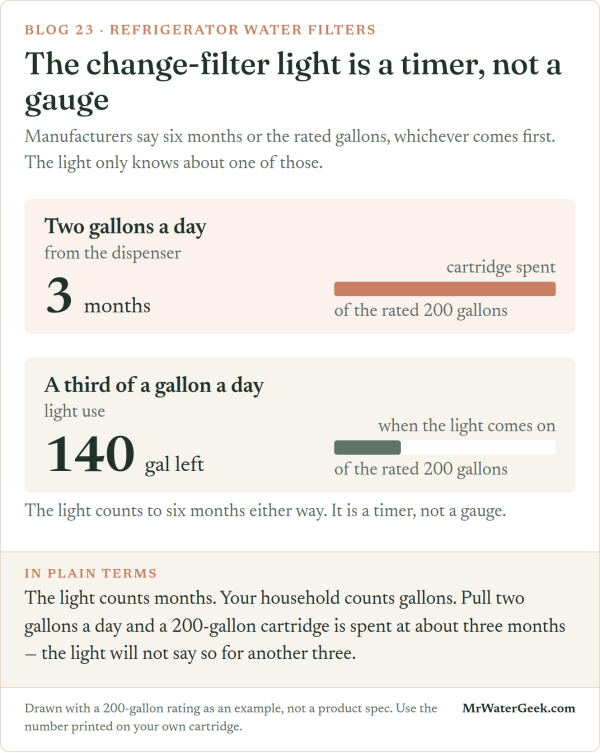
The second gap is sequence. Guidance says “filter,” but a filter is a treatment, and you don’t treat before you diagnose. Test your specific tap first — many utilities offer kits, or a certified lab will run one — then choose a device rated for what you actually found. If lead is your issue, a filter certified for lead at the point of use is the targeted move; if PFAS shows up, look specifically at a PFAS-rated system. And whatever you install has a service life. A certified cartridge run months past its rated capacity can perform worse than no filter, because contaminants that accumulated can release. Change it on schedule.
Practical steps for parents
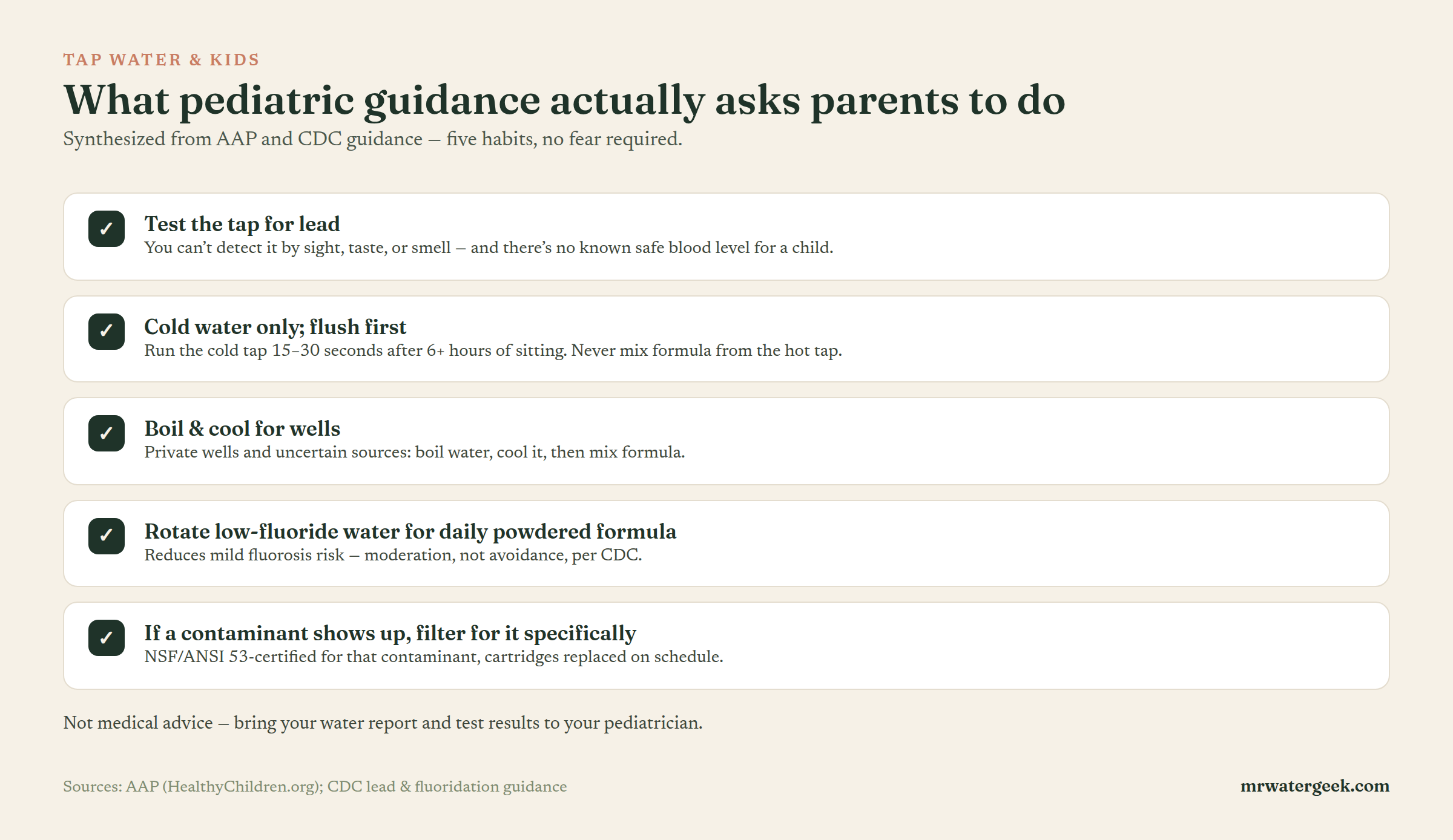
A short checklist that lines up with what the AAP and CDC actually recommend:
- Test your tap water for lead — you cannot detect it by sight, taste, or smell.
- Run the cold tap 15 to 30 seconds after it’s sat six hours or more, and only ever use cold water for drinking and formula.
- For wells or uncertain sources, boil and cool water before mixing formula.
- If you mix powdered formula daily, alternate in low-fluoride bottled water some of the time.
- Choose filters certified to NSF/ANSI 53 for the specific contaminant you found, and replace cartridges on schedule.
- Bring your water report and any test results to your pediatrician or dentist rather than guessing.
None of this is about fear. It’s about knowing your own water and matching your response to it, which is exactly what the guidance is trying to get parents to do.
FOR THE LITTLEST DRINKERS
Start with your actual water, not a guess
Look up what’s been detected in your ZIP, then filter for what’s really there.
FAQ
Is tap water safe for making baby formula? In most U.S. homes, yes, if you start from a lead-free cold-water source and follow the flushing rules. Use cold water only, and for wells or uncertain sources, boil and cool it first. The main variables are your plumbing and, if you mix powdered formula daily, fluoride.
Do I need to filter water for my baby? Not automatically. Test first. If your water tests clean for lead and other health contaminants, a filter is optional. If lead or PFAS shows up, a point-of-use filter certified to NSF/ANSI 53 for that specific contaminant is a reasonable step.
Is fluoride safe for infants? At recommended low levels, pediatric bodies support fluoride for preventing tooth decay. The one nuance is that mixing powdered formula with fluoridated water every day can raise the odds of mild dental fluorosis, which is why the CDC suggests rotating in low-fluoride water part of the time.
Should I worry about PFAS in my breast milk? The research is still developing, and no pediatric body is advising mothers to stop breastfeeding over it. The practical takeaway is to reduce PFAS in the water a pregnant or nursing parent drinks, especially if PFAS has been detected locally. Discuss your situation with your pediatrician.
What about microplastics in tap water? The WHO currently rates the health risk as low, while being candid that the evidence is limited and more study is needed. There’s no specific pediatric recommendation to act on microplastics alone today, and filters aimed at lead or PFAS reduce particles as a bonus.
As a reminder, this article summarizes public health guidance and is not medical advice. Talk to your pediatrician about your child’s specific situation.
Shashank — 9 years at Kohler building water products. Currently building the next generation of water health products.