Roughly 43 million Americans get their drinking water from private
wells.The problem is, nobody is testing their water quality – the EPA
doesn’t regulate private wells, and no utility is publishing a Consumer
Confidence Report. If your drinking water comes from a private well, the
quality of that water depends entirely on your well’s construction and
what’s happening on the land and in the ground around it. A USGS survey
of over 2,100 domestic wells found that 1
in 5 contained at least one contaminant above health-based
benchmarks — and most well owners had no idea. If you want to start
testing the quality of your well water but don’t know where to start, it
doesn’t have to be complicated – this guide starts where every well
water filter guide should start: with the test, not the product.
Key
Takeaways — What should well owners actually do?
43 million Americans drink from private wells. Nobody tests that
water for them. The “best” well water filter doesn’t exist — your well’s
geology, location, and depth determine what’s in it, and a $100–$300 lab
test is the only way to find out. Most well owners need a sediment
pre-filter (every well) plus a targeted system for whatever the test
shows. Iron staining is annoying but not dangerous. Arsenic, nitrate,
radon, and bacteria are the ones that actually matter — and a carbon
filter alone won’t handle any of them. Test first. Match the technology
to the result. Don’t buy a system because a website told you to.
The one thing to do first
Your well has no annual report. A lab test is the only way to know.
A $100–$300 certified test tells you exactly what to treat — before you buy a single system.
Why
can’t you just buy the “best” well water filter?
Because not all well water is the same. A well in central Florida
tapping into a limestone aquifer (the permeable rock your well water is
being drawn from) produces completely different water than a well in
rural New Hampshire drilled through granite, or one in the agricultural
Midwest sitting below decades of fertilizer application. The
contaminants, the pH, the hardness, the sediment load – it all varies by
geography and geology.
A filter system that solves one well’s problems might be useless or
even counterproductive for another. An RO
system that makes sense for arsenic in Arizona groundwater would
be overkill for a Michigan well whose only issue is iron staining. A UV
disinfection unit that handles bacteria contamination in a shallow dug
well does nothing for the nitrate problem in an Iowa agricultural
well.
Every good well water filter recommendation starts with a water test.
Without one, you’re buying blind.
What should you
test for, and how often?
The CDC recommends annual testing for four baseline parameters: total
coliform bacteria, nitrates, total dissolved solids, and pH. But that’s
the minimum – the
CDC specifically says to contact your local health department
about additional testing based on your region.
Here’s what else you should test for based on where you live:
Northeast (CT, MA, ME, NH, PA, VT): Radon. It
dissolves into groundwater from crystalline rock aquifers and can be
released as a gas when you shower or run water. Testing is inexpensive,
and aeration or granular activated carbon systems can remove it. Also
test for arsenic, as high concentrations of natural arsenic are present
throughout New England. (Sources: USGS, radon in groundwater; EPA, arsenic MCL.)
Midwest (IA, IL, IN, OH, MI, MN, WI): Iron and
manganese. These are not health threats at typical levels, but they
stain everything and make water taste metallic. Also test for nitrate if
you’re anywhere near agricultural land. In the SWIGG study of southwest Wisconsin, about 42% of tested private wells were unsafe due to bacteria or nitrate. (Source: SWIGG study / Clean Wisconsin.)
Sun Belt / Southwest (AZ, NM, NV, parts of CA and
TX): Arsenic. It occurs naturally in groundwater across the
arid West — some areas have concentrations well above the 10 ppb MCL.
Also test for fluoride (naturally elevated in some desert aquifers) and
TDS. (Sources: EPA, arsenic in drinking water; USGS, groundwater quality.)
Southeast and Gulf Coast (AL, FL, GA, LA, MS, SC):
Bacteria. Shallow wells in warm climates and high water tables are more
susceptible to microbial contamination. Hard water is common due to the
presence of limestone in the local geology. Test for total coliform and
E. coli annually. Tannins from organic material can cause yellow or
brown water that’s harmless but unpleasant.
Rural agricultural areas (anywhere): Nitrate from
fertilizer runoff and pesticides. The MCL for nitrate is 10 mg/L. Above
that level, it causes methemoglobinemia, which is a blood disorder that
prevents oxygen delivery, in infants. Test quarterly if you have small
children and your well is within a mile of actively farmed land.
Near industrial or military sites: PFAS. A 2024
USGS study estimated that up to 95 million people in the Lower 48 — more than 20% of the U.S. population — may rely on groundwater with detectable PFAS.
Highest risk areas are wells near military bases (due to AFFF
firefighting foam), airports, manufacturing facilities, or landfills are
highest risk. The EPA’s 2024 enforceable limit is 4 ppt for PFOA and
PFOS. (Sources: USGS, 2024 groundwater PFAS study; EPA, PFAS rule.)
Use a state-certified lab for testing — your county health department
can point you to one. Home test kits are useful for quick screening but
don’t replace a certified lab analysis for making treatment
decisions.
What
does each type of well water filter actually remove?
Once you have your well water test results, it becomes simpler to choose your filtration technology based on present
contaminants. The honest engineering breakdown:
Sediment filters (5-micron or finer). These are
mechanical screens – they catch particles, sand, silt, and rust. They’re
almost always the first stage in a well water system because sediment
destroys downstream filters faster. They don’t remove dissolved
chemicals. Think of them as the bouncer at the door. Every well water
system needs one. Cost: $50–$150 for the housing; $10–$30 per
replacement cartridge every 3–6 months depending on sediment load.
Carbon filters (granular activated carbon or carbon
block). These adsorb chlorine (relevant if you’re chlorinating
your well), VOCs, some pesticides, taste and odor compounds, and certain
organic chemicals. Carbon block filters with sub-micron ratings can also
reduce lead and cryptosporidium. They do NOT effectively remove
bacteria, nitrate, arsenic, fluoride, or heavy hardness minerals. Look
for NSF/ANSI 53 certification for health-effect contaminant claims.
(Sources: NSF International; EPA, point-of-use treatment.)
Reverse osmosis (RO). The broadest-spectrum option.
RO membranes reject 95–99% of dissolved solids, including arsenic,
nitrate, fluoride, PFAS, lead, and most heavy metals. The trade-off:
they waste several gallons of water for every single gallon filtered in
a 3:1 ratio on older systems, and closer to 2:1 on modern tankless
units; they strip beneficial minerals, though most 2026 systems add a
remineralization stage; they’re slow; and they need pre-filtration to
protect the membrane. RO makes sense when your test shows dissolved
contaminants that carbon can’t handle, especially arsenic, nitrate, or
fluoride. (Source: EPA, treatment technologies.)
UV disinfection. Ultraviolet light deactivates
bacteria, viruses, and protozoa by damaging their DNA. It doesn’t filter
anything – the water passes through a chamber with a UV lamp. It doesn’t
work well on turbid or sediment-heavy water because particles shield
microorganisms from the light. UV is the right tool when your well tests
positive for coliform bacteria. It’s not a substitute for filtration and
doesn’t address chemical contaminants. Most systems cost $200–$600 and
the lamp needs annual replacement (~$50–$100). (Sources: CDC, home treatment; NSF/ANSI 55.)
Iron / manganese removal. Oxidizing filters, such as
birm, greensand, and air injection, convert dissolved iron and manganese
to solid particles that can be filtered out. These systems are
specifically designed to address well water problems, like the iron
which, when above 0.3 mg/L, causes orange staining, or manganese which,
when above 0.05 mg/L, causes black staining. They’re effective but need
periodic backwashing and media replacement. These contaminants are not a
health issue, but more of a quality-of-life issue. Committing to a
whole-house system makes sense for iron or manganese removal because the
staining affects laundry, toilets, and showers, not just the kitchen
tap.
Water softeners (ion exchange). These remove
hardness minerals (calcium and magnesium) and replace them with sodium.
These systems are relevant for well water with hardness above 7 GPG,
especially in limestone-aquifer regions. They don’t remove health-effect
contaminants. Salt-free
conditioners are an alternative that makes minerals less likely
to form scale but doesn’t remove them — they work best below 10 GPG and
have no NSF certification standard. (Source: NSF/ANSI 44 for water softeners.)
Match the filter to the test, not the marketing.
Get a certified lab panel before you spend on equipment.
How do
you build a well water filtration system?
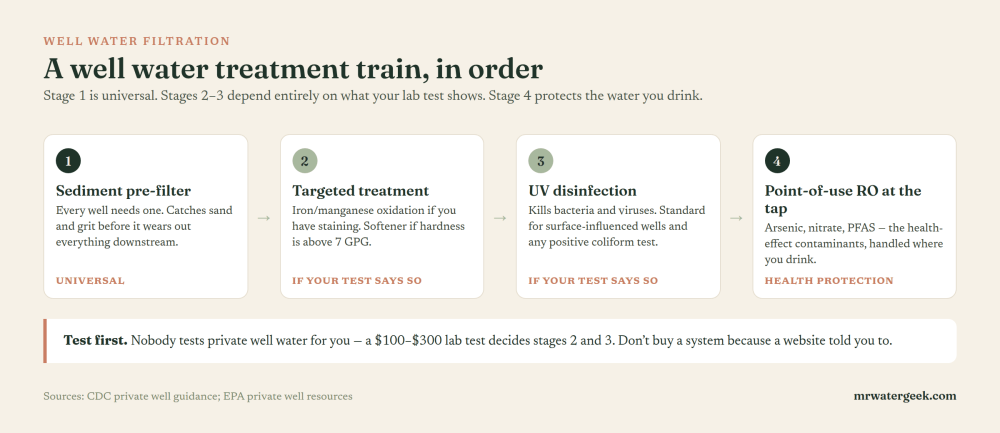
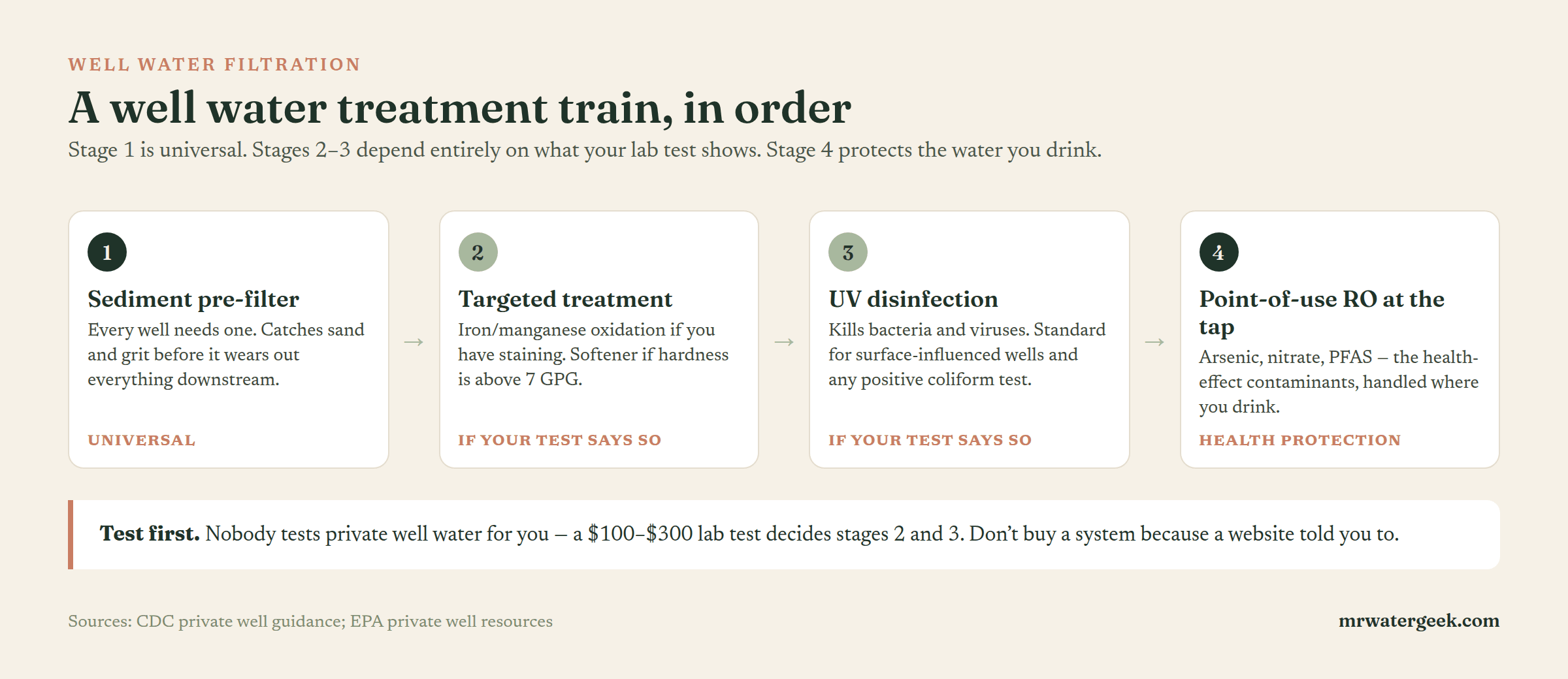
The right system isn’t one box. It’s a sequence where each stage
handles a specific category of contamination, in order.
Stage 1: Sediment pre-filter. Every well needs this.
It protects everything downstream. Replace on a schedule based on your
sediment load.
Stage 2: Targeted treatment. This is where your
water test dictates the equipment. Iron/manganese oxidation if you have
staining. Water softener if hardness is above 7 GPG. These are
whole-house systems because the problems affect every fixture.
Stage 3: Point-of-use at the kitchen tap.
Health-effect contaminants – lead, arsenic, nitrate, PFAS, VOCs – get
handled here. Also consider an under-sink
RO or carbon block system with NSF/ANSI 53 or 58 certification
for your specific contaminants. You don’t need to treat every drop of
shower water for arsenic, you just need to treat the water you drink and
cook with.
Stage 4 (if needed): UV disinfection. If bacteria is
a recurring issue, install UV after all other filtration stages. The
water reaching the UV chamber should be clear and sediment-free for
maximum effectiveness.
Without first treating their water, most people mistakenly choose
improper filtration systems – they buy a whole-house system to solve a
kitchen-tap problem, or they choose a kitchen-tap system when they
really need to solve a whole-house problem. Staining, hardness, and
sediment need whole-house treatment. Health-effect contaminants need
point-of-use treatment at the faucet where you fill your glass. Some
wells need both. Many wells need a combination that no single product
provides.
How much does
well water filtration cost?
Costs vary enormously because the problems vary enormously. Some
ranges:
A basic sediment + carbon whole-house system with a point-of-use RO
at the kitchen tap: $600–$1,200 installed, $150–$250/year in
maintenance. This handles the majority of well water situations where
the primary concerns are sediment and taste, with the point-of-use RO handling the one or two dissolved contaminants at the tap.
An iron removal + softener + point-of-use RO system: $2,000–$4,000
installed, $200–$400/year in maintenance. This is the setup for Midwest
wells with heavy iron, hard water, and a desire for clean drinking water
at the tap.
A comprehensive system with oxidation, softening, whole-house carbon,
UV, and point-of-use RO: $4,000–$8,000+ installed. This is for wells
with multiple overlapping issues. It’s not common, but when you need it,
you need it.
The single cheapest thing you can do is the test. A certified lab
analysis runs $100–$300 depending on the panel. It tells you exactly
what you’re dealing with and prevents you from spending $3,000 on
equipment that doesn’t address your actual problem.
What
are the most common mistakes well owners make?
Buying a filter before testing. This is the number
one mistake. A Reddit thread or a neighbor’s recommendation isn’t a
water test. Your well is specific to your location, your aquifer, your
depth, and your surrounding land use.
Assuming iron staining means unsafe water. Iron at
the levels that cause orange staining (0.3+ mg/L) isn’t a health hazard,
it’s just a nuisance. Arsenic at 10 ppb — which you can’t see, taste, or
smell — is the health hazard. Don’t prioritize the visible problem over
the invisible one.
Ignoring bacteria after a single clean test.
Bacteria contamination in wells is intermittent. A single negative test
doesn’t mean your well will always be clean. Heavy rain, flooding, or
seasonal water table changes can introduce bacteria. If your well is
shallow or your area has a high water table, consider ongoing UV
treatment even if your initial bacteria test comes back clean. (Source: CDC, well testing.)
Neglecting the well itself. A filter system can’t
fix a compromised well casing, a missing well cap, or a well that’s too
close to a septic system. Before spending money on filtration, make sure
the well itself is properly sealed and maintained. Your county health
department or a licensed well contractor can do an inspection.
Skipping maintenance. Well water is harder on filter
systems than municipal water. Higher sediment loads, mineral content,
and potential bacterial growth mean filters need more frequent
attention. A system that’s not regularly maintained breeds bacteria,
leaches contaminants back into the water supply, and gives you false
confidence.
Test first. Match the technology to the result.
FAQ
How often should I test my well water? The CDC
recommends at least once per year for bacteria, nitrate, TDS, and pH.
Test more frequently if you have infants in the home, notice changes in
taste or appearance, have had recent flooding, or live near agricultural
or industrial activity. Add contaminant-specific tests based on your
region. (Source: CDC, well testing guidelines.)
Can I use a whole-house filter as my only treatment?
Depends on the contaminants. Whole-house sediment and carbon filters
handle particulates and taste/odor. But for health-effect contaminants
like arsenic, nitrate, or PFAS, a point-of-use system at the kitchen tap
(typically RO) is more effective and efficient than trying to treat
every gallon that enters the house. (Source: EPA, POU/POE guidance.)
Is well water safe for babies? Only if you’ve tested
it and confirmed that nitrate is below 10 mg/L and bacteria is absent.
Nitrate above that level can cause methemoglobinemia (blue baby
syndrome). Lead at any detectable level is a concern for infants. If you
haven’t tested, use bottled water for formula until you get results.
(Sources: EPA, nitrate; CDC, infant water safety.)
Do I need to treat my well water if it tastes fine?
Taste tells you nothing about the presence of arsenic, nitrate, radon,
PFAS, or bacteria – none of these have a taste or odor at the
concentrations that matter for health. The contaminants that change how
water tastes (iron, sulfur, minerals) are generally not the ones that
harm you. Always test regardless of taste. (Source: EPA, well water contaminants.)
Should I get a water softener for my well? Only if
your hardness is above 7 GPG and you’re dealing with scale buildup on
fixtures and appliances. Softeners address hardness — they don’t remove
health-effect contaminants. If you’re below 10 GPG and don’t mind the
mineral deposits, a salt-free
conditioner can reduce scale adhesion without the salt, sodium,
or wastewater. Above 10 GPG, salt-free conditioners become unreliable.
(Source: NSF/ANSI 44 for water softeners.)
Shashank — 9 years at Kohler building water filtration. Mr Water
Geek translates water science into clear decisions.