Testing your tap water means collecting a sample and sending it to a laboratory certified for drinking water analysis. Home strips give you a rough read on a handful of parameters in minutes; a certified lab gives you numbers you can act on. The EPA’s position is unambiguous: use a laboratory certified to do drinking water testing.
Key Takeaways — How should you test your water?
Start with your utility’s annual report, because it’s free and it tells you what’s in the water leaving the plant. Then test your own tap, because the report can’t see your plumbing. Use a certified lab for anything you plan to make a decision on — strips are fine for curiosity and useless as evidence. And check with your local health department first; plenty of them test private wells at no cost.
STEP ONE IS FREE
Read the report before you buy a test
Your utility already publishes what it detected. Pull yours by ZIP in about 30 seconds.
Why Your Utility’s Report Isn’t a Test of Your Water
Every community water system publishes an annual water quality report, and it’s the right starting point. It names what was detected, at what levels, and whether the system had violations. It costs nothing and it’s specific to your supply.
What it can’t do is describe your house. The report characterizes water as it leaves treatment and moves through the distribution system. Between that point and your glass sit a service line, interior plumbing, solder joints, and fixtures — and that stretch is where lead almost always enters. Two homes on the same street, drawing from the same main, can test very differently because one has a lead service line and the other doesn’t.
So the report tells you what the utility delivered and your own test tells you what you’re drinking. You need both, in that order, and our guide to reading your city water quality report covers how to interpret the first one.
Three Ways to Test, and What Each One Buys You
The options differ less in what they measure than in how much you can trust the number.
| Method | What you get | Good for | Not good for |
|---|---|---|---|
| Test strips | A color-matched estimate of hardness, chlorine, pH, sometimes iron | A quick sense of hardness or chlorine; screening before a real test | Anything at trace levels — lead, PFAS, nitrate, bacteria |
| Mail-in kits | Lab results on a defined panel, ordered online | Convenience and breadth, when the lab is certified | Anything, if the lab isn’t certified — check first |
| State-certified lab | Documented results by approved methods, with the detection limits stated | Every decision that costs money or affects health | Instant answers — expect turnaround and a fee |
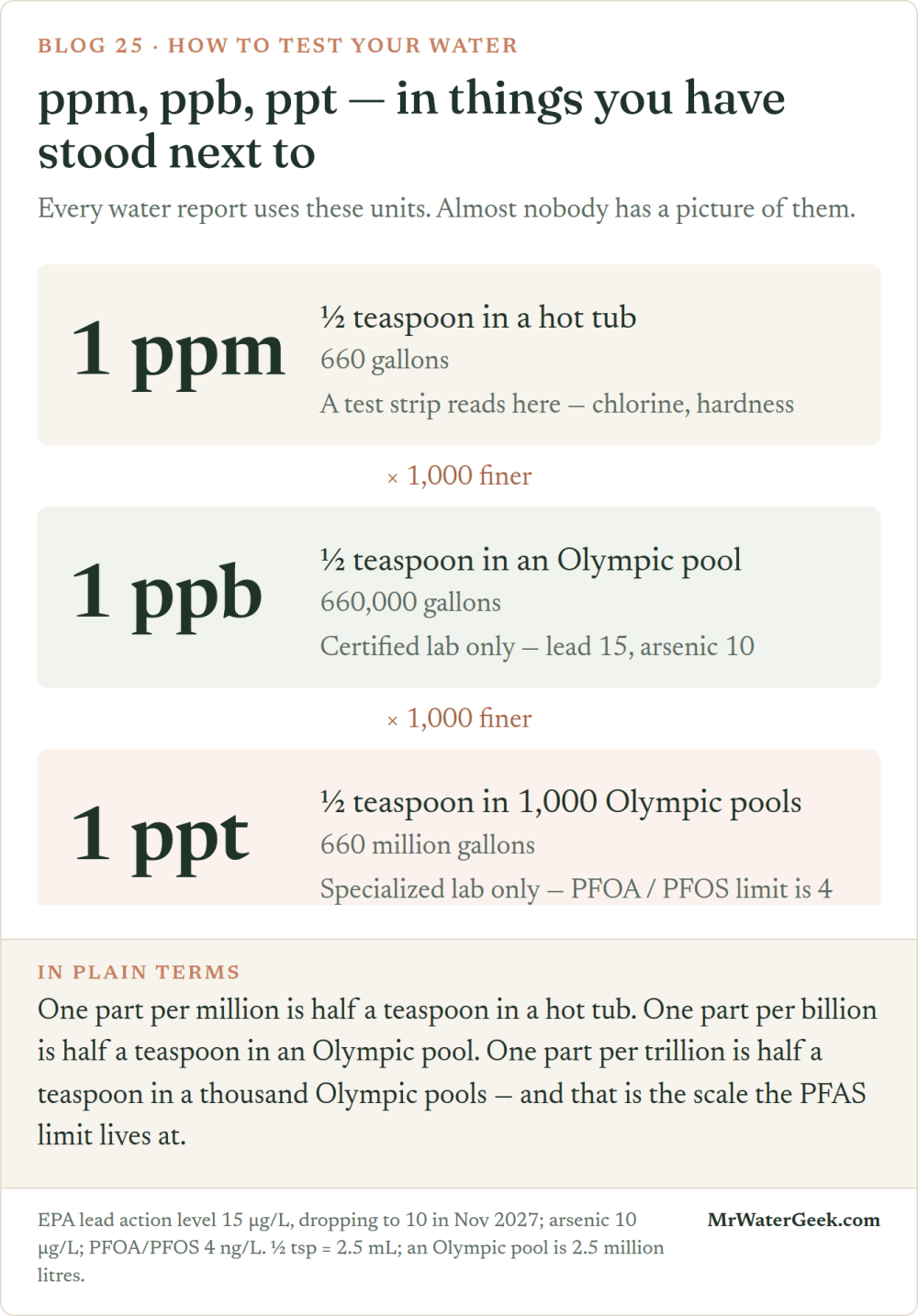
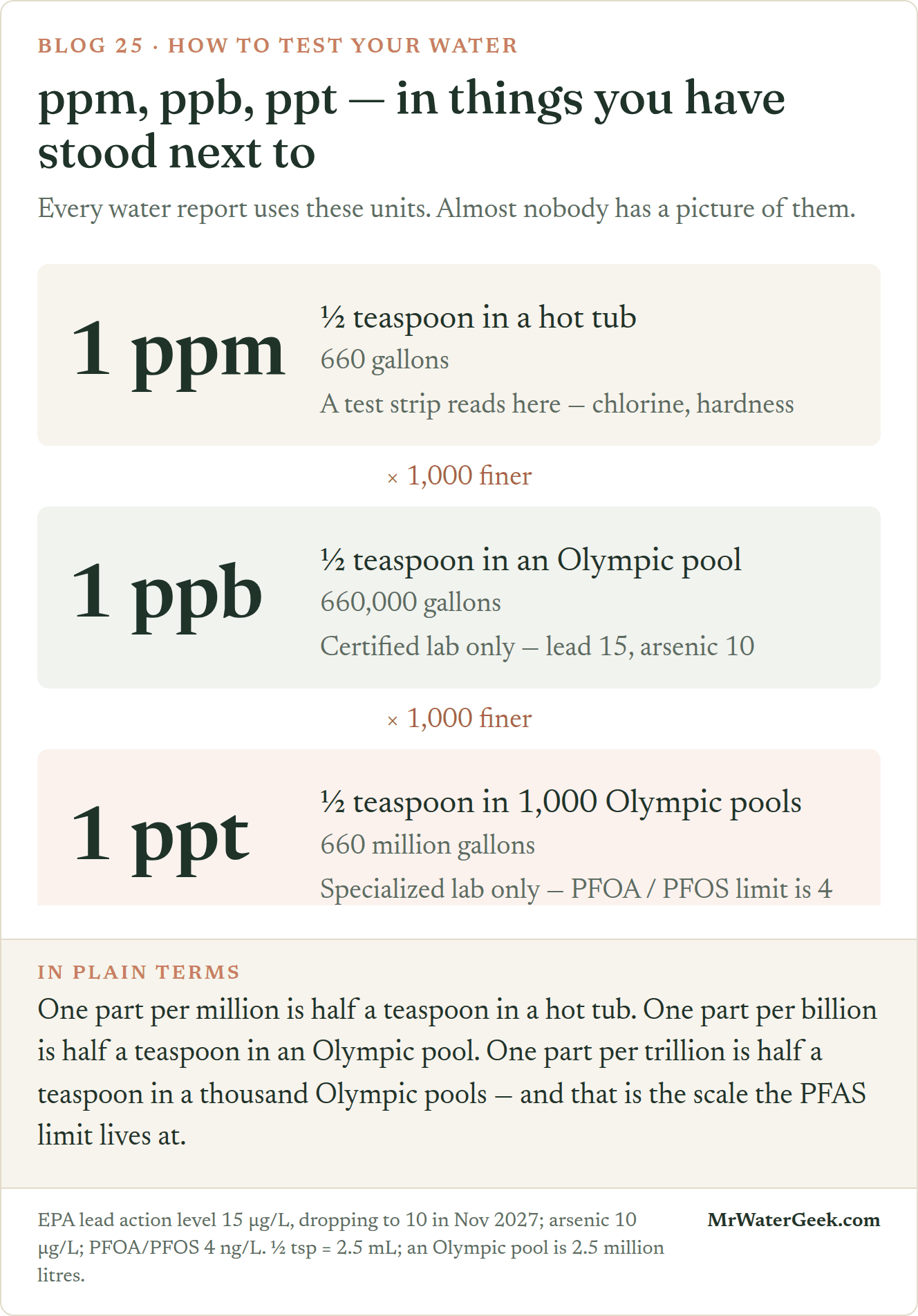
The gap between strips and a lab is one of scale, not brand quality. Lead matters at parts per billion and PFAS at parts per trillion, concentrations no color-change chemistry can resolve. A strip that reads “no lead detected” is reporting that it couldn’t see lead at its own detection limit, which sits far above the level anyone cares about. For hardness — a parameter measured in grains per gallon — a strip is genuinely useful.
What the EPA Actually Recommends
For anyone on a private well, the EPA’s guidance is specific. Use only laboratories certified to do drinking water testing. Test annually for total coliform bacteria and nitrate — the two baseline health tests — and more often when young children, older adults, or pregnant or nursing family members are in the house. EPA’s baseline list also names total dissolved solids and pH, but those are aesthetic and operational indicators rather than health tests, so treat them as optional.
The EPA also names the moments to test regardless of schedule: after any known groundwater problem in the area, after significant changes near the well, after repairs to the well system, and any time the water changes in appearance, taste, or smell.
Two practical notes that get missed. Private wells aren’t covered by the Safe Drinking Water Act at all, which means no one is testing them but you. And many local health departments test private wells at no cost — worth a phone call before paying for a kit.
What to Test For — Start With the Report, Not a Panel
Testing for everything is expensive and mostly unnecessary. What you test for should follow from your water report and, on a well, from what your senses are already telling you.
On city water, start with the free step: pull your report by ZIP. It names what your utility detected — and, the part people miss, when it was last measured. Under EPA’s reporting rules a water quality report can carry monitoring data more than a year old, and some contaminants are sampled only once every three years, with the report printing the date of the most recent sample. So read two things: what was detected, and how fresh the data is.
Report current and clean? You may not need a paid test at all, with one exception below.
Most recent testing more than about twelve months old? Then the report can’t tell you what’s in your water now. That’s the trigger to test your own tap for the health contaminants that matter: lead, arsenic, nitrate and nitrite, pesticides, and disinfection byproducts.
Lead is the exception to all of it. No utility report can see your home’s plumbing, so if your house predates the 2014 lead-free rule — and especially if it predates 1986 — test your own tap for lead regardless of how clean or current the report looks. The five-minute check below tells you what you’re working with.
PFAS is a special case, and worth testing deliberately rather than by default. A PFAS panel is a separate, specialized lab test and an expensive one, often $100 to $300 on its own. Pay for it when there’s a reason: your current or a past report has shown PFAS at any non-zero level, or your area has a known source such as a military base, an airport, or an industrial site. If PFAS has never been detected in your supply, it usually isn’t the first dollar to spend.
On a private well, let taste, smell, and sight narrow the panel. Nobody tests a private well but you, so start with EPA’s two baseline health tests — total coliform bacteria and nitrate, annually — then add based on what you’ve noticed. TDS and pH appear on EPA’s baseline well list as well, but they’re aesthetic and operational indicators rather than health tests, so they’re useful for diagnosing corrosion or off-taste rather than for deciding whether the water is safe.
If lead is your concern specifically, our lead filter guide covers what a result means and which certifications address it.
What Your Water Is Telling You: Well-Water Triage
Most of what people notice is a nuisance rather than a hazard, but a few signs are health flags. Use the symptom to decide what to test for, and confirm before you treat. One root cause is worth naming up front: acidic, low-pH water is the quiet driver behind blue-green copper stains, metallic taste, pinhole leaks, and faster lead and copper leaching. If you see blue-green stains or taste metal, test pH alongside the metal.
| You notice… | Likely culprit | Nuisance or health? | Test or do |
|---|---|---|---|
| Rotten-egg smell, cold and hot | Hydrogen sulfide or sulfur bacteria in the well | Nuisance, and corrosive | Test for hydrogen sulfide and total coliform |
| Rotten-egg smell from hot water only | The water heater’s anode rod, not your source water | Not a water problem | Replace the anode rod |
| Musty, earthy, or fishy smell | Organic matter, algae byproducts, or bacteria | Usually nuisance | Test total coliform; shock-chlorinate if positive |
| Gasoline, solvent, or fuel smell | VOC or fuel contamination | Health — urgent | Stop drinking it, call your health department, test for VOCs |
| Soapy smell with foaming | Possible septic intrusion into the well | Health flag | Test coliform and nitrate; check septic-to-well separation |
| Metallic taste | Iron, manganese, copper, or low pH | Iron and manganese are nuisance; copper is a health question | Test iron and manganese; if you also see blue-green stains, test copper and pH |
| Salty taste | Chloride or sodium — road salt, seawater intrusion, or softener discharge | Nuisance, with a sodium note for low-sodium diets | Test chloride and sodium; check the softener |
| Reddish, orange, or brown stains | Iron | Nuisance (staining) | Test iron |
| Black stains or specks | Manganese | Nuisance, but it carries a health guidance level | Test manganese |
| Blue-green stains on sinks or tubs | Copper from your pipes plus corrosive, low-pH water | Secondary health concern, plus pinhole leaks | Test copper and pH; the fix is often a pH neutralizer |
| Yellow or tea-colored tint | Tannins from decaying vegetation | Nuisance (harmless) | Confirm tannins rather than iron; tannin filter if it bothers you |
| Cloudy water that clears from the bottom up | Trapped air | Harmless | Nothing |
| Cloudy water that won’t clear, or visible particles | Sediment and turbidity | Nuisance, and it can shield microbes | Sediment filter; test coliform if it follows rain |
| White chalky scale, spotty glassware | Hardness (calcium and magnesium) | Nuisance, plus appliance wear | Consider a softener above about 7 grains per gallon |
| Pink film in the shower or toilet | Serratia — airborne bacteria, not your water | Not a water problem | Clean the surfaces; don’t chase it in the water |
On municipal water this table still helps diagnose taste, odor, and staining, but the health decision starts with the ZIP-code report rather than with your senses.
Is My Plumbing Lead? A Five-Minute Home Check
Lead hides in three places: the service line running from the street to the house, the solder at copper-pipe joints, and the brass inside fixtures. Here’s how to read your own.
1. Scratch it, then hold a magnet to it. Find the pipe where water enters the house, just before the main shut-off, usually in a basement or crawl space, and scratch the bare metal with a coin or a key. If it’s soft, scratches to a shiny silver, and a magnet won’t stick, that’s lead — often with a bulb-shaped bend near the valve. If it scratches to a copper-penny color and a magnet won’t stick, it’s copper. If the magnet sticks and the pipe is silver and threaded, it’s galvanized steel, which can still carry lead it picked up upstream. White or gray pipe joined with clamps or glue is plastic.
2. Use the age of the house. A water connection made after about 1988 makes a lead service line very unlikely. Before 1986, lead solder and lead service lines were both still legal. And brass sold as “lead-free” between 1986 and 2014 could contain up to 8 percent lead, so the faucet itself can contribute in a house that feels far too new to have a lead problem.
3. Ask your utility. Under EPA’s Lead and Copper Rule Revisions, water systems had to publish a lead service line inventory, with the first versions due in October 2024. Search for your utility’s name plus “lead service line inventory,” or call and ask what material is on record for your line.
4. Confirm with a test, because that’s the only real answer. The scratch test only shows the exposed indoor pipe; solder and brass are hidden, and the buried line isn’t visible at all. Lead also varies from one draw to the next, which is why a first-draw lab sample — water that has sat at least six hours — is how you actually know. One low result isn’t an all-clear.
NARROW THE PANEL
Let the report tell you what to test for
Knowing what’s already been detected locally keeps you from paying for a panel you don’t need.
Taking the Sample So the Result Means Something
A lab can only analyze what you hand it, and sampling technique changes the answer more than most people expect — especially for lead.
A first-draw sample is collected from a tap that hasn’t run for at least six hours, usually overnight. It captures water that has been sitting in contact with your plumbing, so it shows the maximum the pipes contribute. A flushed sample is taken after running the tap, and it reflects what’s arriving from the main. They answer different questions, and a lab kit will specify which one it wants.
The rest is procedural and worth following exactly: use the container the lab provides rather than your own bottle, don’t rinse it out, collect from the tap you actually drink from, use cold water, remove nothing from the aerator unless instructed, and get the sample back within the stated holding time. Bacteria samples in particular have short windows and need to stay cold.
Sloppy sampling produces confidently wrong numbers, which is worse than no number at all — it can talk you out of a filter you need or into one you don’t.
Reading the Results
A lab report gives you a value, a unit, and usually a detection limit. Three things are worth knowing before you interpret it.
Units are not interchangeable. Lead is reported in parts per billion, PFAS in parts per trillion. Reading one as the other is off by a factor of a thousand.
“Non-detect” means below the detection limit, not zero. The limit itself should be printed on the report, and it’s the number that tells you how sensitive the test was.
Regulatory limits aren’t health thresholds. The EPA’s lead action level of 15 ppb — dropping to 10 ppb in November 2027 under the Lead and Copper Rule Improvements — is a trigger for utilities to act, not a line below which lead is safe. The CDC’s position is that no blood lead level in a child is known to be safe. A result under the action level is not the same as a clean result.
Then, and Only Then, Choose a Filter
This is the step that makes every other filtration decision cheaper. Once you have a result, you’re shopping for a certification that names your contaminant instead of buying general-purpose reassurance. A filter certified to NSF/ANSI 53 for lead is a specific answer to a specific finding; a filter certified to NSF/ANSI 42 improves taste and may do nothing for what you found.
The sequence is diagnose, then treat, and it’s the same order you’d accept anywhere else. Nobody takes a medication before knowing what’s wrong. Water is the one place people routinely reverse it — buying the device first and never learning whether it addressed anything.
DIAGNOSE FIRST
Start with what’s already been detected near you
Free, instant, and it tells you which test is worth paying for.
FAQ
How do you test tap water for lead? Collect a first-draw sample — from a tap that hasn’t run for at least six hours — into the container a certified laboratory provides, and return it within the stated holding time. Lead matters at parts per billion, which is far below what home test strips can resolve, so a lab is the only route to a number you can act on.
Are home water test strips accurate? They’re reasonable for hardness, chlorine, and pH, which occur at concentrations color chemistry can read. They’re not usable for lead, PFAS, nitrate, or bacteria, where the levels of concern sit far below any strip’s detection limit. A strip reading “not detected” for lead means the strip couldn’t see it, not that it isn’t there.
Where can I get my water tested? Through a laboratory certified for drinking water testing, which the EPA recommends over any uncertified option. Start with your local health department, since many test private wells at no cost, and your state maintains a list of certified labs — EPA publishes the contact for every state’s certification program on its lab certification page. If you use a mail-in kit, confirm the lab behind it is certified before paying.
How often should you test well water? Annually for total coliform bacteria and nitrate — the baseline health tests, per EPA guidance — and more often with young children, older adults, or pregnant or nursing family members in the home. Test immediately after well repairs, nearby groundwater problems, or any change in how the water looks, tastes, or smells.
Does a water quality report tell me what’s in my tap? Only partly. It describes water leaving the treatment plant and moving through the distribution system, not what your own service line, solder, and fixtures add on the way to your glass. That last stretch is where lead usually enters, which is why two homes on the same street can test differently.
Do I need to test if I’m on city water? Not always, but it’s worth it in specific cases: a home built before 1986, a known or unknown service line material, a recent main break or plumbing work, or a report showing something you want to confirm at your own tap. If none of those apply and your report is clean, the report may be enough.
Shashank — 9 years at Kohler building water products. Currently building the next generation of water health products.