A touchless kitchen faucet uses an infrared sensor and a solenoid valve to start and stop water when you wave a hand near the spout. Underneath that layer sits the same mechanical mixing valve as any other faucet. You’re not buying a different faucet — you’re buying electronics bolted onto a normal one, which buying both convenience and additional parts that can fail.
Key Takeaways — Are touchless faucets worth it?
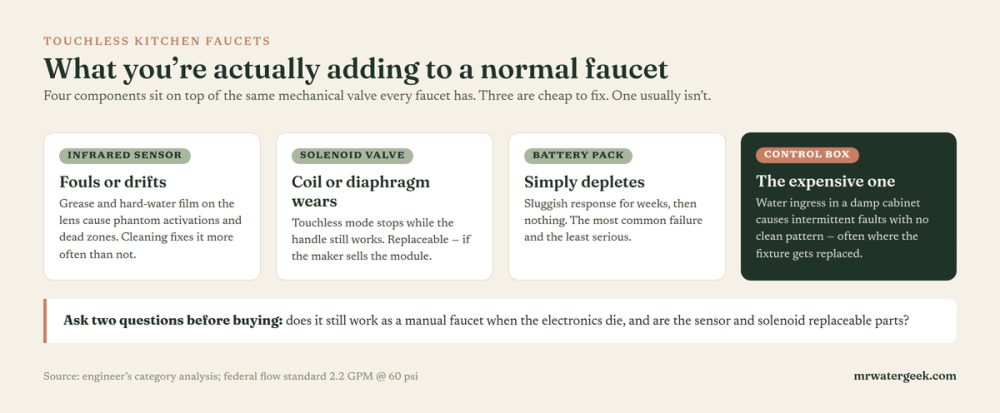
If you cook with raw meat on your hands, the convenience is real and you’ll use it daily. What I’d insist on before buying: it has to work as a normal faucet when the electronics die, and the sensor and solenoid have to be replaceable parts rather than sealed into the body. Meet both and it’s a reasonable buy. Miss either and you’ve bought a disposable faucet.
BEFORE YOU UPGRADE
A smarter faucet doesn’t change what’s in the water
Sensors are convenience. What comes through the pipe is health. See yours by ZIP.
How a Touchless Kitchen Faucet Actually Works
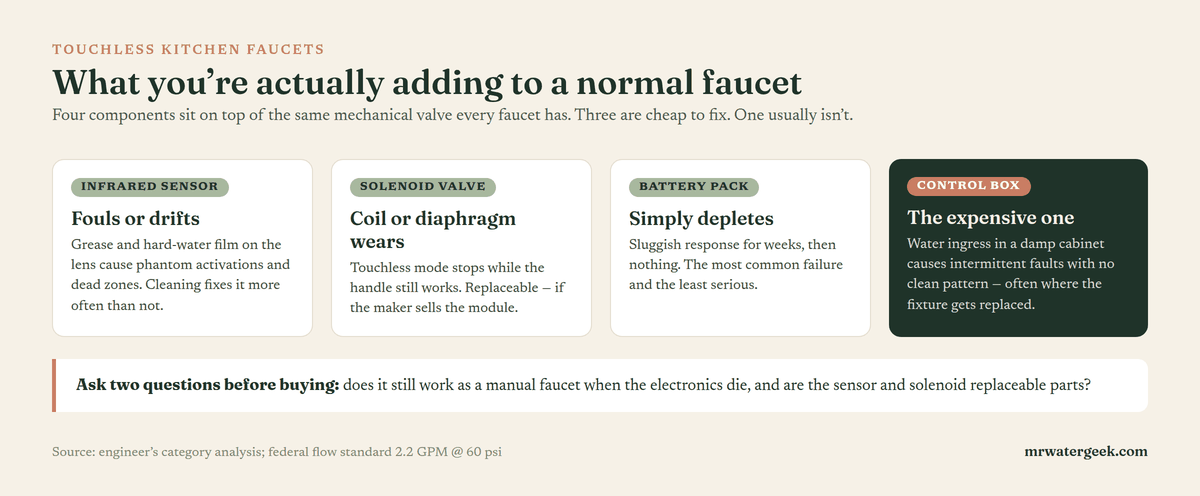
Three components turn an ordinary faucet into a touchless one. An infrared sensor sits near the base or under the spout, emitting a beam and watching for its reflection. Break the beam with a hand and the sensor signals a solenoid valve — an electrically actuated valve that opens when current energizes a coil and closes when it stops. Powering both is a battery pack or transformer under the sink, usually a set of AA cells in a plastic housing clipped to the cabinet wall.
Note what isn’t on that list: the mixing valve. Temperature still comes from the mechanical handle, set the way you set any faucet. The sensor doesn’t mix anything. It decides whether water flows at whatever temperature the handle is already calling for, which is why a touchless faucet parked on hot will hand you hot water when you wave at it.
Those additions are the whole story of what changes. In the Johns Hopkins research I’ll come to below, the lead investigator counted five extra parts that a manual faucet simply doesn’t have. Every one of them lives in a wet cabinet, and every one is a component that can eventually stop working.
The Two Questions to Ask Before You Buy
Most touchless buying advice sorts models by features. After nine years around faucet design, I’d sort them by two questions, because the answers determine whether you own a faucet or a countdown.
Does it fall back to manual operation? A well-designed touchless faucet keeps its mechanical valve fully functional. Batteries die, the sensor fails, and the handle still turns water on the way it always did. A poorly designed one routes everything through the solenoid, so when the electronics quit, the faucet quits. This is the single most important spec on the page, and it’s often buried in a manual rather than printed on the box.
Are the sensor and solenoid replaceable? These are the parts most likely to need service in the first decade. If the manufacturer sells a replacement sensor module and solenoid, a failure is a twenty-minute repair. If those components are sealed into the faucet body, the same failure means replacing the entire fixture. Ask for the parts diagram before you buy, the same way you’d check whether a cartridge is available a decade out.
The Hygiene Question, and the Research That Complicates It
The pitch for touchless is hygiene: you don’t smear raw-chicken hands on a handle you’ll touch again later with clean ones. It’s a simple benefit: fewer contacts with a contaminated surface is fewer contacts.
What complicates the picture is what happens inside the fixture. A team at Johns Hopkins sampled water from electronic and manual faucets in a hospital and found the electronic ones considerably more likely to grow bacteria. In their results, presented to the Society for Healthcare Epidemiology of America and later published in Infection Control & Hospital Epidemiology, 50% of electronic faucet samples grew Legionella species compared with 15% of manual ones. When the researchers dismantled two of the electronic faucets, every internal component they cultured grew bacteria.
Their explanation was mechanical rather than mysterious: the extra valve components create additional interior surface area where water sits still between uses, and biofilm establishes itself in exactly those conditions.
Now the caveats, which matter as much as the finding. This was a hospital, not a kitchen. It covered one manufacturer’s faucets. The population at risk from waterborne Legionella is immunocompromised patients, not healthy adults rinsing vegetables. The study is not a reason to distrust the faucet in your house, and I want to be plain that I’m not extending a hospital infection-control result into a home health warning.
What does transfer is the design lesson. More internal parts mean more surface for stagnant water, and stagnation is the condition biofilm needs. If a touchless faucet is going to sit unused for a week — a vacation home, a guest kitchen — running it for a minute when you return is a sensible habit. That’s the same advice that applies to any fixture that sits idle, and it costs nothing.
Water Savings: Real, But Smaller Than the Marketing
Hands-free operation genuinely saves water in the tasks where you’d otherwise leave the tap running — scrubbing a pan, working through a pile of vegetables, lathering your hands. Shutting off between steps takes a wave instead of a wet handle, so people actually do it.
The ceiling on that benefit is set by federal law, not by the sensor. Kitchen faucets are capped at 2.2 GPM at 60 psi, with California and Colorado requiring 1.8 GPM or lower, and a touchless model runs at the same rate as a manual one from the same maker. The savings come entirely from shorter run time, which means they scale with how you cook. Someone who already turns the tap off between tasks will save very little. Someone who leaves it running through a whole sink of dishes will save more.
Failure Modes: What Actually Breaks
Every added component has a characteristic way of going wrong, and most of them announce themselves before they fail completely.
| Component | How it fails | What you’ll notice | Fixable? |
|---|---|---|---|
| Infrared sensor | Lens fouls with grease and hard-water film, or drifts out of alignment | Phantom activations, or dead zones where your hand reads as nothing | Usually. Clean the lens first — it solves this more often than not |
| Solenoid valve | Coil burns out or the internal diaphragm wears | No flow in touchless mode while the handle still works normally | Yes, if the manufacturer sells the module |
| Battery pack | Normal depletion, or corrosion at the contacts | Sluggish response for a few weeks, then nothing | Yes — the most common “failure” and the least serious |
| Control box | Water ingress or electronics failure in a damp cabinet | Intermittent everything, with no clean pattern | Sometimes; often the point where the fixture gets replaced |
| Mechanical valve | Ceramic disc wear, identical to any faucet | A drip that persists with the handle closed | Yes — a standard cartridge swap |
The pattern in that table is the part to take away: the first three failures are cheap and fixable, the fourth is the expensive one, and the fifth has nothing to do with being touchless. You’re adding three serviceable parts and one that tends to be terminal.
WORTH CHECKING
The fixture is the last few inches
Whatever you mount on the deck, it’s the water arriving underneath that decides what you drink.
Who Should Buy One, and Who Shouldn’t
Buy touchless if you cook often enough that hands-free matters several times a day, if you’re comfortable changing batteries under a sink, and if the model you’re looking at passes both questions above. Households with kids get a second benefit that rarely gets mentioned: a faucet that shuts itself off is a faucet nobody leaves running.
Skip it if your priority is the fewest possible things that can break over twenty years. A purely mechanical faucet with a ceramic-disc cartridge and a solid brass body has one wear item and a parts catalog. That’s the configuration I’d choose for a rental property or a house I planned to hold for decades — the reasoning is laid out in our guide to choosing a kitchen faucet that lasts 20 years.
Between those two positions sits a large group of people who want touchless and are right to want it. The point isn’t to talk you out of the feature. It’s to make sure the one you buy degrades into a working faucet instead of a broken one.
FROM FIXTURE TO GLASS
You’ve picked the faucet. Now check the water.
Lead, PFAS, hardness — your ZIP tells you what the fixture is dealing with.
FAQ
Are touchless kitchen faucets reliable? They can be, on two conditions: the faucet falls back to manual operation when the electronics fail, and the sensor and solenoid are replaceable parts. Those two design choices separate a faucet that survives an electronics failure from one that gets thrown out because of it. Confirm both before buying rather than after.
What happens to a touchless faucet when the batteries die? On a well-designed model, nothing dramatic — the mechanical handle still controls water normally and you replace the batteries when convenient. On a model that routes all flow through the solenoid, the faucet stops working entirely until you swap them. Most give you weeks of warning through sluggish sensor response.
Do touchless faucets save water? Somewhat, and only through shorter run time. Flow rate is capped by regulation at 2.2 GPM federally, with 1.8 GPM or lower in California and Colorado, and touchless models run at the same rate as manual ones. The savings come from shutting off between tasks, so they’re largest for people who currently leave the tap running.
Are touchless faucets less sanitary inside? Hospital research found electronic faucets more likely to harbor bacteria internally than manual ones, attributed to extra components where water sits still between uses. That work involved one manufacturer in a healthcare setting, where the population at risk is immunocompromised patients. It isn’t a reason to avoid touchless at home, though flushing any fixture that’s sat unused for a week remains sensible.
Can you install a touchless faucet yourself? Usually, if you can install a standard faucet. The extra steps are mounting the control box and battery pack inside the cabinet and connecting the sensor lead, all of it low-voltage plug-together wiring. Leave yourself access to the battery pack, because reaching it later is the part people regret.
Do touchless faucets work with filtered water systems? Yes, because a filtered system typically runs to its own dedicated tap rather than through the main faucet. That separation is a good thing: it keeps the filter cartridge sized for drinking water only instead of every gallon you use for dishes.
Shashank — 9 years at Kohler building water products. Currently building the next generation of water health products.
Tab 2
Verdict: Accurate and unusually well-handled on the one risky claim. Publish-ready after linking.