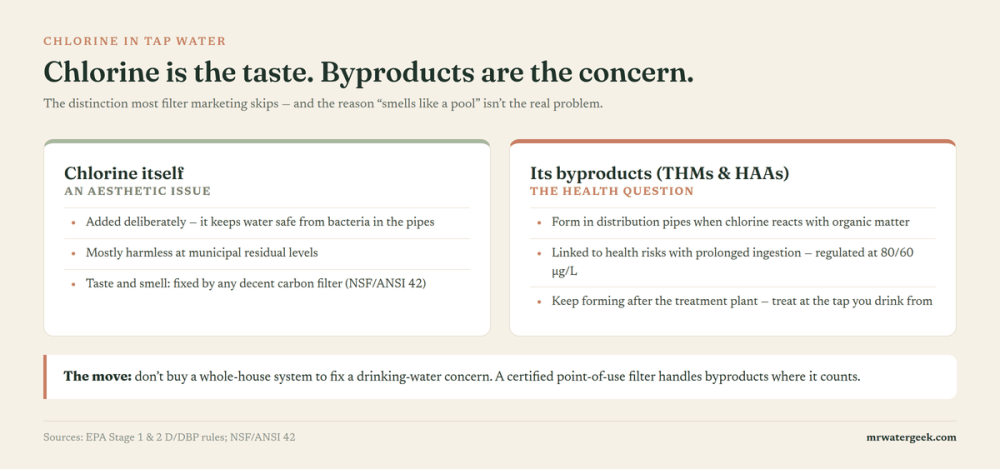
Chlorine in tap water is added on purpose to kill bacteria, viruses, and parasites — and ~90% of the US gets tap water treated with it. At normal concentrations (0.2 to 4 ppm), chlorine itself is not a health threat. The real concern is what happens next: chlorine reacts with organic matter in your pipes and creates disinfection byproducts (DBPs) — the chemical leftovers linked to cancer risk over time.
Key Takeaways
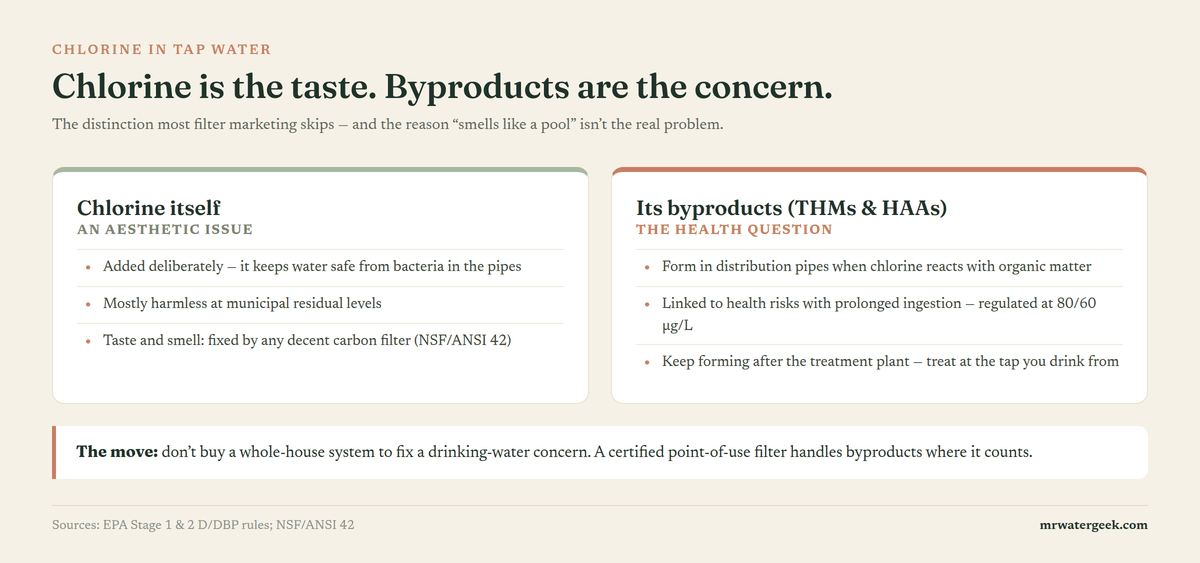
– Chlorine at tap-water levels is not the health threat. The byproducts it creates in your pipes (called DBPs) are.
– THMs and HAAs are the two byproduct families to watch. The EPA caps total THMs at 80 ppb and HAA5 at 60 ppb.
– Carbon block filters remove both chlorine and its byproducts. Standard pitcher filters mostly just improve taste and smell.
– Look for NSF 53 certification, not just NSF 42, if you care about byproduct removal — not just flavor.
Free · 30 seconds
What’s actually in your tap water?
Your utility’s real numbers — free, by ZIP code.
Check my ZIP →Why Is Chlorine in My Tap Water?
Because it works. Chlorination is the single most effective public health tool in the history of water treatment. The CDC credits water disinfection with virtually wiping out waterborne diseases like cholera, typhoid, and dysentery in developed nations.
Your water utility adds chlorine (or chloramine, which I’ll get to) at the treatment plant. It stays active as your water travels through miles of pipes to your home. That leftover chlorine is there on purpose — it keeps bacteria from growing between the plant and your faucet.
At 0.2 to 4 parts per million, chlorine in drinking water falls well within the EPA’s National Primary Drinking Water Regulations. The legal ceiling (called the MRDL) is 4 mg/L. Most systems run well below that.
So if someone tells you chlorine in your water is dangerous, they’re solving the wrong problem.
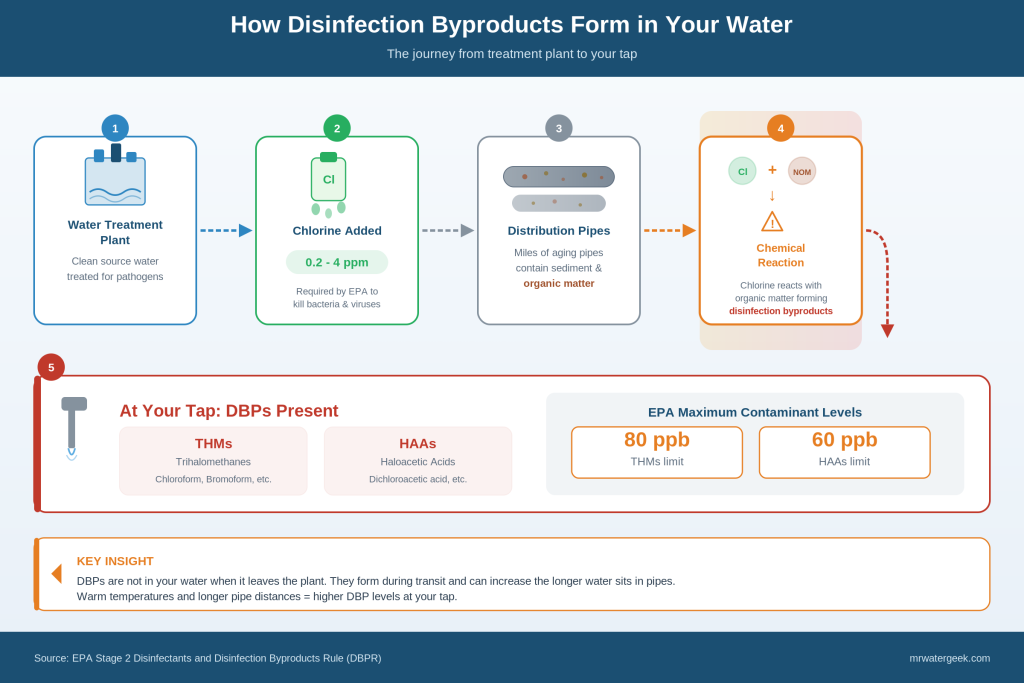
How Do Disinfection Byproducts (THMs and HAAs) Form?
Water leaving the treatment plant isn’t pure H2O. It carries tiny amounts of natural organic matter — bits of decomposed plants, algae, and soil compounds. All harmless on their own.
But chlorine is reactive. As it travels through your pipes, it reacts with that organic matter and creates compounds called disinfection byproducts (DBPs) — the chemical leftovers chlorine creates. The two regulated families:
Trihalomethanes (THMs): These include chloroform, bromodichloromethane, dibromochloromethane, and bromoform. Chloroform is the most common one in chlorinated systems. Think of it this way: chlorine breaks apart organic molecules and reassembles the pieces into new compounds that weren’t in your water when it left the plant.
Haloacetic acids (HAAs): The regulated five (HAA5) are a group of acids — including dichloro- and trichloroacetic acid — that form through similar reactions. They’re less well-known than THMs but regulated just as tightly.
How much of these byproducts end up in your water depends on three things: how much organic matter is in the source water, how much chlorine is added, and how long the water sits in the pipes. If you live at the end of a long pipe run — say a rural area far from the treatment plant — your water has had more time to form byproducts than someone living close to the plant.
What Does the EPA Actually Limit — and What Slips Through?
EPA limits for THMs and HAAs are set by the Stage 2 Disinfectants and Disinfection Byproducts Rule, which establishes legal maximums (called MCLs) for both byproduct families:
– Total THMs: 80 ppb (micrograms per liter)
– HAA5: 60 ppb
These limits are a calculated tradeoff. The EPA weighs the cancer risk from long-term byproduct exposure against the immediate risk of waterborne disease if you cut back on disinfection. The WHO’s drinking water guidelines follow similar logic — chloroform gets a guideline value of 300 ppb, but the WHO is clear that disinfection should never be sacrificed to hit byproduct targets.
I want to be direct about what the research says. Long-term exposure to THMs above these legal limits is linked to increased bladder cancer risk. A 2025 meta-analysis in Environmental Health Perspectives found people in the highest THM-exposure group were roughly 1.5× more likely to develop bladder cancer than those in the lowest-exposure group. The EPA’s own risk assessments acknowledge this. But “linked to increased risk at sustained high exposure” is different from “your tap water will give you cancer.” Context matters.
These legal limits don’t eliminate risk. They manage it. If that distinction bothers you, a filter is a reasonable response. Panic is not.
Does My Water System Have High Byproduct Levels?
The EWG Tap Water Database lets you search your zip code and see detected contaminant levels, including THMs and HAAs. I’d recommend checking it, but with two caveats.
First, many systems will show byproduct levels above EWG’s health guidelines but below EPA legal limits. EWG uses stricter benchmarks based on cancer risk studies rather than the regulatory tradeoff. Both numbers are valid — they just answer different questions.
Second, byproduct levels change with the seasons. Summer months produce higher concentrations because warmer water speeds up the chemical reactions, and source water tends to carry more organic matter in warmer months.
Systems that draw from surface water (rivers, reservoirs) typically produce more byproducts than groundwater systems, because surface water carries more organic matter. Older pipe networks with longer runs and more buildup inside the pipes also tend to create more byproducts.
Not sure what’s in your water?
Check your ZIP code — free, takes 30 seconds.
How Do You Know If Your Water Has High Disinfection Byproducts?
You can’t measure THMs or HAAs without a lab test. But you can spot the conditions that go hand-in-hand with higher byproduct levels:
Chlorine smell from your hot water. When you run a hot shower or fill a pot with hot water, dissolved chlorine escapes into the air faster. If the smell is strong, your water is carrying a lot of active chlorine — and that means byproducts are forming.
Taste changes depending on time of day. Water that sits in your home’s pipes overnight gives chlorine more time to react with organic matter. Your first glass in the morning may taste different from water after the tap has been running.
Seasonal taste shifts. If your water tastes noticeably different (more chemical, sharper) in summer versus winter, that tracks with higher byproduct formation during warm months.
You’re at the end of the line. If you live in a rural area far from the treatment plant, or your neighborhood is at the tail end of the pipe network, your water has had the longest travel time. More time in pipes means more byproducts.
None of these are cause for alarm. They’re signals that a chlorine water filter might be a worthwhile addition to your kitchen.
Which Chlorine Water Filter Removes THMs and HAAs?
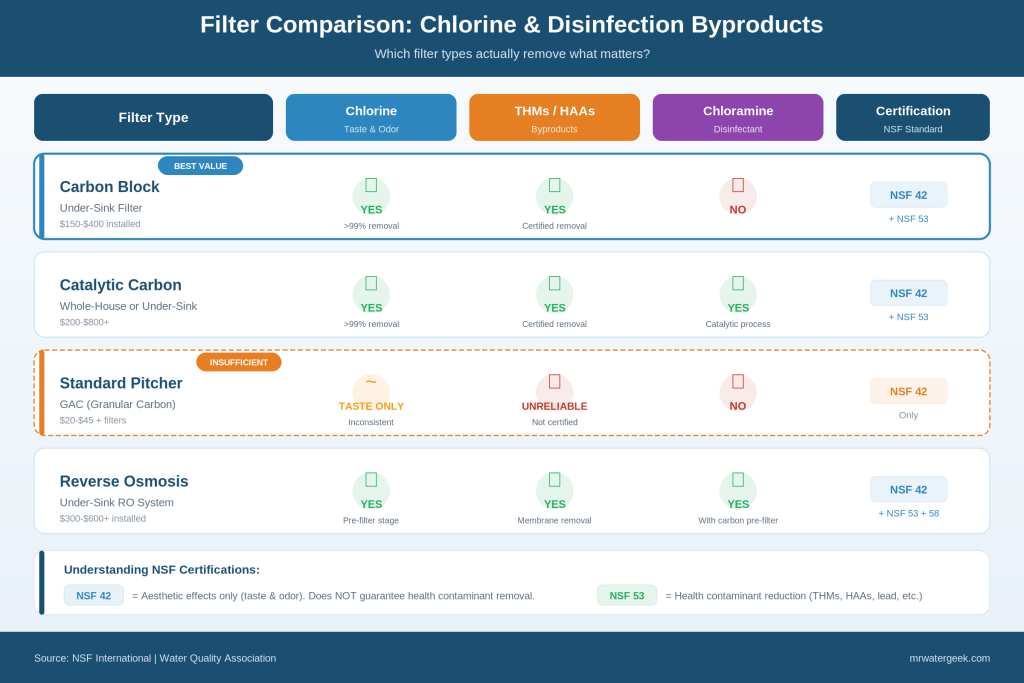
Not all filters handle this equally. Removing chlorine is easy. Removing its byproducts takes more.
| Filter Type | Removes Chlorine? | Removes THMs/HAAs? | Handles Chloramine? | Best Certification |
| Carbon block (under-sink) | Yes | Yes | No (need catalytic) | NSF 53 |
| Catalytic carbon | Yes | Yes | Yes | NSF 53 |
| Standard pitcher (GAC) | Taste/odor only | Unreliable | No | NSF 42 |
| Reverse osmosis | Yes | Yes | Yes | NSF 58 |
1. Carbon block filters — the reliable choice. Solid carbon block filters give water enough contact time to effectively reduce both chlorine and THMs/HAAs. Look for NSF/ANSI 53 certification — that’s the standard for health-related contaminant reduction, not just NSF 42 (which only covers taste and smell). A quality under-sink carbon block or a certified whole home water filter handles both chlorine and its byproducts.
2. Catalytic carbon — needed for chloramine systems. If your utility uses chloramine instead of free chlorine (check your annual water quality report), standard carbon is less effective. Chloramine is more stable and harder to break down. Catalytic carbon — a specially treated form of carbon designed to break down chloramine — handles the job through a different process. Systems like Aquasana’s whole-house filters use catalytic carbon for this reason.
3. Standard pitcher filters — hit or miss. Most pitcher filters use loose carbon granules (called GAC). GAC handles chlorine taste and smell well, and many carry NSF 42 certification. But because the granules are loose, water can flow through gaps without enough contact time — which means THM and HAA removal is unreliable. If a pitcher filter carries NSF 53 certification for THM reduction specifically, it can work. Most don’t. Check the fine print.
4. Reverse osmosis — effective but often overkill. RO pushes water through a filter so fine it blocks dissolved particles, removing virtually everything — chlorine, THMs, HAAs, and most other contaminants. For byproduct reduction alone, that’s more firepower than you need. The waste water, membrane replacements, and ongoing costs aren’t worth it when a carbon block solves the specific problem. RO makes sense when you’re also dealing with other contaminants that carbon can’t handle.
Is Chloramine Different From Chlorine in Drinking Water?
Some utilities have switched from free chlorine to chloramine (chlorine combined with ammonia) because chloramine produces fewer THMs and HAAs. That’s the upside.
The tradeoff: chloramine creates its own category of byproducts, including NDMA (N-Nitrosodimethylamine), a probable human carcinogen. Chloramine also stays active longer in the pipes, which is partly why utilities like it — but it means the disinfectant is still reacting with organic matter when it reaches your tap.
For filtration, this is an important difference. Standard carbon handles free chlorine easily. Chloramine requires catalytic carbon or a much larger carbon bed with longer contact time. If you’re shopping for a chlorine water filter and your system uses chloramine, make sure the filter is rated for chloramine specifically.
Your annual Consumer Confidence Report (CCR) will tell you which disinfectant your utility uses. You can also find it on the EWG Tap Water Database by entering your zip code.
Do You Need a Chlorine Water Filter?
My honest take: probably not worry, but possibly act.
Chlorine at tap-water levels is doing its job. The byproducts are a real concern at sustained exposure levels, especially for people whose systems show higher-than-average THM or HAA readings. But “real concern” means “worth fixing with a good filter,” not “worth losing sleep over.”
If your water smells like chlorine, tastes off, or your system shows elevated byproducts in the EWG database, a carbon block filter rated to NSF 53 is a smart, effective move. It’s not expensive. It’s not complicated.
If your water tastes fine and your system’s byproduct numbers are well below the legal limits, you have other things to spend money on.
The engineer’s answer isn’t “everyone needs a chlorine water filter.” It’s “know what’s in your water, understand the difference between the disinfectant and the byproducts it creates, and filter based on data — not fear.”
FAQ
Is chlorine in tap water safe to drink? At the levels used in US tap water (up to 4 mg/L), chlorine itself is considered safe by the EPA, CDC, and WHO. The health concern isn’t the chlorine — it’s the byproducts (THMs and HAAs) that form when chlorine reacts with organic matter in the pipes. A carbon block filter certified to NSF 53 reduces both.
What’s the difference between chlorine and chloramine in drinking water? Chlorine is a standalone disinfectant. Chloramine combines chlorine with ammonia so it lasts longer in the pipes. Chloramine produces fewer THMs but creates its own byproducts, including NDMA. Standard carbon filters handle chlorine well, but chloramine needs catalytic carbon — a specially treated form of carbon designed to break it down.
Do Brita filters remove chlorine from water? Most Brita pitchers use loose carbon granules (called GAC) and carry NSF 42 certification, which means they reduce chlorine taste and smell. But NSF 42 does not cover byproducts like THMs and HAAs. For byproduct removal, look for filters with NSF 53 certification — that’s the standard for health-related contaminant reduction.
What are trihalomethanes and why should I care? Trihalomethanes (THMs) are compounds — including chloroform, bromodichloromethane, dibromochloromethane, and bromoform — that form when chlorine reacts with natural organic matter in water pipes. The EPA caps total THMs at 80 ppb because long-term exposure at elevated levels is linked to increased cancer risk.
How do I find out what’s in my tap water? Check your utility’s annual Consumer Confidence Report (CCR), which is required by federal law and lists detected contaminants including THMs and HAAs. You can also search the EWG Tap Water Database by zip code for an independent look at how your system’s levels compare to both legal limits and health-based guidelines.
Chlorine is just one piece of what’s in your water — and frankly, it’s the one doing its job. The bigger picture is what carbon can and can’t remove, how whole-home systems stack up against point-of-use filters, and whether your water actually calls for a water softener alternative or something else entirely. That’s where the next deep dive goes.
About the author: Shashank — 9 years at Kohler building water filtration. Mr Water Geek translates water science into clear decisions.
Your water tells a story. Find out what’s actually in it.
Free report by ZIP →