You noticed something. Whether it’s a new smell, color, taste, or residue, noticing a change is valuable information.
The problem is that the internet answers every one of these questions the same way, which is to tell you it could be dangerous and then sell you a filter. Most of these are not dangerous. A couple are worth a test. Here is how to tell them apart.
Key Takeaways — Should I worry?
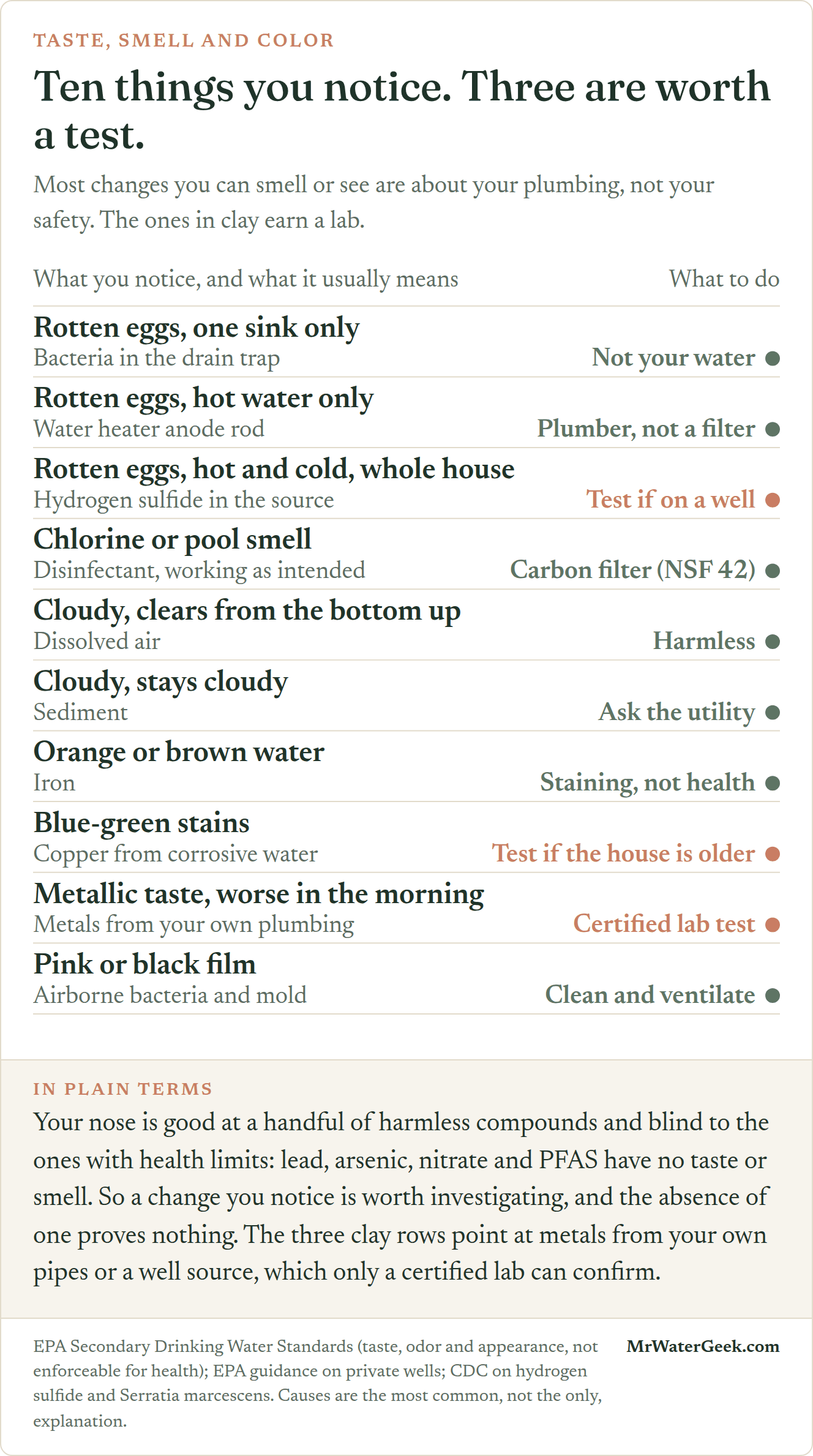
A rotten egg smell is almost always harmless and almost always hydrogen sulfide. Cloudy water that clears from the bottom up is just air. Chlorine smell means your utility is doing its job. Three are worth acting on: a metallic taste, water that is discolored when you first turn it on, and any change that shows up right after work was done on the street or in your house. Those are all about your plumbing, which no water report can see.
WHAT IS NORMAL WHERE YOU LIVE
Check what your utility reported for your area
Disinfectant, hardness, metals. About 30 seconds by ZIP.
Rotten eggs or sulfur
This is typically a well-water problem and the odor almost always indicates the presence of hydrogen sulfide. It comes from bacteria that are perfectly happy in oxygen-poor water underground. You can smell it at concentrations far below anything that could hurt you — your nose is more sensitive here than most lab equipment. Often, this bacteria uses any iron available in the water as a catalyst which results in red/pink stained toilets and showers.
While the bacteria themselves can be harmless to us, the bio slime can clog plumbing, foul valves, and also trap other pathogens that can be harmful to us.
There is a fast way to narrow it down to your well or a drain. Fill a glass, take it to another room, and smell it there. If the smell has vanished, the problem is not your water — it is your drain, where the same bacteria live in the gunk in the P-trap. If the glass still smells, keep going.
Next test: does it happen on hot water only? If so, the culprit is usually the magnesium anode rod inside your water heater reacting with sulfate in the water. A plumber can swap it for an aluminum one. If both hot and cold smell and you are on a well, you have sulfide in the source water which is a treatment question rather than a plumbing one.
A metallic taste, or water that looks rusty
This one earns a second look, because the metals that get into water between the treatment plant and your glass are the metals in your pipes.
Orange or brown usually means iron, which is a staining and taste problem rather than a health one. Blue-green staining in a sink or tub means copper, usually from corrosive water sitting in copper pipe. A sharp, metallic taste is the one worth testing for, especially first thing in the morning. Lead itself has no taste, but the conditions that pull lead out of a pipe pull other metals as well.
If your house went up before 1986, or you have no idea what your service line is made of, this is the symptom that should send you to a certified lab.
The pattern that tells you the most
Run the cold tap for two minutes and taste it again. If the water tastes fine after a flush but bad first thing in the morning, whatever you are tasting is coming from the pipes in and around your house, not from the supply. That is useful, and it is the opposite of reassuring.
Chlorine, or a swimming-pool smell
That is the disinfectant, and it is there on purpose. Chlorinating drinking water did more for life expectancy last century than almost any other public health measure. The smell is proof it is still working on the way to you.
The issue with chlorine (or chloramine) in your water is that there is a good chance your water also has disinfection byproducts as the disinfectants do their jobs. Byproducts like THMs (trihalomethanes) and HAA5 (haloacetic acids) are carcinogenic.
While chlorine is the easiest thing on this list to fix, the byproducts are not. An NSF 42 certified carbon filter in a pitcher, on the faucet, or under the sink takes care of chlorine well. That is the job most carbon filters are built and tested for. You can also just fill a jug and leave it in the fridge uncovered for a few hours. Much of it gases off on its own.
For the other contaminants however, the NSF 42 filter won’t do. You’ll need one certified to NSF 53.
Cloudy or milky water
Fill a clear glass and watch it for thirty seconds.
If it clears from the bottom upward, that is dissolved air coming out of solution, and it is nothing at all. It happens in winter when cold water is under pressure, and after any work on the mains. Harmless.
If it stays cloudy, or clears from the top down, something is suspended in the water rather than dissolved in it. That is sediment, and it is worth asking your utility whether there was a main break nearby. On a well it can mean surface water is getting in, which is a bacteria question.
Pink or black film in the toilet or shower
Not your water. That is Serratia marcescens, an airborne bacterium that settles on damp surfaces and shows up pink, and ordinary mold for the black. Both live on soap residue in a humid bathroom. Your water is a bystander here.
Clean it and keep the room ventilated. No filter will change it, because it is not arriving through the pipe.
IF SOMETHING CHANGED RECENTLY
Start with your area’s report
A main break, a disinfectant switch, a hardness change — the utility has usually logged it. Enter your ZIP.
When to stop reading and test
Four situations merit a test:
-
Your water changed suddenly and you cannot explain it.
-
Work was done on the street or on your plumbing in the last few weeks.
-
The house was built before 1986 and nobody has ever checked.
-
There is a pregnancy or a young child in the house and you want a baseline.
In those cases, use a lab certified for drinking water rather than a strip. Call your local health department first. A lot of them test private wells at no cost, and most will tell you which labs nearby are certified.
NOT SURE WHAT IS NORMAL?
Check the local report by ZIP
It takes about 30 seconds and tells you what your utility already found.
FAQ
My water tastes different at a friend’s house across town. Why? Different source, different mineral content, sometimes a different disinfectant. Even individual homes’ plumbing can affect smell and/or taste. Taste varies enormously between neighborhoods on the same system, and it says very little about safety either way.
Should I buy a filter to fix a smell? For chlorine, yes, and almost any carbon filter will do it. For sulfur, find the cause first — if it is your drain or your water heater, a filter is money spent on the wrong problem.
Is there anything I should never ignore? A boil-water notice from your utility, and any sudden change right after plumbing work. Both are cheap to act on and expensive to be wrong about.
Next: if the smell turned out to be your plumbing, the follow-up is a five-minute check of what your service line is made of — a coin and a magnet are all it takes.
Shashank — 9 years at Kohler building water products. Currently building the next generation of water health products.