Is Your Kitchen Faucet Adding Lead to Your Water? An Engineer’s Guide
Municipal tap water in the U.S. meets EPA standards for over 90 regulated contaminants — but “legal” and “optimal” aren’t the same thing. PFAS weren’t federally regulated until 2024; microplastics still aren’t. And the Consumer Confidence Report your utility publishes tests water at the plant, not at your faucet. The gap between those two points — treatment plant and tap — is where most water quality issues actually live. And the faucet itself may be adding to the problem.
Key Takeaways — What should you actually do?
Find out what’s in your water before spending anything. Look up your utility’s annual water quality report, or check your zip code at mrwatergeek.com/audit. Once you know whether your concern is hardness, contamination, or both, the right product category becomes obvious. Most people’s real issue is at the kitchen tap, not the water main — and the faucet is the last thing your water touches before you drink it.
You probably think about what you eat. Maybe you track macros, or at least read nutrition labels. You have opinions about processed food. You notice when produce is organic and when it isn’t.
Now think about water. How much thought have you given to what comes out of your kitchen faucet? Not whether you drink enough of it — that’s a different conversation. What’s actually in it. What it picked up between the treatment plant and your glass. Whether the pipes in your building — or the faucet itself — are doing something to it that the municipal report can’t account for.
For most people, the answer is: almost none. And that’s not because they’re careless. It’s because the entire system is designed to make water invisible. Turn on the tap, water comes out, it looks fine, it probably is fine. Right?
Usually, yes. But “usually” and “definitely” are doing a lot of heavy lifting in that sentence.
What’s the gap between “treated” and “safe”?
Municipal water treatment in the U.S. is good by global standards. Better than most countries, actually. The EPA regulates over 90 contaminants under the Safe Drinking Water Act. Your local utility tests regularly and publishes results annually. The infrastructure works. Cholera, typhoid, the waterborne diseases that still kill hundreds of thousands of people worldwide every year — those aren’t a concern here. That’s a real achievement.

But there’s a gap between “meets EPA standards” and “nothing in this water affects your health over 30 years.” The regulatory framework was designed for acute safety — preventing outbreaks, keeping obvious toxins below immediate-danger thresholds. It wasn’t designed to account for the kinds of low-level, long-term exposures that modern toxicology is increasingly concerned about.
PFAS weren’t regulated at the federal level until April 2024. Microplastics still aren’t. Disinfection byproducts — the compounds created when chlorine reacts with organic matter in your pipes — are regulated under the Stage 2 DBPR, but the limits are set based on balancing disinfection benefits against cancer risk, not on eliminating risk entirely. The EPA’s maximum contaminant levels (MCLs) for several substances are higher than what health-based guidelines from the same agency would suggest.
So, while your tap water isn’t explicitly dangerous, the key distinction that most miss is that there is a gap between what’s non-dangerous and optimal. This distinction is what regulators rarely address, and where independent research and understanding makes all the difference.
What happens between the plant and your faucet?
Even if your utility’s water is pristine at the treatment plant, it still has to travel through miles of distribution pipes — some of them over a century old — before reaching your home. Then it runs through your building’s internal plumbing, which may include lead solder joints, copper pipes with corroded fittings, or galvanized steel that’s been slowly degrading for decades.
The Consumer Confidence Report your utility publishes tests water at the treatment plant and at select points in the distribution system. It doesn’t test what comes out of your specific faucet, in your specific building, through your specific plumbing. That last stretch is where lead contamination typically happens. It’s where copper levels can spike. It’s where bacteria can colonize in dead-leg pipes that don’t get regular flow.
This isn’t theoretical. The Flint crisis happened not because the treatment plant failed catastrophically, but because a change in water source chemistry corroded the pipes between the plant and homes. The water was legal at the plant. It was toxic at the tap. That gap — between the plant and the tap — is the gap most people aren’t thinking about.
Is your faucet part of the problem?
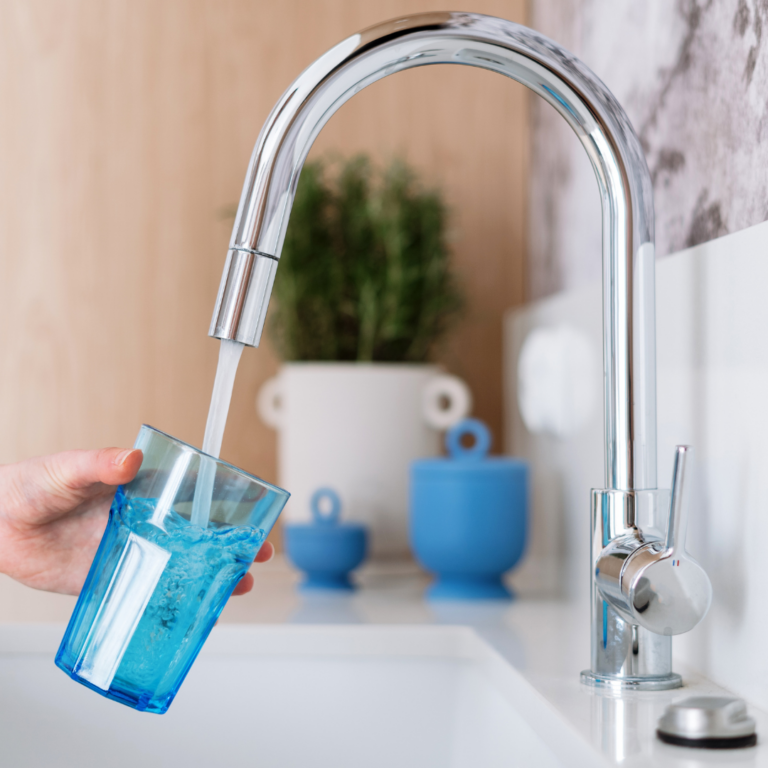
Here’s something almost nobody considers: the faucet itself. Your water passes through miles of treatment infrastructure and plumbing — and the very last thing it touches before entering your glass is a metal fixture.
Most kitchen faucets are made of brass — an alloy of copper and zinc. From 1986 until 2014, a faucet could be sold as “lead-free” and still contain up to 8% lead in its brass. The Reduction of Lead in Drinking Water Act, enacted in 2011 and effective January 2014, redefined “lead-free” to mean a weighted average of no more than 0.25% lead on the wetted surfaces of plumbing fixtures. That was a massive improvement — but it’s not zero. And any faucet installed before that law still sits in millions of kitchens.
Water that sits in a brass faucet overnight leaches lead from the interior surfaces. First-draw water — the initial flow when you turn the tap on in the morning — carries the highest concentration. The NSF/ANSI 61 standardwas revised in 2024 to tighten lead leaching limits to 1 microgram for faucets — five times more protective than the previous limit. Even that standard acknowledges the reality: faucets leach.
Water chemistry makes this worse. Soft water, acidic water (low pH), water with low mineral content — these are more corrosive to metal fixtures. The same properties that make water “pure” in one sense make it more aggressive in another. It grabs onto metals as it passes through. Paradoxically, the cleaner your water is upstream, the more it can pick up from the fixtures at the end of the line.
This creates an interesting problem. Your water treatment works. Your pipes may be fine. But the fixture you trust to deliver clean water to your glass might be the thing quietly adding contaminants back in.
Which contaminants are actually worth worrying about?
I’m not going to list every possible thing that could be in your water — that turns into a fear-mongering exercise. The point is that a few categories of contaminants are worth understanding because they’re widespread, health-relevant, and addressable.
Lead has no safe exposure level according to the EPA, the CDC, and the WHO. The EPA estimates millions of lead service lines still deliver water to U.S. homes. The effects are neurological, especially in children — irreversible impacts on cognitive development. We cover lead filtration options in detail here.
PFAS (forever chemicals) don’t break down in the environment or in your body. A USGS study estimated at least 45% of U.S. tap water contains one or more PFAS compounds. The EPA’s 2024 final rule set limits at 4 parts per trillion for PFOA and PFOS.
Disinfection byproducts — THMs and HAAs — form when chlorine reacts with organic matter. The real concern isn’t the chlorine itself — it’s what the chlorine produces downstream. A pooled analysis has associated long-term THM exposure with increased bladder cancer risk.
Microplastics have been found in municipal tap water, bottled water, and well water. The WHO has called for more research, noting current evidence is insufficient for firm health conclusions but that presence is widespread.
How do you actually find out what’s in your water?
This is the part that matters. Not the contaminant list — the action step.
Your water utility publishes an annual Consumer Confidence Report. Most are available online with a quick search. You can also pick up a home water test kit for a more localized reading of what’s coming out of your specific tap — including what the fixture adds.
You can also look up your zip code at mrwatergeek.com/audit to see detected contaminants benchmarked against both EPA legal limits and health-based guidelines. The gap between those two numbers is often where the interesting information lives.
If you’re on well water, you don’t have a utility testing for you. The CDC recommends annual testing for total coliform bacteria, nitrates, total dissolved solids, and pH at minimum.
Once you know what you’re dealing with, the question of whether to filter — and what technology actually matches your specific contaminant profile — stops being a marketing decision and starts being an engineering one. We cover the specifics for lead filtration, under sink filters, reverse osmosis systems, and whole-home filtration in separate guides.
What should you look for in a kitchen faucet if water quality matters?
Most faucet buying guides talk about spray patterns, finishes, and handle styles. None of that has anything to do with what’s in the water the faucet delivers. If water quality is part of why you’re shopping, these are things I’d look for.
1. Look for the lead-free certification, not the word “lead-free.” Since 2014, a faucet sold in the U.S. as “lead-free” must contain no more than a weighted average of 0.25% lead on its wetted surfaces. The way to confirm a fixture actually meets that standard is the certification mark: NSF/ANSI 61 (health effects of the material) and NSF/ANSI 372 (lead content). If a listing claims “lead-free” but carries no certification, treat that as marketing, not verification.
2. Material matters more than finish. Most faucets are made of brass — an alloy of copper and zinc that historically carried lead. Modern certified low-lead brass is fine for normal use. Stainless steel faucets avoid lead-bearing alloys entirely. What the faucet is made of affects water; the finish (chrome, brushed nickel, matte black) is purely cosmetic and corrosion resistance on the outside. Don’t pay a wellness premium for a color.
3. Understand what a faucet does — and doesn’t — do. This is the part the category gets wrong. A faucet’s job is to deliver water. It does not clean it. No standard kitchen faucet filters anything. If your water has a contaminant you care about — lead, PFAS, chlorine byproducts — the faucet itself won’t solve it. You need point-of-use filtration matched to your specific contaminants, which today means a separate system plumbed in under the sink. (See our engineer’s guide to lead filtration for how to match technology to contaminant.)
4. Flush a brand-new faucet for its first weeks. Even compliant, certified faucets leach small, detectable amounts of lead when they’re new, before the wetted surfaces stabilize. Run a new faucet for its first days of use and avoid drinking the very first draw each morning during that break-in period.
5. Test before you spend — on a faucet or a filter. A new faucet only addresses the fixture. If lead is entering from your service line or your home’s pipes, replacing the faucet won’t fix it. Find out where the problem actually is first.
Here’s the honest state of the category: filtration today is something you bolt onto your plumbing, separately from the fixture that dispenses your water. The faucet — the most-used water source in your home, the last thing your water touches before you drink it — is still specced like a plumbing part, not a health device. That’s a gap worth watching.
Frequently asked questions about kitchen faucets and water quality
Do kitchen faucets contain lead? Many older ones do. From 1986 until 2014, a faucet could be sold as “lead-free” and still contain up to 8% lead in its brass. Since 2014, “lead-free” means a weighted average of no more than 0.25% lead on the surfaces that touch water — far lower, but not zero. Even new, compliant faucets can leach small amounts of lead when first installed.
Are brass faucets safe? Modern brass faucets certified to NSF/ANSI 61 and 372 meet the current lead-free standard and are considered safe for normal use. The risk concentrates in older brass fixtures installed before 2014, and in first-draw water that has sat in the fixture overnight. Stainless steel faucets avoid lead-bearing alloys altogether.
Can my faucet add lead to my water even if my city water is clean? Yes. Water can be well-treated at the plant and still pick up lead afterward — from your service line, your home’s pipes and solder, or the faucet itself, which is the last thing the water touches before your glass. Soft and acidic water make this worse because they’re more corrosive to metal.
How long should I run the tap to clear standing water? If water has been sitting in your pipes for more than about six hours, run the cold tap for 30 seconds to two minutes — or until the water turns noticeably colder — to flush the water that’s had the most contact with your pipes and fixture. Use cold water for drinking and cooking; hot water dissolves lead faster.
Does a faucet-mounted water filter actually work? It can, but only for the contaminants it’s certified to reduce. Look for the specific NSF/ANSI certification that matches your concern — for example, NSF/ANSI 53 for lead — rather than a vague “filtered water” claim. Faucet-mount cartridges are small, so they need replacing more often than an under sink system.
Does the faucet finish affect water quality? No. Finish is purely about appearance and exterior corrosion resistance. Choose it for looks and durability. Judge water safety by the fixture’s lead-free certification and by your filtration — not its color.
Is it worth replacing an old faucet just for water quality? If your faucet predates 2014 and you have young children or a pregnant household member, swapping it for an NSF-certified lead-free model is a reasonable step. But it only addresses the fixture. If the lead is coming from your service line or pipes, a new faucet alone won’t solve it — which is why testing first matters.
About the author: Shashank — 9 years at Kohler building water filtration. Mr Water Geek translates water science into clear decisions.